
Can You Put Tea Tree Oil Directly on Skin? The Neat-Use Question
No. We do not recommend applying undiluted tea tree oil directly on skin, even as a quick dab on one spot. The oil's concentration of terpinen-4-ol and related monoterpenes is higher than most skin needs to meet neat, and the risk it carries builds quietly over repeated use rather than announcing itself the first time. Every job this oil does in a cosmetic routine, it does just as well, and more safely, diluted in a carrier.
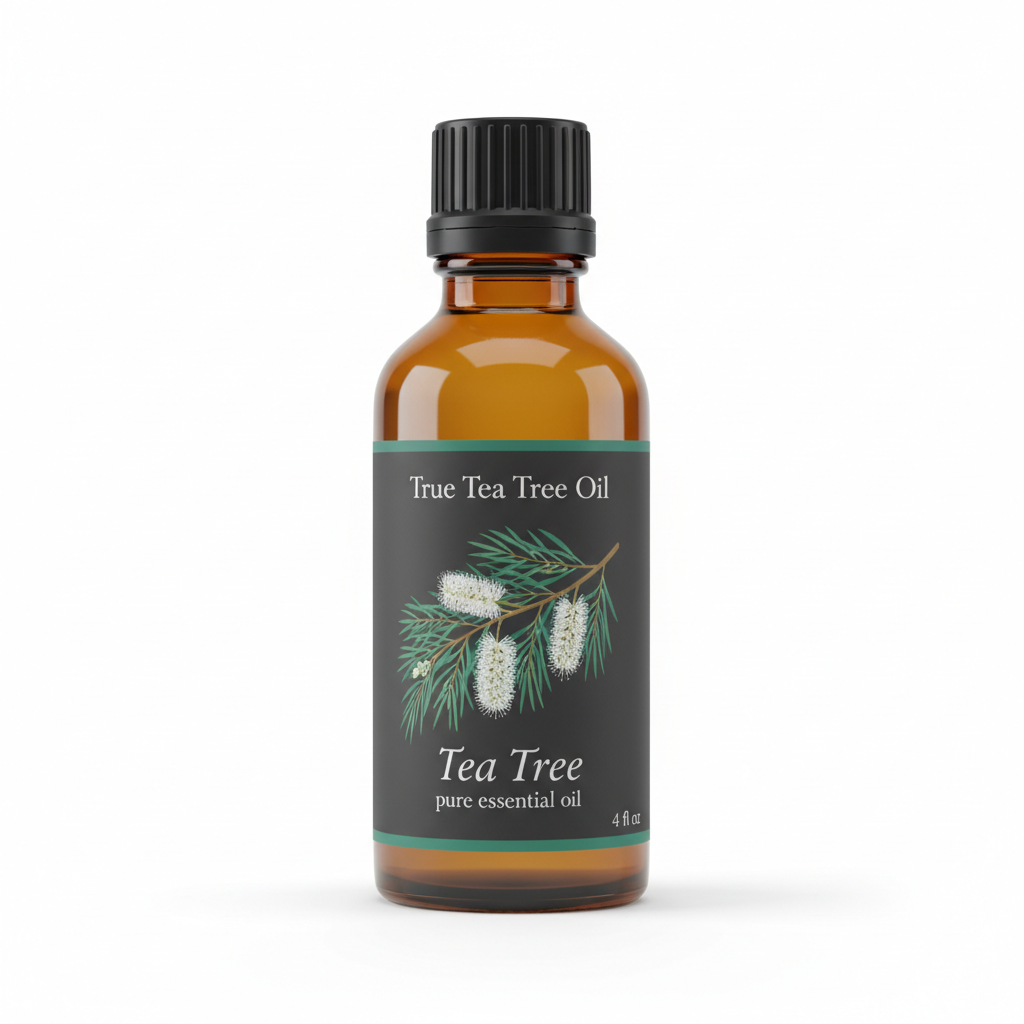
Tea Tree Essential Oil
Our own Tea Tree Essential Oil, in sizes from 0.5 oz to bulk.
From $10.99
Shop Now →The Direct Answer
Can you put tea tree oil directly on skin?
We would rather you didn't. Applying tea tree oil directly on skin without a carrier puts the full concentration of its monoterpenes against living tissue, and skin was not built to meet that concentration repeatedly without some cost. The cost is not always obvious the first time, which is exactly the problem: a shopkeeper who tells you "it's fine, I use it neat" is really only telling you it hasn't caught up with them yet.
Is undiluted tea tree oil ever appropriate for cosmetic use?
Not as a routine practice. Every cosmetic and aromatic use this oil is suited for, from a clarifying scalp rinse to a purifying step in a skincare routine, works at a diluted concentration, typically in the 1 to 2 percent range in a carrier oil. If measuring that out isn't appealing, pre-diluted roll-ons in the shop remove the guesswork entirely.
Does applying tea tree oil directly give a stronger result than diluting it?
It gives a stronger scent impression, not a stronger case for safety. Strength of smell is not the same as strength of effect, and the only thing neat application reliably increases is the dose of monoterpenes sitting on skin. For the scent and feel most people are actually after, see our note on using tea tree oil as a purifying feeling note, where the diluted version does the same job.
Why Neat Use Is a Losing Trade: Sensitization
What is sensitization, and how is it different from ordinary irritation?
Irritation is a direct chemical response: it shows up fast, it is proportional to exposure, and it tends to fade once exposure stops. Sensitization is different. It is the immune system learning, over repeated exposure, to object to a substance it previously ignored, and once that learning happens, it does not reliably unlearn itself.
Can tea tree oil used neat for months without incident still become a problem later?
Yes, and that delayed timing is the core of why neat use is a losing trade. Sensitization can arrive after weeks or months of apparently uneventful use, because the immune system's "objection" builds in the background before it ever shows up on skin. Someone applying tea tree oil directly on the same patch of skin for a long stretch is not proving the practice is safe; they may simply be partway through the process.
- Simple irritation: fast, proportional, fades with time off
- Sensitization: slow to build, can appear after long uneventful use, tends to persist
Why do Robert Tisserand and Rodney Young lean so heavily on dilution in Essential Oil Safety?
Because concentration is the one variable a person actually controls once they've chosen to use an essential oil at all. Tisserand and Young's Essential Oil Safety, now in its second edition, treats dilution as the primary lever against sensitization risk precisely because exposure to a lower concentration of the oil's reactive components gives the immune system less to object to. Our own rundown of sensible cautions before first use walks through the same logic in more depth.
If skin becomes sensitized to tea tree oil, does it go back to normal later?
Not reliably, which is the whole reason the dilution conversation matters so much more than any single application. Once the immune system has learned to object to a substance, that memory tends to be long-lived, and the sensible response is to stop using the oil on that skin rather than hope repeated low-dose use will reverse it. This is also a good moment to talk to a qualified healthcare provider rather than troubleshoot it with more oil.
The Oxidation Multiplier: Old Bottles, New Risk
Does an older, often-opened bottle of tea tree oil behave differently on skin than a fresh one?
Yes, and the difference works against neat use specifically. Every time a bottle is opened, air reaches the oil, and the monoterpenes in tea tree oil, including the alpha- and gamma-terpinene alongside the terpinen-4-ol that ISO 4730:2017 uses to define the oil's chemical profile, react with that oxygen over time. The oxidation byproducts that build up as a result are generally harsher company for skin than the fresh oil was, which means an old bottle applied neat is a double exposure: full concentration plus degraded chemistry.
So when someone says "I've used tea tree oil neat for years with no problem," what is that statement actually telling you?
It's telling you less than it sounds like. It's a statement about how often that bottle was opened, how long it sat on a shelf, and how fresh the oil inside it really was each time, not a statement that undiluted tea tree oil is broadly safe on skin. A bottle used sparingly and replaced often is a very different exposure than one kept open on a bathroom shelf for a year.
Does storage affect how much oxidation risk builds up?
It does. Heat, light, and repeated air exposure all accelerate the chemical changes that make an older bottle riskier to apply neat, so how the oil is kept between uses matters as much as how it's used. Keeping the cap tight, the bottle away from direct light and heat, and replacing it on a reasonable timeline all slow that process down.
Is oxidized tea tree oil more likely to cause a reaction than fresh oil, at the same dilution?
Reasoning from the chemistry, yes: an oxidized oil carries breakdown compounds that the fresh, ISO-profiled oil doesn't, so the same percentage dilution of an old bottle is not chemically identical to that percentage of a fresh one. This is one more reason dilution and bottle freshness work together rather than as separate precautions.
The "Just One Spot" Exception That Isn't
Does dabbing tea tree oil on just one small spot avoid the risks of neat use?
No. A smaller surface area does not change the chemistry of what's touching it; the concentration against that patch of skin is identical to the concentration in the bottle, whether it covers a fingertip-sized spot or a whole forearm. Size of area is a volume question, not a safety question.
What about using a cotton swab instead of a fingertip? Doesn't that keep the skin contact more controlled?
It keeps the mess more controlled, not the exposure. The swab tip itself touches skin at full strength, and the skin surrounding the intended spot usually picks up some contact too, whether from the swab's edge, a drip, or the fingers holding it. A cotton bud applying tea tree oil neat on skin is still neat application; it's just a smaller brush.
What does the cautious, "just this one spot" version actually look like?
It looks like the same spot treatment, at a lower concentration. A 1 to 2 percent dilution in a carrier oil, applied with a clean cotton swab to the exact area in question, gives the same targeted placement without putting full-strength monoterpenes on skin. Our guide to dilution ratios, carriers, and patch tests walks through how to mix that in practice.
Should a spot application still be patch tested first, even at a low dilution?
Yes, every time the oil, the carrier, or the batch changes. A patch test on the inner forearm, left alone for roughly 48 hours before wider use, is the cheapest insurance available against an unexpected reaction, and our 48-hour patch test walkthrough covers exactly how to run one.
If Tea Tree Oil Touches Skin Undiluted by Accident
What's the first thing to do if undiluted tea tree oil splashes on skin by accident?
Reach for a plain carrier oil before you reach for the sink. Wiping the area with a neutral carrier oil, such as jojoba or fractionated coconut oil, helps lift the tea tree oil off the skin's surface because like dissolves like, pulling the concentrated oil away rather than pushing it further in.
Why not just rinse it with water right away?
Because tea tree oil doesn't mix with water, so rinsing with water alone tends to spread the oil across a wider area of skin rather than remove it. Wiping with a carrier first, then following with soap and water, gives the soap something it can actually emulsify and carry away.
Does washing with soap after the carrier-oil wipe matter, or is the wipe enough on its own?
Both steps matter. The carrier oil wipe handles the bulk of the surface oil, and the soap-and-water wash that follows clears the residue the carrier oil loosened, since soap is what actually breaks oil down for rinsing. Skipping straight to soap and water, without the carrier wipe first, leaves you fighting an oil-and-water mismatch from the start.
When does an accidental neat exposure need more than a wipe-and-wash?
If the oil reaches the eyes, gets swallowed, or the skin's reaction seems to be escalating rather than settling down, that's a moment to call US Poison Control at 1-800-222-1222 or a qualified healthcare provider rather than wait it out. For pets, the ASPCA Animal Poison Control Center is the equivalent resource. Keeping that number somewhere visible near where the oil is stored costs nothing and saves time if it's ever needed.
Who Should Be the Strictest About Dilution
Who should be the most careful about never using tea tree oil neat?
Anyone with reactive skin, anyone shopping for a child, and anyone holding a bottle of unknown age all have more reason than most to keep this oil diluted without exception. For each of those situations, the margin between "fine" and "not fine" is narrower, so there's less room for the shortcut of applying tea tree oil directly.
Why does reactive skin change the dilution math?
Skin that already reacts easily to other products has a lower threshold before it registers a new substance as a problem, which means the same neat exposure that one person tolerates for a while can show up faster on reactive skin. A patch test and a conservative dilution matter more here, not less.
See the sensible cautions before first use guide for how to judge that threshold before starting.
Why are children held to a stricter standard around tea tree oil?
Children's skin is thinner and their body weight is lower relative to any given dose, so the same amount of oil represents a proportionally larger exposure for a child than for an adult. Dilutions that are already conservative for adult skin need to be lower still for children, and neat application has no place in that picture at all.
Does a bottle of unknown age deserve extra caution even if it looks and smells fine?
Yes. Oxidation byproducts don't always announce themselves through smell or color before they've built up enough to matter, so "it still smells like tea tree oil" isn't the same as "it hasn't changed." Treating any bottle without a known purchase date as if it were older and more reactive, meaning diluting it more conservatively and patch testing it again, is the safer default.