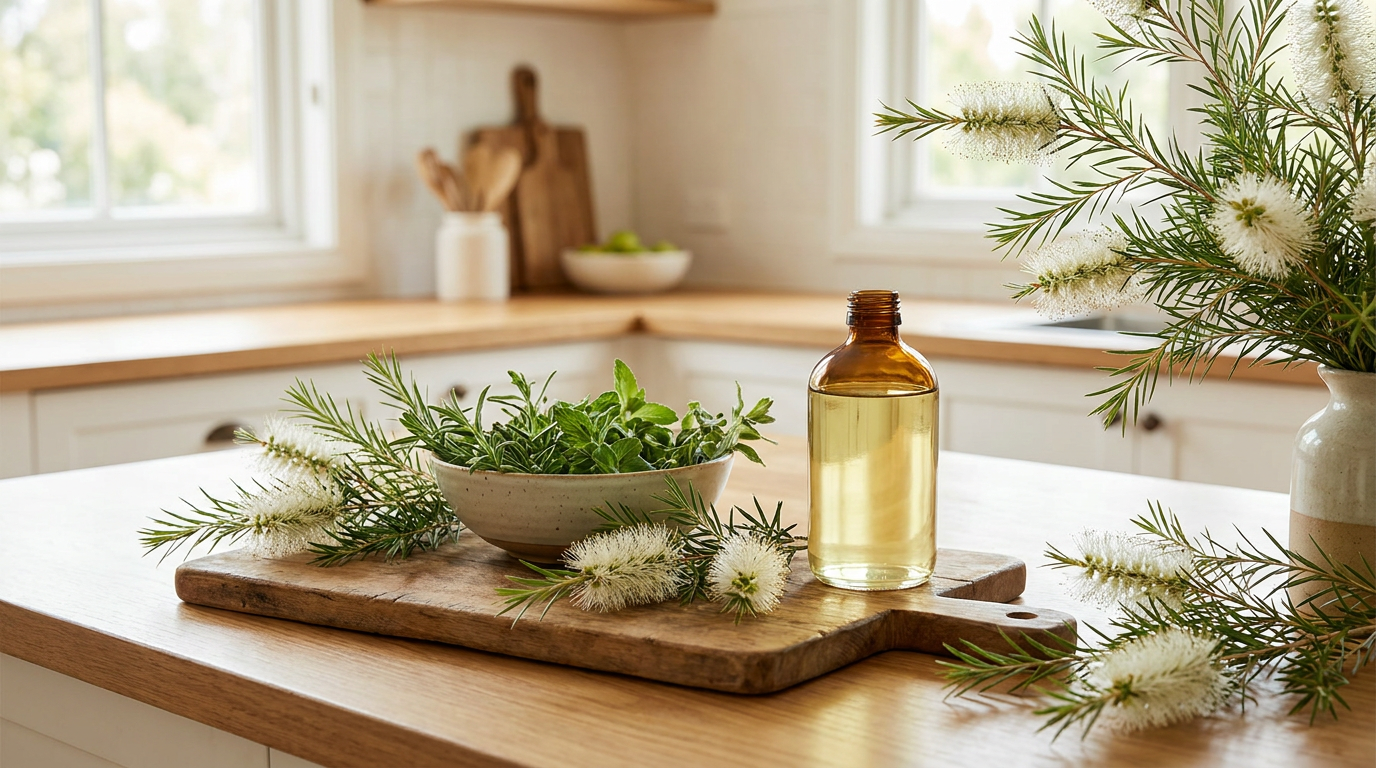
The Southern Cross Blend: True Tea Tree Oil's Signature Recipe
Every essential oil company eventually builds a house blend, the one recipe that shows up on the label of every gift set and gets typed into the search bar more than any other. Ours is the Southern Cross. It takes its name from the constellation that sits low over the same Australian coastline where Melaleuca alternifolia, the tree behind true tea tree oil, has grown wild for longer than anyone has kept records. Pair that tea tree with eucalyptus and cold-pressed lime and you get a diffuser blend that reads as open windows and eucalyptus groves at dawn, sharp at first breath and rounder once it settles. This is our tea tree oil diffuser blend recipe in full: ratios, blending steps, safety notes, and a few ways to bend it toward your own taste.
Why Tea Tree Anchors This Blend
Tea tree oil has a reputation for being blunt: green, a little medicinal-adjacent, more useful than pretty. On its own in a diffuser it can feel one-note. What tea tree actually offers a blend is structure. Its aroma is crisp and slightly camphoraceous, with a woody undertone that keeps it from ever smelling saccharine, and that structure is exactly what a bright citrus top note like lime needs to lean against. Without it, lime alone reads as a burst of freshness that fades within minutes. With tea tree underneath, the brightness has somewhere to land.
Origin matters here too. Tea tree grown and distilled in the swampy lowlands of New South Wales, the traditional heartland for Melaleuca alternifolia, tends to carry a cleaner, less harsh profile than oil rushed through cheaper high-volume distillation. We source ours from growers who still steam-distill in small batches, which is part of why the aroma in this blend stays smooth instead of sharp-edged. If you want to get to know the oil on its own before blending, our tea tree oil product page has the full sourcing and batch details.
Eucalyptus does the work of widening the blend, adding a cooler, more expansive top note, while lime brings the sparkle that makes the whole thing feel like a signature scent rather than a single raw ingredient piped into a diffuser. Together they form a tea tree eucalyptus lime diffuser blend that smells considered, not accidental.
The Full Ingredients List
This recipe is sized for one fill of a standard ultrasonic diffuser with a 100 to 150 ml water reservoir. Measurements are given in both drops and milliliters, since droppers vary slightly by brand and a kitchen scale reading in ml is the more reliable check if you're scaling the recipe up.
| Ingredient | Drops | Milliliters |
|---|---|---|
| True tea tree essential oil (Melaleuca alternifolia) | 6 drops | 0.3 ml |
| Eucalyptus essential oil | 4 drops | 0.2 ml |
| Cold-pressed lime essential oil | 3 drops | 0.15 ml |
| Water (per your diffuser's fill line) | n/a | 100–150 ml |
That works out to a 6:4:3 ratio of tea tree to eucalyptus to lime, thirteen drops total. It's a good starting formula for a signature tea tree essential oil blend precisely because none of the three notes gets buried. If you'd rather premix a batch bottle to keep on hand, the section on variations below has a scaled-up version.
How to Blend the Southern Cross
You don't need anything beyond a diffuser and the three oils, but a small glass mixing dish makes it easier to combine the oils evenly before they hit the water.
- Fill your diffuser's reservoir with clean water up to the manufacturer's fill line. Overfilling is the most common reason a diffuser blend smells weak or uneven.
- In a small glass dish (skip plastic, since citrus oils can degrade some plastics over time), add 6 drops of tea tree oil first. It's the base note, so building on top of it keeps the ratio easy to track.
- Add 4 drops of eucalyptus oil, then 3 drops of cold-pressed lime.
- Swirl the dish gently for a few seconds to combine. You don't need to shake or agitate hard, essential oils blend readily on contact.
- Pour the combined oils into the diffuser's water reservoir and give the reservoir itself a light swirl before switching the diffuser on.
- Run on a standard intermittent setting rather than continuous mist for the first session, so you can gauge the strength in your specific room size before committing to a longer run.
Diffuser Recipe Ratios: Getting the Balance Right
The 6:4:3 ratio above is a starting point, not a fixed law. Tea tree oil diffuser recipe ratios shift depending on room size, diffuser output, and personal taste, and the Southern Cross is easy to adjust once you know which lever moves which effect.
- Small rooms or bedrooms (under 150 sq ft): drop to a 4:3:2 ratio, nine drops total, so the blend doesn't overwhelm a tighter space.
- Open living areas or larger rooms: the standard 6:4:3 ratio works well, and can be scaled up proportionally (for example 9:6:4.5) for reservoirs over 200 ml.
- Want more citrus brightness: nudge lime up by a drop or two before adding more of anything else. Lime is the most assertive of the three in small quantities, so small adjustments go further than they look like they should.
- Want a softer, less sharp blend: reduce tea tree by one drop and keep eucalyptus and lime as written. Tea tree carries most of the blend's edge.
As a general rule for any tea tree oil diffuser blend recipe, total essential oil content should stay under roughly 1 percent of the water volume in the reservoir. The Southern Cross at 13 drops in 120 ml sits comfortably within that.
Dilution, Patch Testing, and Safety Notes
Diffusing doesn't put oil directly on skin, so no carrier oil dilution is needed for the recipe above. But if you'd like to wear the Southern Cross as a personal fragrance in a roller bottle rather than diffusing it, dilute before it ever touches skin.
For topical fragrance use, a 2 percent dilution is the standard starting point: about 6 total drops of the Southern Cross blend (kept at the same 6:4:3 ratio, scaled down) topped off with carrier oil in a 10 ml roller bottle.
Before applying anything to skin, patch test first. Apply a small diluted amount to the inside of your forearm, cover loosely, and wait 24 to 48 hours to see how your skin responds before using it more broadly. Cold-pressed citrus oils like lime carry a photosensitivity note, meaning skin exposed to strong sunlight shortly after topical application can react more than usual, so keep any area where the diluted blend was applied out of direct sun for 12 to 18 hours.
A few other notes worth keeping in mind:
- Keep essential oils, diluted or not, away from eyes and other sensitive areas.
- Diffuse in ventilated spaces rather than small closed rooms for extended sessions.
- Cats in particular are known to be sensitive to many essential oils, tea tree included, so if pets share your home, diffuse in a room they can leave and keep bottles well out of reach.
- Anyone pregnant, nursing, or managing an ongoing health situation should check with a qualified healthcare provider before making essential oils a regular part of a routine.
- Keep all essential oils out of reach of children.
If you're new to diffuser blending generally, our guide on how to patch test an essential oil before you use it walks through the process in more depth.
Storage and Shelf Life
Store all three oils, and any premixed batch of the Southern Cross, in amber or cobalt glass away from direct sunlight and heat. A cupboard or drawer works better than a windowsill or a spot near a stove.
Tea tree oil holds up reasonably well when stored properly, generally keeping its aroma for one to two years unopened. Eucalyptus follows a similar timeline. Cold-pressed lime is the one to watch: citrus oils oxidize faster than tea tree, generally holding their brightest character for six months to a year once opened, and the aroma will noticeably flatten before the oil is technically unusable. If you premix a batch bottle of the Southern Cross, treat the lime component as the limiting factor and plan to use the batch within about six months for the truest version of the scent.
A tightly sealed cap matters as much as the glass. Oxygen exposure, not just light, is what pushes citrus oils toward that flat, slightly off smell over time.
Three Variations on the Southern Cross
The Batch Bottle (for regular diffusing)
If the Southern Cross becomes a regular part of your routine, premixing saves time. In a 10 ml amber glass bottle, combine 90 drops (4.5 ml) tea tree, 60 drops (3 ml) eucalyptus, and 50 drops (2.5 ml) lime. Cap tightly and shake gently before each use. Use 10 to 13 drops of the finished blend per standard diffuser fill, the same as the single-session recipe above.
The Evening Version
Swap one drop of lime for one drop of lavender to round the blend into something quieter for evening hours: 6 drops tea tree, 4 drops eucalyptus, 2 drops lime, 1 drop lavender. The citrus brightness softens and the overall character leans calmer, better suited to a wind-down routine than an energizing morning session.
The Winter Version
Add 1 drop of cedarwood to the standard ratio (6 tea tree, 4 eucalyptus, 3 lime, 1 cedarwood) for a warmer, woodier take that suits colder months better than the brighter original. Cedarwood's dry, grounding note plays well against the sharper tea tree and eucalyptus without competing with the lime.
The Southern Cross was built to be a starting formula, not a fixed recipe carved in stone. Once you've made it a few times at the 6:4:3 ratio, you'll have a feel for how far you can push each oil before the balance tips. That's really the goal of any signature tea tree essential oil blend: a formula reliable enough to return to, flexible enough to make your own.