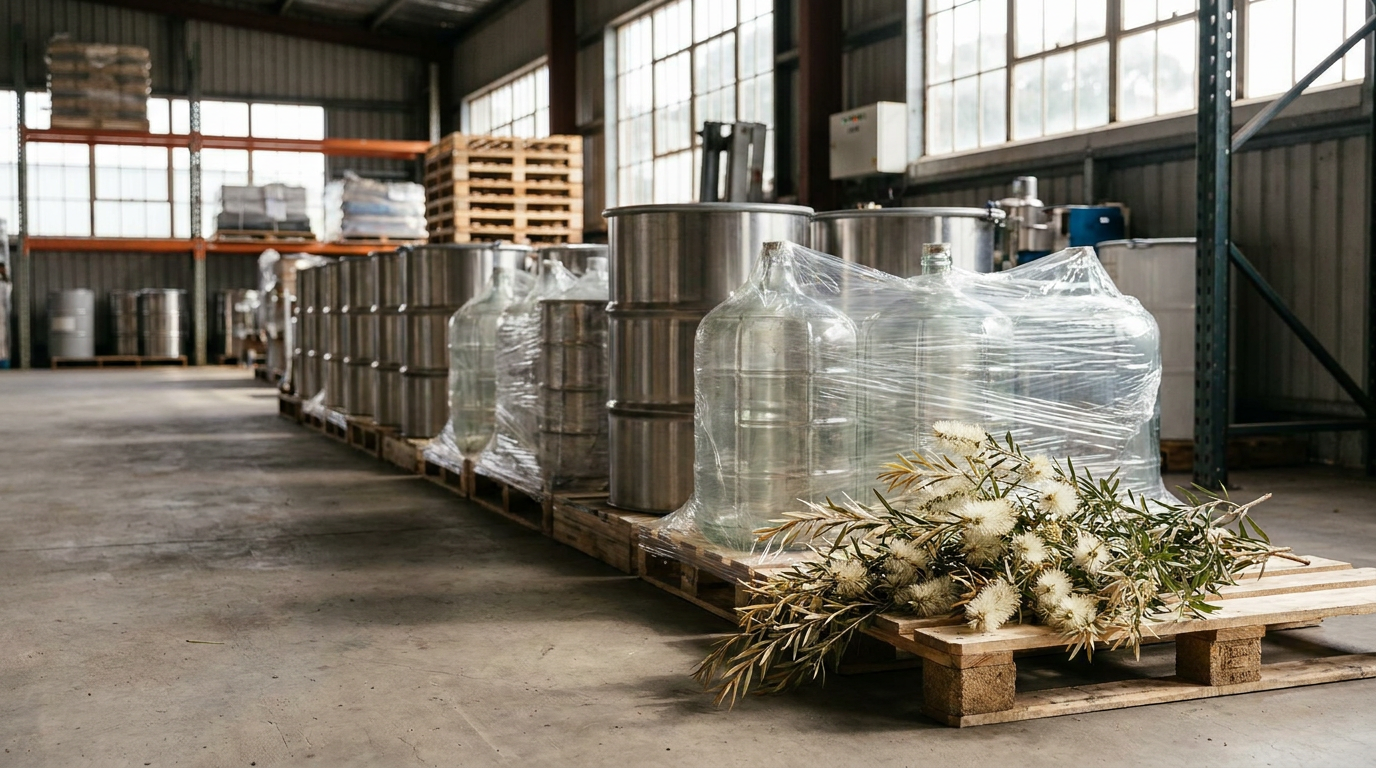
True Tea Tree Oil moves through the wholesale channel in volumes far beyond a single dropper bottle, feeding formulators across cleaning, hair care, skincare, soap, candle, and diffuser businesses. This guide explains what separates benchmark-grade Australian oil from the diluted and mislabeled stock that circulates at the low end of the market, and how buyers should size, document, and reorder a bulk purchase.
Compare pound-tier pricing on the bulk page before you commit to a drum.
Tea tree oil is steam-distilled from the narrow leaves of Melaleuca alternifolia, a paperbark native to the creeks and swamps of northern New South Wales. The distillation process and the standard it is measured against are laid out in detail in how tea tree oil is made, from harvest to steam still, and buyers new to the category benefit from the broader primer in what tea tree oil is and why Australia's leaf became the benchmark.
Origin and grading matter more in this category than in most essential oils, because tea tree is grown and distilled well outside Australia as well as within it, and the resulting oil varies in aroma and consistency. The differences between Australian and Chinese-origin stock are covered in Australian vs Chinese tea tree oil: does origin change the bottle, while the complete guide to grades and quality walks through the label claims worth trusting.
For buyers comparing bottles already on the shelf, what tea tree oil grades really mean decodes the claims, and wholesale tea tree oil: bulk sizes, grades, and pricing maps those grades onto the size run a formulator actually orders against.
| Sold as | What it actually is | How to recognize it |
|---|---|---|
| Pure Australian tea tree oil | Distilled to the recognized purity standard from Melaleuca alternifolia grown in its native range | A published, batch-specific Certificate of Analysis and a label that reads Melaleuca alternifolia rather than a genus-only name |
| Tea tree oil of mixed or unstated origin | Often redistilled or blended stock sourced outside the traditional growing region | Vague sourcing language, no COA offered, pricing well under the benchmark range for the category |
| Fragrance oil marketed as tea tree | A synthetic reconstruction built to mimic the aroma with no Melaleuca content at all | Labeled as fragrance oil rather than essential oil, no botanical name, no distillation claim anywhere on the sheet |
| High-volume budget bottles | Genuine oil sold at scale with thin batch documentation and aroma that drifts from lot to lot | Reviewed in the budget roundup for buyers weighing price against consistency |
The budget and premium tiers both show up on general retail shelves rather than in wholesale catalogs, but the same grading logic applies: the budget tea tree oils roundup and the premium tea tree oils roundup both use documentation and aroma consistency, not price alone, to separate a dependable supplier from a risky one.
The sourcing trap in this category is not fake oil so much as undocumented oil: a bottle that is genuinely Melaleuca alternifolia but carries no batch-level testing, so a formulator has no way to verify consistency between reorders. Buy on the paperwork, not the price sheet.
The wholesale buyer for True Tea Tree Oil looks nothing like a single household shopper. Natural cleaning brands blend it into purifying sprays and laundry boosters by the drum, hair care manufacturers formulate clarifying shampoos and scalp formulas around its aroma and crisp finish, and skincare labs use it in low-dilution facial and body formulas where a consistent aroma profile from lot to lot is non-negotiable.
Soap makers and candle studios buy for a different reason: aroma performance under heat and cure conditions rather than skin-contact dilution, and both categories run batch testing before committing to a drum-scale order, a process documented in a candle studio's batch notes on testing tea tree oil load rates. Spa and service-room suppliers round out the buyer base, sourcing diffuser blends and massage oil bases in case-pack volume for the rooms a studio runs.
Before committing to a bulk order, a formulator should confirm the following on any supplier's spec sheet.
Ask for the Certificate of Analysis before the quote, not after the invoice. True Tea Tree Oil publishes its batch COA at /docs/trueteatreeoil-coa.pdf, and any supplier unwilling to do the same is telling a buyer something about how the rest of the order will go.
Bulk buyers rarely start at drum scale. Most formulators sample in ounce sizes, validate a formula, then step up to pound-tier sizing as production scales, a progression covered from the small-bottle end in best tea tree oil sizes: which bottle should you order first.
For established production runs, the pound-tier sizes below are where most wholesale accounts settle, with the largest drums reserved for brands running continuous fill lines.
Order a small bottle, typically 1 oz or 2 oz, to confirm aroma and clarity against the published spec before committing further.
Build and test the formula at bench scale, checking load rate and cure or cook-down behavior specific to the finished product.
Step up to a pound-tier size, most commonly 5 lbs or 25 lbs, once the formula is locked and a production date is set.
Move to 100 lbs or 400 lbs drums for continuous production, requesting the new batch COA with each reorder to confirm consistency.
The application guides below cover the buyer categories that actually purchase True Tea Tree Oil at wholesale scale, each with its own formulation approach and supplier checklist.
Purifying sprays and laundry boosters built around tea tree's crisp, green top note, sourced by the drum for continuous production runs.
Read the sourcing guide →Clarifying shampoo and scalp-focused hair care formulated around tea tree's crisp finish, benchmarked against the drugstore and specialty shelf.
Read the sourcing guide →Clarifying-feeling facial and body formulas built around tea tree's crisp top note, dosed with the dilution discipline skin-contact products require.
Read the sourcing guide →Cold-process and melt-and-pour soap production formulated around tea tree's aroma performance through cure and cook-down.
Read the sourcing guide →Wax and diffuser blend production formulated around tea tree's crisp top note, tested for load rate and hot-throw performance.
Read the sourcing guide →Foot soak and shoe-freshening products built around tea tree's clean, camphorous finish, formulated for repeat daily use.
Read the sourcing guide →Diffuser blend and massage oil base production for service-room studios, sourced in case-pack volume for repeat weekly use.
Read the sourcing guide →Reach out for a quote, a sample bottle, or the current batch COA.