
True Tea Tree Oil vs Eucalyptus Oil: Choosing Your Green Scent
Eucalyptus oil throws a bigger, more camphorous scent across an open room. True tea tree oil is the more versatile craft ingredient, the one you reach for in sprays, soap bars, and diluted skin routines. Neither one is the better oil in general; they are built for different jobs, and the chemistry that separates them tells you exactly which job each one is good at.
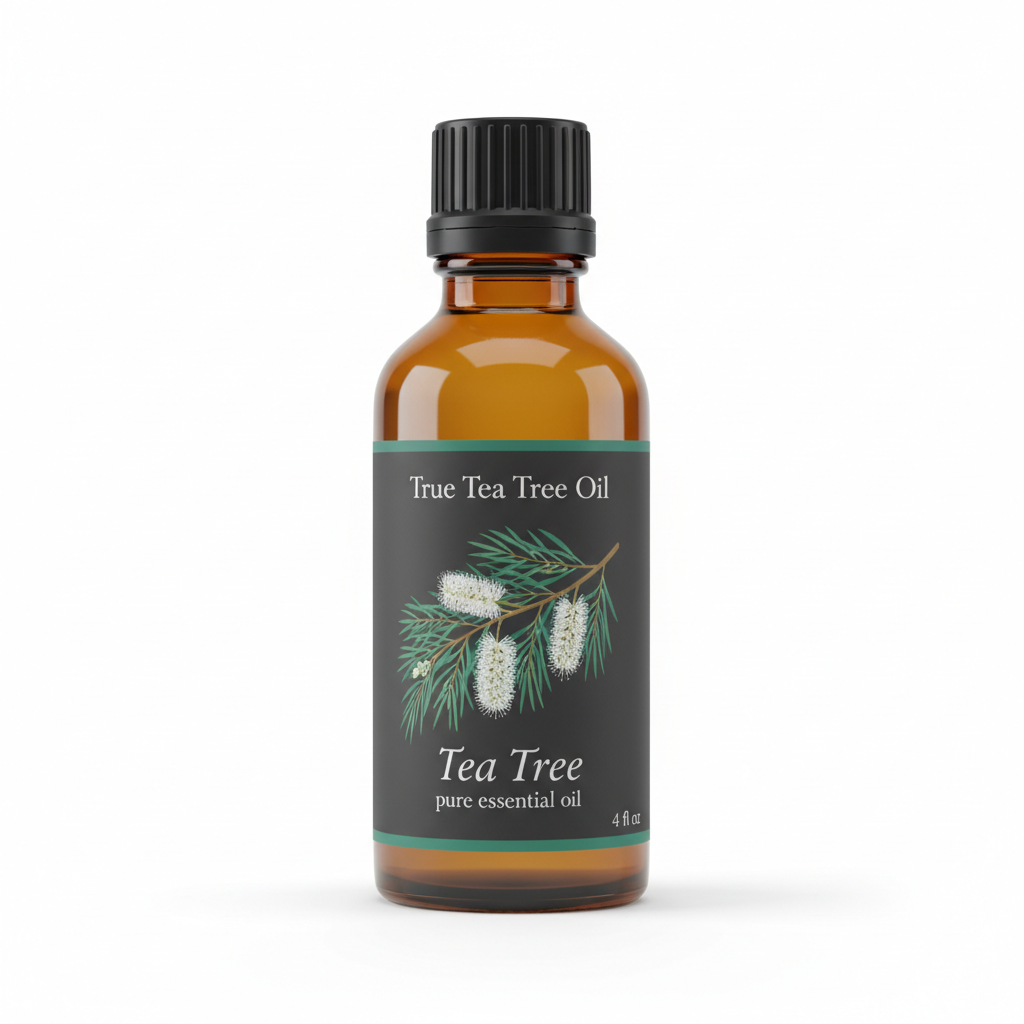
Tea Tree Essential Oil
Our own Tea Tree Essential Oil, in sizes from 0.5 oz to bulk.
From $10.99
Shop Now →One Molecule Flipped: Why These Two Oils Smell So Different
Tea tree and eucalyptus both come from Australian trees in the Myrtaceae family, and both read as unmistakably green and medicinal on first sniff. That family resemblance is exactly why people lump them together. But look at a gas chromatography readout for each one and you find a near mirror image.
Eucalyptus oil, specifically the globulus species most commonly sold, gets its identity from 1,8-cineole (also called eucalyptol), which forms the bulk of the oil's profile according to PubChem's compound data for the molecule. Cineole is the sharp, cooling, almost minty-camphor note you associate with chest rubs and old-fashioned cough drops.
Tea tree oil does the opposite. ISO 4730:2017, the international standard that defines what can legally be sold as oil of Melaleuca, terpinen-4-ol type, requires terpinen-4-ol to sit at roughly 30 to 48 percent of the oil, while capping 1,8-cineole at around 15 percent. The Australian Tea Tree Industry Association (ATTIA) holds growers and distillers to that same compositional window. In other words, the standard that defines true tea tree oil works specifically to keep low the exact molecule that defines eucalyptus. That inversion is the whole story. Everything downstream, the scent, the best use case, even the safety conversation, traces back to which of those two molecules is doing the talking.
Chemistry and Scent, Side by Side
Cineole-heavy oils smell like a blast of cold air through the sinuses: sharp, resinous, a little medicinal, the smell most people picture when they hear the word "eucalyptus" even before they open the bottle. It is a big, generous, slightly shouty scent. A few drops fill a room fast.
Terpinen-4-ol reads quieter and earthier. It still has a green, slightly piney edge, but it sits lower and rounder than cineole, without the nose-clearing snap. True tea tree oil smells more like a damp forest floor after rain than a cough drop tin. That is also why tea tree blends so easily into other scents (citrus, herbal, woody) without fighting them for attention, while eucalyptus tends to dominate whatever it is mixed with.
Job by Job: Which Oil Actually Wins
Diffusing a Living Room
For sheer broadcast presence in a big, open room, eucalyptus wins by a nose. Cineole is highly volatile and reads as "bigger" per drop, so it fills a living room or open-plan kitchen faster and holds its ground longer than tea tree does in the same size space.
If you are diffusing tea tree instead, for its quieter, more blendable character or simply because that is the oil you already have on hand, it rewards a proper setup rather than guesswork. Our diffuser starter kit guide walks through bottle sizes, water ratios, and a few beginner blends, and a diffuser-ready bottle from our tea tree oil collection is the easiest place to start if you do not already have one open.
The Cleaning Caddy
Either oil earns a spot under the sink. Both carry the same sharp, green note that reads as "clean" in a spray bottle, and the US EPA's guidance on reducing indoor moisture and mildew-friendly conditions applies to good ventilation and surface care generally, not to any single essential oil's performance. The practical difference shows up in blending: tea tree layers more easily with citrus oils in a multi-surface spray, since it does not compete for the top note the way eucalyptus's bigger cineole punch does. Our guide to scent pairings for true tea tree oil covers which citrus and herbal notes round it out best in a spray bottle.
Shower-Adjacent Rituals
Hanging a bundle of fresh eucalyptus from the showerhead is a genuinely old habit, and the steam does what steam always does: it carries the oil's volatile cineole into the air around you for a few warm, fragrant minutes. Tea tree does not really have an equivalent shower-bundle tradition, since the fresh leaf is not commonly sold for that purpose, but it shows up constantly in bar soap and wash formulations, where its scent profile holds up well against other fragrance notes without taking over the bar.
Anything Skin-Adjacent
This is tea tree's home turf. When an essential oil is going anywhere near skin, even briefly, it needs to be diluted in a carrier oil first, and the usual working range for tea tree in skin-adjacent routines sits around 1 to 2 percent. Always patch test on a small area first and watch for any reaction before wider use. Our dilution guide walks through exact ratios, carrier oil choices, and how to run a patch test properly. Eucalyptus is used in skin-adjacent formulations too, but its higher cineole content means it needs even more careful handling, and it is not the oil most crafters reach for first in a leave-on routine.
True Tea Tree Oil vs Eucalyptus Oil: The Comparison Table
| Attribute | True Tea Tree Oil | Eucalyptus Oil |
|---|---|---|
| Dominant chemistry | Terpinen-4-ol (ISO 4730:2017 range) | 1,8-cineole (eucalyptol) |
| Scent character | Earthy, green, quieter | Sharp, camphorous, big |
| Diffuser room presence | Moderate | Strong, fills open rooms fast |
| Blends well with citrus | Yes, layers easily | Can dominate the blend |
| Skin-adjacent routines (diluted) | Common, well-documented dilution range | Less commonly used this way |
| Household with young children | Generally easier to live with | Extra caution warranted around young children's faces |
| Around pets | Keep off pets | Keep off pets |
| Price and availability | Widely available, commodity-scale | Widely available, commodity-scale |
Pros and Cons
True Tea Tree Oil
- Pro: Versatile across sprays, soap, and diluted skin-adjacent routines.
- Pro: Blends cleanly with citrus and herbal notes without dominating.
- Pro: The ISO 4730:2017 standard gives shoppers a concrete compositional benchmark to check a bottle against.
- Con: Quieter scent means it takes more drops to fill a large, open room by diffuser.
- Con: Its earthier note is less universally recognized as a "fresh" scent than eucalyptus's camphor blast.
Eucalyptus Oil
- Pro: Unmatched room presence in a diffuser, especially in larger or open-plan spaces.
- Pro: Instantly recognizable, nose-clearing scent with a long shower-steam tradition behind it.
- Pro: Widely available and affordably priced.
- Con: High cineole content calls for extra caution in households with young children.
- Con: Dominant scent profile can overpower other oils in a blend.
- Con: Less commonly used in diluted skin-adjacent routines.
The Safety Asymmetry
This is the part of the comparison that actually changes a buying decision, so it is worth stating plainly rather than burying it in fine print. Robert Tisserand and Rodney Young, in Essential Oil Safety, 2nd edition, advise keeping high-cineole essential oils away from the faces of young children. Eucalyptus, being a high-cineole oil by definition, falls squarely into that caution. Tea tree's much lower cineole content under the ISO 4730:2017 standard does not erase the need for care around kids, but it does mean the oil most people reach for first in a family home carries a smaller version of that specific concern.
If there are young children in the house, this tips the decision: eucalyptus should be held more loosely, used in smaller amounts, and kept well away from a toddler's face or a nursery diffuser, while tea tree is the easier oil to build a daily routine around. Our parent's guide to safe tea tree habits covers age-based guidance in more detail. Keep the number for US Poison Control, 1-800-222-1222, somewhere accessible regardless of which oil is in the house.
Pets are a separate conversation and the answer is the same for both oils: keep them away from cats and dogs. Cats in particular lack some of the metabolic pathways that break down many plant compounds efficiently, which is why both tea tree and eucalyptus oil should stay off fur, paws, and bedding, and out of diffusers in small, poorly ventilated rooms where a pet cannot leave. The ASPCA Animal Poison Control Center is the right resource if a pet has direct contact with either oil. Our guide to tea tree oil and dogs goes through what safe handling actually looks like in a multi-pet household.
Price and Availability
Both oils are produced at commodity scale. Eucalyptus globulus is cultivated widely across Australia, Portugal, Spain, China, and South Africa, and tea tree production is concentrated in the Northern Rivers region of New South Wales under ATTIA's quality oversight. That scale keeps both oils affordably priced and easy to find from any reputable supplier. This comparison was never going to come down to budget, since neither oil carries a meaningful price premium over the other. It comes down to scent and use.
Best For, By Use Case
- Best for filling a large living room with scent: Eucalyptus oil, used in a diffuser.
- Best for a household with young children: True tea tree oil, used carefully and kept out of reach.
- Best for a multi-oil cleaning spray: True tea tree oil, layered with citrus.
- Best for a shower-steam ritual: Eucalyptus oil, hung as a fresh bundle.
- Best for diluted, skin-adjacent routines: True tea tree oil, at a standard 1 to 2 percent dilution.
- Best for a simple one-oil pickup with no fuss: Whichever scent you actually prefer; both are well-suited to their lane.
The Verdict
If your home has young children, true tea tree oil is the easier oil to live with day to day. Its lower cineole content under the ISO 4730:2017 standard, its versatility across sprays and diluted skin-adjacent routines, and its gentler blending behavior all point the same direction. It is the oil that fits into more corners of a household without asking you to think too hard about where it goes.
If what you actually want is one oil whose entire job is making a big room smell like a eucalyptus grove after rain, buy eucalyptus oil and do not let anyone upsell you past it. It does that one thing better than tea tree does, and trying to get the same effect from a lower-cineole oil just means using more of it for a weaker result. Buy the oil that matches the job, not the one with the longer ingredient story.
Neither oil is a universal substitute for the other. The chemistry that makes tea tree gentle in a blend is the same chemistry that keeps it from filling a room the way eucalyptus does, and the chemistry that gives eucalyptus its room-filling punch is the same chemistry that calls for more caution around kids. Pick for the job, not the reputation.