
Tea Tree Oil Myths, Debunked: Grades, Ingestion, and Miracle Claims
Most tea tree oil myths collapse once you ask one question: what's the actual chemistry behind the claim? Below are the eight versions we hear most, from grading labels to the idea that a sniff test proves purity, each checked against documented standards and named sources instead of the marketing copy that keeps essential oil misinformation in circulation.
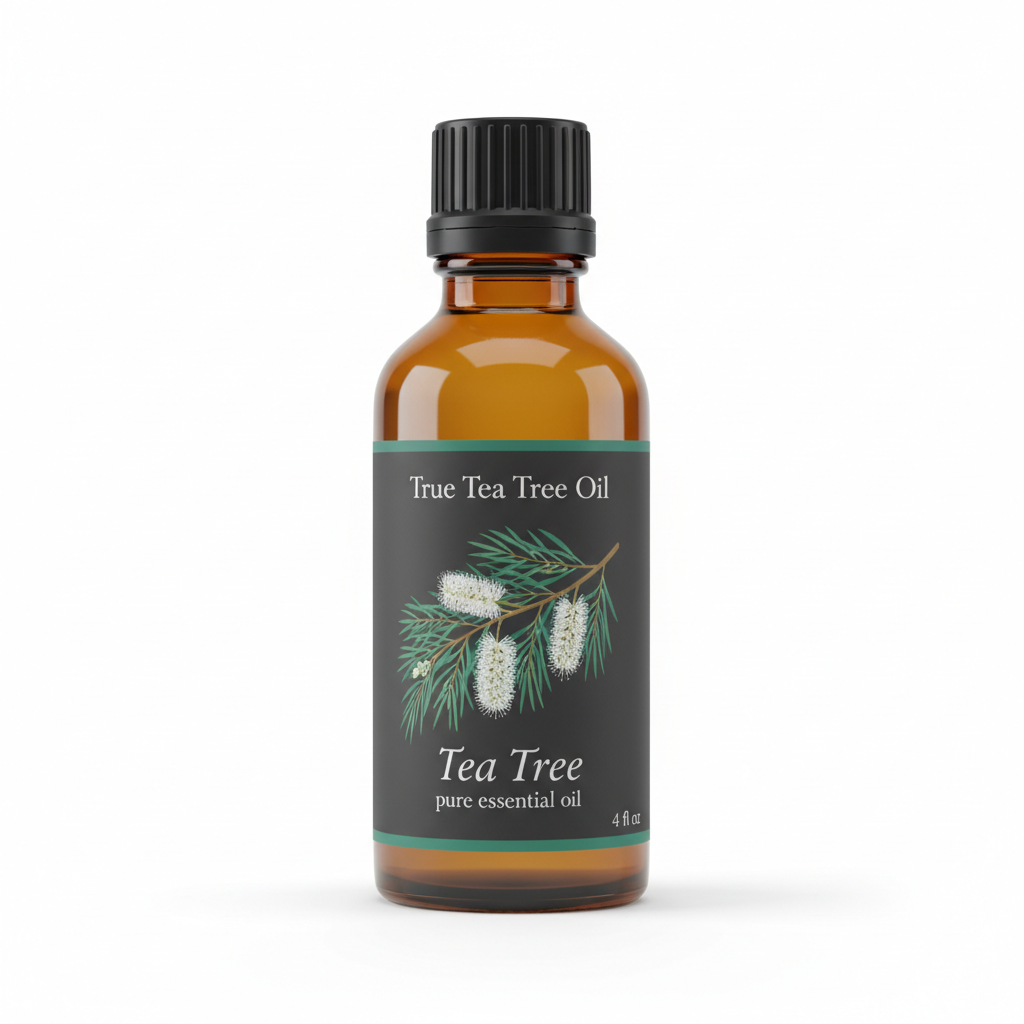
Tea Tree Essential Oil
Our own Tea Tree Essential Oil, in sizes from 0.5 oz to bulk.
From $10.99
Shop Now →| Myth | Verdict |
|---|---|
| A certified "grade" label means a regulator signed off | False |
| Pure means safe to swallow | False, and dangerous |
| Natural means gentle | False |
| If it tingles on skin, it's working | False |
| The paper test proves purity | False |
| More drops work better | False |
| It makes hair grow | Not supported |
| Essential oils never expire | False |
Myth: A "certified grade" label means a regulator signed off on it
Verdict: False. No government body grades essential oils. There's no FDA tea tree oil grading office, no inspector stamping bottles "premium" or "grade A." The grading vocabulary that shows up on labels is seller-written marketing language, and in several cases it's a trademarked phrase owned by a specific company rather than an industry-wide classification.
The closest thing to an actual standard is ISO 4730:2017, the international specification for oil of Melaleuca, terpinen-4-ol type. It defines a composition window: minimum and maximum percentages for terpinen-4-ol, 1,8-cineole, and roughly a dozen other constituents that a gas chromatograph can measure. It says nothing about how the oil performs and isn't issued or policed by any government agency. The Australian Tea Tree Industry Association (ATTIA) works with growers and distillers toward that composition profile, but ATTIA doesn't hand out a public grading seal either.
The myth persists because "grade" sounds official, the same way "grade A" sounds official on an egg carton where an actual USDA inspector is involved. Tea tree oil borrowed the vocabulary of regulated grading without any of the regulation. When a label uses the word, the useful question is which document it's pointing to. Our full breakdown of what tea tree oil grades really mean walks through how to read a grading claim against ISO 4730 instead of taking the label's word for it.
Myth: Pure means safe to swallow
Verdict: False, and dangerous. Purity is a compositional claim: it describes what is and isn't in the bottle. It is not a safety claim about how the body handles that composition internally. A oil can be compositionally pure, matching the ISO 4730 window exactly, and still be unsuitable for swallowing. Those are two separate questions, and the myth works by merging them into one.
True tea tree oil is a concentrated mix of monoterpenes that the body was never built to process by mouth. Robert Tisserand and Rodney Young's reference text, Essential Oil Safety, 2nd edition, catalogs documented cases of accidental swallowing and treats every one of them as a poisoning event, not a dosing question, regardless of how pure or expensive the bottle was. Grade, price, and purity don't change that classification.
If a child or a pet swallows any amount of tea tree oil, the correct first call is US Poison Control at 1-800-222-1222, or the ASPCA Animal Poison Control Center for a pet. Don't wait to see what happens, and don't let a "100% pure" label on the bottle delay the call. Our full household guide, is tea tree oil toxic if swallowed, covers what to do and why purity doesn't change the answer.
Myth: Natural means gentle
Verdict: False, as a rule of logic. "Natural" is a statement about origin. It says a compound came from a plant rather than a lab. It says nothing about concentration, and concentration is what skin actually experiences on contact.
Distilling tea tree leaves into oil concentrates the plant's chemistry by a large factor. A single drop carries far more reactive monoterpene content than the equivalent amount of leaf ever would in nature, where it was diluted across plant tissue, weather, and time. Putting that concentrate directly on skin without dilution, commonly called neat use, is the single habit our neat-use guide spends the most time walking back, because the "it's natural" instinct quietly skips the concentration step. Carrier oil doesn't weaken the tea tree oil chemically; it spreads the same reactive molecules across more surface area, which lowers how much any one patch of skin contacts at once. Read the full explanation in can you put tea tree oil directly on skin.
Myth: If it tingles on skin, it's working
Verdict: False. A tingling or warm sensation on skin is a sensory nerve response to a chemical crossing the skin's outer barrier. It signals that nerve endings are reacting to something, not that a process is being accomplished or rewarded. There's no mechanism by which more sensation means more benefit.
Tisserand and Young's safety reference documents skin reactions to tea tree oil as a known irritation risk, one that becomes more likely at higher concentrations or on skin that's already compromised by sun exposure, recent shaving, or other oils layered underneath. Evidence indicates the sensation scales with concentration and exposure time, not with any kind of improving effect. If a patch test tingles, the honest reading is "this concentration is too strong for this skin today," not "keep going."
The myth likely survives because plenty of cosmetic products are formulated to tingle on purpose, think menthol in a scalp rinse, and people transfer that expectation onto an oil that was never formulated the same way.
Myth: The paper test proves purity
Verdict: False. The paper towel test checks one thing: whether a liquid leaves an oily residue after it evaporates. Research into adulterated essential oils suggests that test alone is weak evidence of anything, because plenty of synthetic fragrance blends and diluted products pass or fail it inconsistently depending on paper type, ambient temperature, and how much liquid was used.
What the paper test can't do is detect a synthetic additive dissolved into real tea tree oil, measure the percentage of terpinen-4-ol against the ISO 4730 window, or catch oxidation byproducts forming in a bottle that's been open too long. Those require actual lab analysis: gas chromatography and mass spectrometry (GC/MS), the method distillers and transparent sellers use to generate batch reports. A paper towel can't run that test, and no amount of watching it dry will substitute for one.
Our guide on how to tell if tea tree oil is pure walks through what to actually look for: label language, a published lab report, and a price that's consistent with real distillation costs. If you want oil with that kind of documentation already in hand, our shop lists current batches with their sourcing noted.
Myth: More drops work better
Verdict: False. Concentration-response in skin contact and inhalation doesn't climb in a straight line forever. Past a certain point, receptor and barrier responses level off while irritation risk keeps climbing with every added drop. Adding more oil doesn't scale a benefit upward; it mostly just adds exposure.
This is why dilution ratios in recipes are written as specific percentages, often in the range of 1 to 2 percent for a lotion or diffuser blend, rather than "as much as smells good." The math behind those ratios is deliberately conservative. The right amount in most of our recipes looks smaller than instinct suggests, and that gap between instinct and the written ratio is intentional, not a rounding error or an overly cautious editor.
The myth probably comes from how other household products work: more detergent, more cleaning. Concentrated botanical chemistry doesn't follow that same logic once it's touching skin.
Myth: It makes hair grow
Verdict: Not supported. Scalp-care routines built around tea tree oil are common, and plenty of people report liking how their scalp feels after using one. Research suggests that's a long way from evidence that the oil causes new hair growth. The claim tends to travel on anecdotal reports rather than on any settled body of findings tying scalp application to growth outcomes, and we'd rather say that plainly than dress up an anecdote as a mechanism. If you're building a scalp routine around tea tree oil, frame it as part of a hair-care ritual, not as a growth strategy.
Myth: Essential oils never expire
Verdict: False. Once a bottle is opened, oxygen in the headspace reacts with the oil's monoterpenes, including terpinen-4-ol, and slowly converts a portion of them into oxidation byproducts. PubChem's compound data on terpinen-4-ol and related monoterpenes documents exactly this kind of air-driven reactivity. Among the compounds that can form is ascaridole, which evidence indicates raises skin irritation risk even when the bottle still smells fine on top.
This is a chemistry timeline, not a marketing one. A bottle that's half empty has more airspace sitting on top of the oil than a full one, so it oxidizes faster even if both were bottled the same week. Tight caps, cool storage away from light, and buying oil in a size you'll actually finish within a reasonable window all slow the process down. Smell is a decent early warning, but it isn't the only signal that matters, how long a bottle's been open and how it's been stored count too.
How to evaluate the next claim you meet
Every myth above traces back to the same mistake: treating a concentrated botanical chemical like magic instead of like chemistry that follows the same rules as any other reactive compound. The fix isn't memorizing eight rebuttals. It's asking three questions of any new claim before accepting it.
- What's the mechanism? If a claim can't explain what the compound is actually doing at a chemical level, that's a sign it's marketing language dressed up as a fact.
- What's the concentration? Dose and dilution change outcomes more than almost any other variable in this category. A claim that ignores concentration is usually incomplete.
- What's the source? A named standard, a documented reference text, or a lab report carries weight. "People say" doesn't.
Those are the same three questions our guide on how to read tea tree oil research without getting fooled walks through in more depth, aimed at the next headline or label claim you run into after this one. Evidence indicates the myths that spread fastest are the ones that skip all three questions at once, which is exactly why they're worth asking out loud.
None of this is medical guidance, and nothing here is a substitute for talking with a qualified healthcare provider about your specific situation.