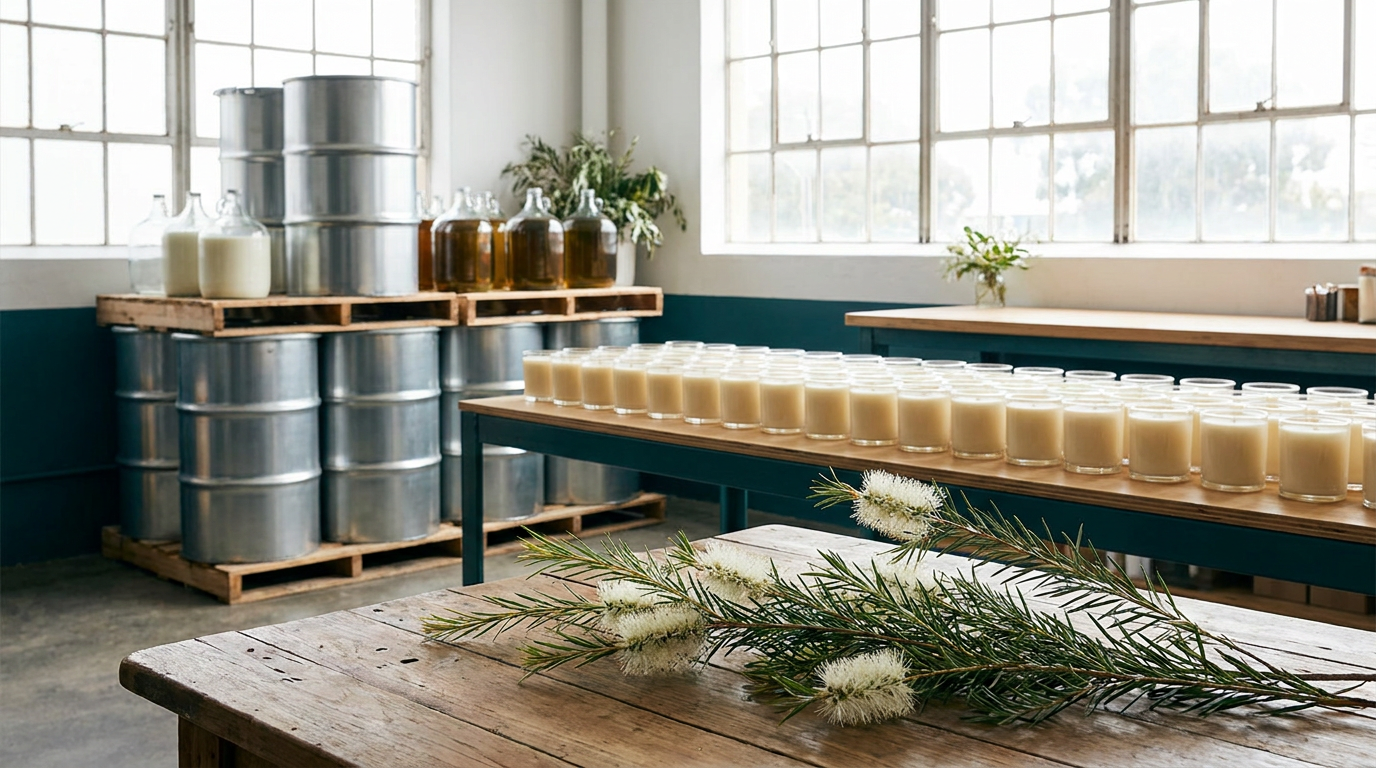
Candle studios buy tea tree oil to build a crisp, green top note into wax and reed diffuser blends, testing load rate carefully before scaling a batch. This page is part of our Guide to Buying Tea Tree Essential Oil in Bulk.
See pound-tier pricing before your next production pour.
A studio scaling a candle recipe from bench test to full pour needs to know exactly how a given load rate performs in wax, a process documented directly in a candle studio's batch notes on testing load rates.
Because tea tree reads as a sharp, herbal top note rather than a base or heart note, it pairs best in a blend rather than carrying a candle alone. This brand's own house blend approach, described in the Southern Cross blend: true tea tree oil's signature recipe, offers a useful pairing template, and the aroma itself is profiled in what tea tree oil smells like.
Candle studios generally test load rate in small test pours before committing wax to a full production run, watching for hot-throw performance rather than just cold-sniff strength from the bottle. Since tea tree is a top note, it tends to fade faster through burn than a heavier base note, so studios often pair it with something longer-lasting to anchor the blend.
Reed diffuser and room-spray lines follow similar logic at a different carrier ratio, testing throw over the life of the reeds rather than in a single burn cycle.
Bench-test hot throw before locking a production pour: tea tree's top-note character means it can read strong cold and fade fast hot, so load rate decisions belong in wax, not in the bottle.
Test pours generally run on 1 oz or 2 oz bottles, with full production runs scaling to 5 lbs once hot-throw performance is confirmed.
Get a small bottle to test load rate and hot throw.