How to Read a Tea Tree Oil Label: 4 Lines to Check
The front of a tea tree oil bottle is where the brand does its talking. The facts sit in the smaller lines: a botanical name, a quantity, and sometimes a code. You do not need a lab to read them, only a minute and a good idea of what each line is for.

Tea Tree Essential Oil
Our own Tea Tree Essential Oil, in sizes from 0.5 oz to bulk.
From $10.99
Shop Now →Line one: the botanical name
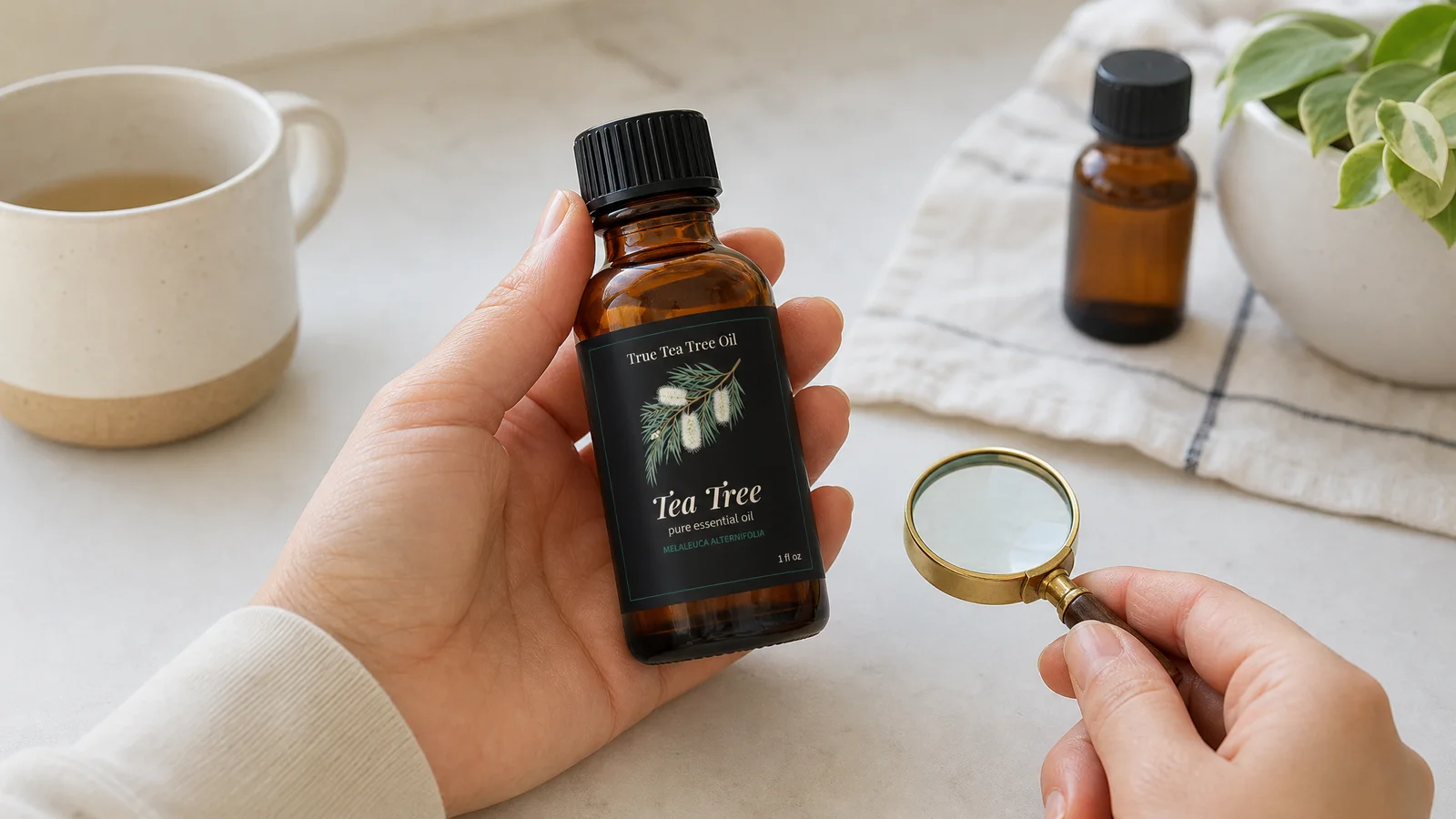
"Tea tree" is a common name, and the genus Melaleuca is large. The oil you want here is from Melaleuca alternifolia. Cajeput and niaouli are different Melaleuca oils with their own character: niaouli and cajeput smell softer and sweeter than tea tree. When a label says only "melaleuca oil" or "tea tree oil," it gives you less to go on than the full botanical name does. Both of our tea tree oils carry the species name on the label: Melaleuca alternifolia.
It helps to have a bottle in front of you as you read, so pick one up, whether it is ours or someone else's. Hold it in good light, because small print on a dark label can be hard to read, and a phone torch makes a surprising difference. Turn the bottle slowly and read every line, including the ones near the base and around the back.
Line two: the ingredient name
When tea tree oil is an ingredient in a cosmetic, you will see it written in the standard cosmetic form, Melaleuca alternifolia (tea tree) leaf oil. You can see exactly that wording on the public drug facts label for a well-known tea tree shampoo, where it appears as one entry on a long list. The same wording is a handy search term: if you are unsure what a product contains, the botanical name in the ingredient list is what to look for. Our guide to reading a tea tree shampoo label shows how that works in practice.
Another identifier is the CAS number. The European Commission's consumer safety committee lists tea tree oil under CAS 68647-73-4, and you will find the same number on the Certificate of Analysis we publish. It is a tidy way to confirm that two documents are talking about the same material.
Line three: how much is in the bottle
Net contents is a quiet but practical line. Tea tree oil is used by the drop, and a dropper delivers roughly 20 drops per millilitre, so by our arithmetic a 10 mL bottle holds about 200 drops, a 15 mL bottle about 300 and a 30 mL bottle about 600. Our labels show the size in fluid ounces. A one-ounce bottle (29.57 mL) is around 590 drops, and at 1 percent in a body oil, about 6 drops go into an ounce of carrier. That tells you very quickly whether a size suits you.
Line four: any code or date
If a label carries a lot or batch code and a best-by date, that is the key that connects paper to bottle. A Certificate of Analysis is only meaningful if it names the lot it covers. The certificate we publish names one batch of the Australian oil, and it lists relative density, refractive index and optical rotation. It does not include a GC-MS breakdown, and we publish no document for the South African oil. If you need composition data for a bottle or a lot, ask us in writing through the contact page before you order and keep the answer in writing.
A two-minute label check
Once you know the four lines, you can run a quick check on any bottle in about two minutes. First, find the botanical name. Second, find the quantity and decide whether the size suits your habits. Third, look for any code or date and ask yourself how a document would connect to it. Fourth, read the handling lines and note anything you would want to double-check.
If something is missing, that is not a reason to panic. It is a reason to ask. A friendly note to a seller costs a minute, and a clear answer in writing is worth having before you rely on a bottle.
Keeping what you learn
If you buy more than one tea tree oil over the years, a small note on your phone can help. Jot down the brand, the botanical name and the size, then add a word on how it smelled when you opened it. Next time you shop, you will have a little record of what you liked, which is worth more than any adjective on a front label.
And when you finish a bottle, keep the label if you can. A photograph of the back of the bottle, with its name and quantity, makes a handy reference for later.
The lines that say how to use it
Look for dilution and handling guidance too. Our guidance is to dilute to 0.5% to 2% in a carrier oil, patch test a small area first, keep it away from eyes, children and pets, avoid internal use and store it tightly capped in a cool, dark place. An amber bottle with a tight cap, which is how ours arrive, is part of the same story. Those lines are not small print for the sake of it. The oil is a documented skin sensitiser, oxidation raises that potency, and a review of 159 adverse-reaction reports concluded it should never be taken by mouth. See our guide to diluting tea tree oil for the maths, and our notes on what to check on a label, a lab report and a price for the wider picture.
Reading labels gets quick with practice. Name, quantity, code, guidance: four lines, and you know what you are holding.
Tea Tree Essential Oil
Tea Tree Essential Oil from our own shop, in sizes from 0.5 oz to bulk.
From $10.99
Shop Now →