How to Dilute Tea Tree Oil: Percentages and Drops
Choose the percentage first and count drops second. Drops are what you hold in your hand, but the percentage is what regulators, dermatologists and our own guidance talk about, and the drop count simply follows from it.

Tea Tree Essential Oil
Our own Tea Tree Essential Oil, in sizes from 0.5 oz to bulk.
From $10.99
Shop Now →The arithmetic, once
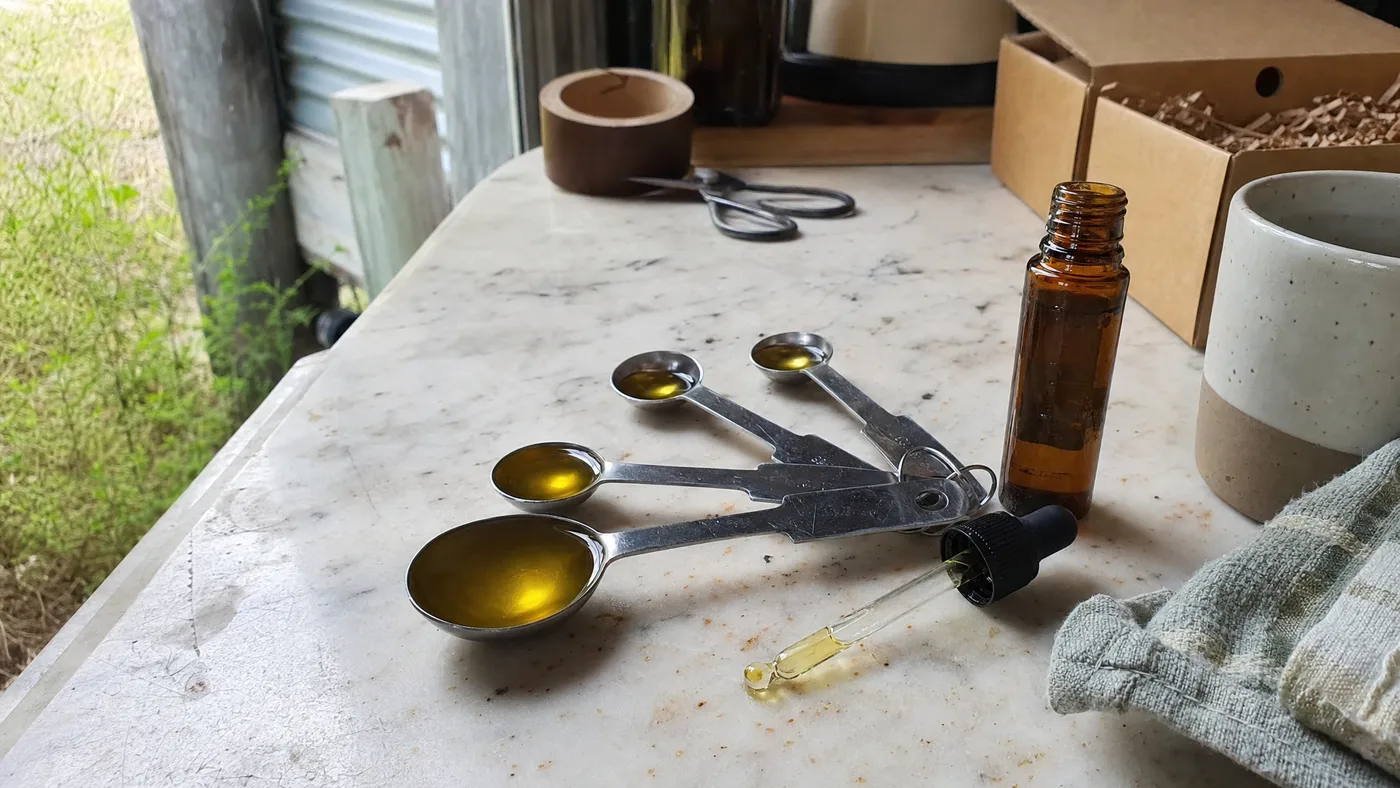
A US fluid ounce is 29.57 mL, and a dropper delivers about 20 drops per mL (it varies with the bottle and how you tilt it, so every drop figure here is approximate). The calculation is carrier volume in mL, times the percentage, times 0.2, which gives drops of oil. This is our own arithmetic and it ignores the small volume the oil adds.
| Target | In 30 mL (1 oz) of carrier | In 100 mL of carrier |
|---|---|---|
| 0.1% | about 0.6 drop | about 2 drops |
| 0.5% | about 3 drops | about 10 drops |
| 1% | about 6 drops | about 20 drops |
| 2% | about 12 drops | about 40 drops |
The first row teaches the most. You cannot hit 0.1% by counting drops into a one-ounce bottle, so low targets call for a larger batch or a pipette marked in fractions of a millilitre. A scale helps too: the Certificate of Analysis we publish for one batch of our Australian oil gives a relative density of 0.896, so a millilitre weighs a little under a gram, and a scale that reads to 0.01 g beats a dropper for small batches. We publish no density for the South African oil, so weigh that one.
Which percentage?
We recommend 0.5% to 2% in a carrier oil for general skin use, with a patch test on a small area first, and to stop if irritation occurs. We start at the lower end, and here is why. The EU's consumer safety committee (SCCS) adopted its opinion on tea tree oil on 30 October 2025. It found the oil safe in finished products at up to 2.0% in shampoo, 1.0% in shower gel, 1.0% in face wash and 0.1% in face cream, and calls it a moderate skin sensitiser. Those numbers apply only to oil whose composition meets ISO 4730:2017, to adults, and to the products named, and the committee says the oil's stability has to be kept within the specification.
Read that as a map. Rinse-off products tolerate more, leave-on facial products far less, and a body oil sits somewhere between. A sensible plan is 0.5% for a first try on the body, 1% once you know your skin, and 2% as the ceiling for a small area of the body, not a goal. Anything for the face should be much lower, and our beard balm piece shows what 0.1% looks like in practice.
Setting up your bench
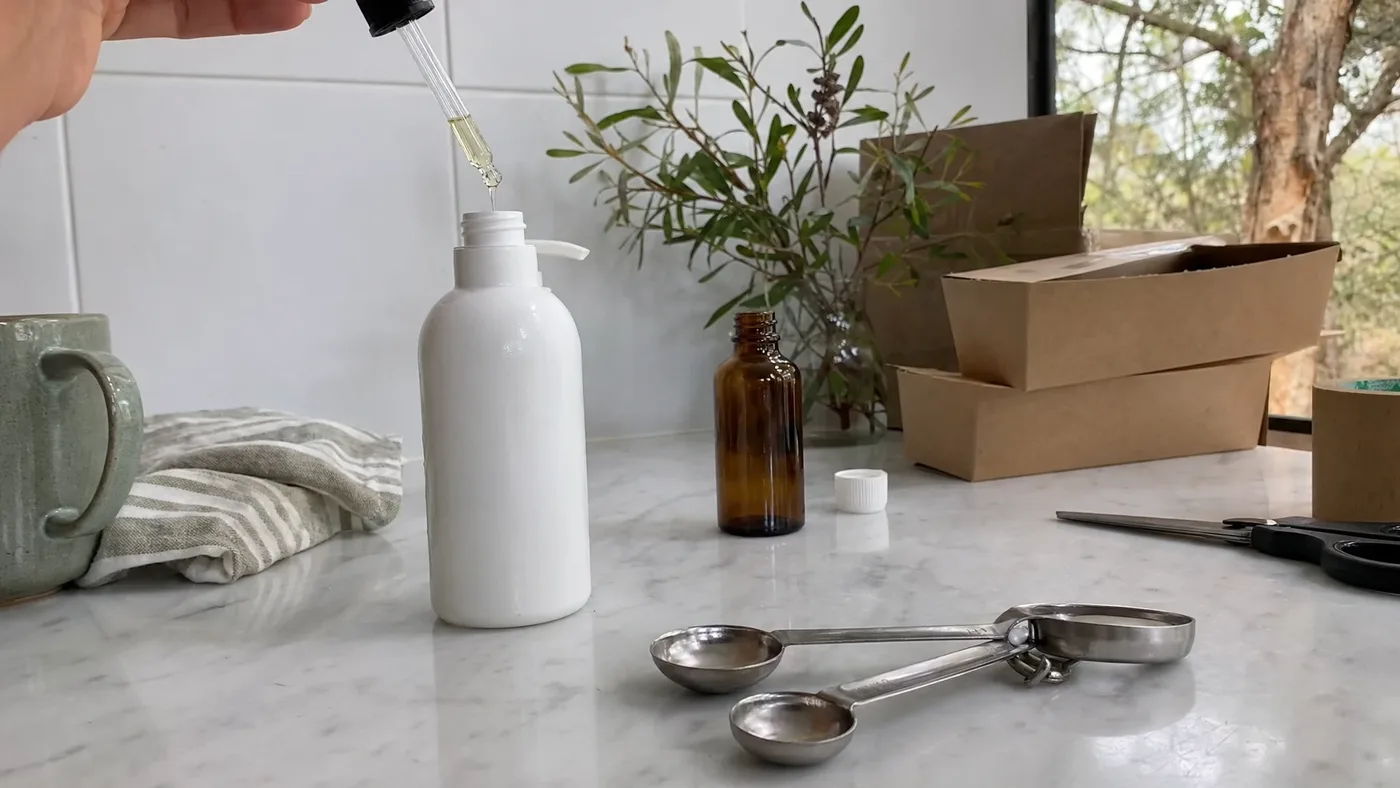
Mixing goes better when you prepare first. Wash and dry a clean glass bottle, set out a paper towel, and keep the tea tree bottle capped until the very moment you need it. Pour the carrier in first, then add the drops, then cap and turn the bottle gently end over end. Doing it in that order means the concentrated oil never sits undisturbed in an empty bottle, and a slipped hand lands on carrier rather than neat oil.
Count the drops out loud, or tick them off on a scrap of paper. It sounds fussy, but losing count at drop seven is one of the most common mix-ups, and starting over on a small batch costs very little.
Choosing a carrier
Our guidance names jojoba or sweet almond as examples. We do not sell carrier oils, so you will find them at a craft or supply shop, a pharmacy or a grocery. Jojoba and sweet almond are both easy to find, and anyone with a nut allergy should skip the almond. Our longer comparison of carrier oils for tea tree goes through the choices. Whatever you pick, buy a small bottle and use it while it is fresh.
Writing it down
A label saves you from your own memory. Put the date, the carrier, and the percentage on every bottle you mix, for example "1%, jojoba, opened in spring". A month from now you will not remember whether the little bottle by the sink is the gentle one or the strong one, and the label settles it at a glance.
It also helps to keep a small notebook page of your favorite ratios. When a blend suits you, you can repeat it exactly instead of guessing, and when one does not, you will know what to change.
Freshness matters as much as the ratio
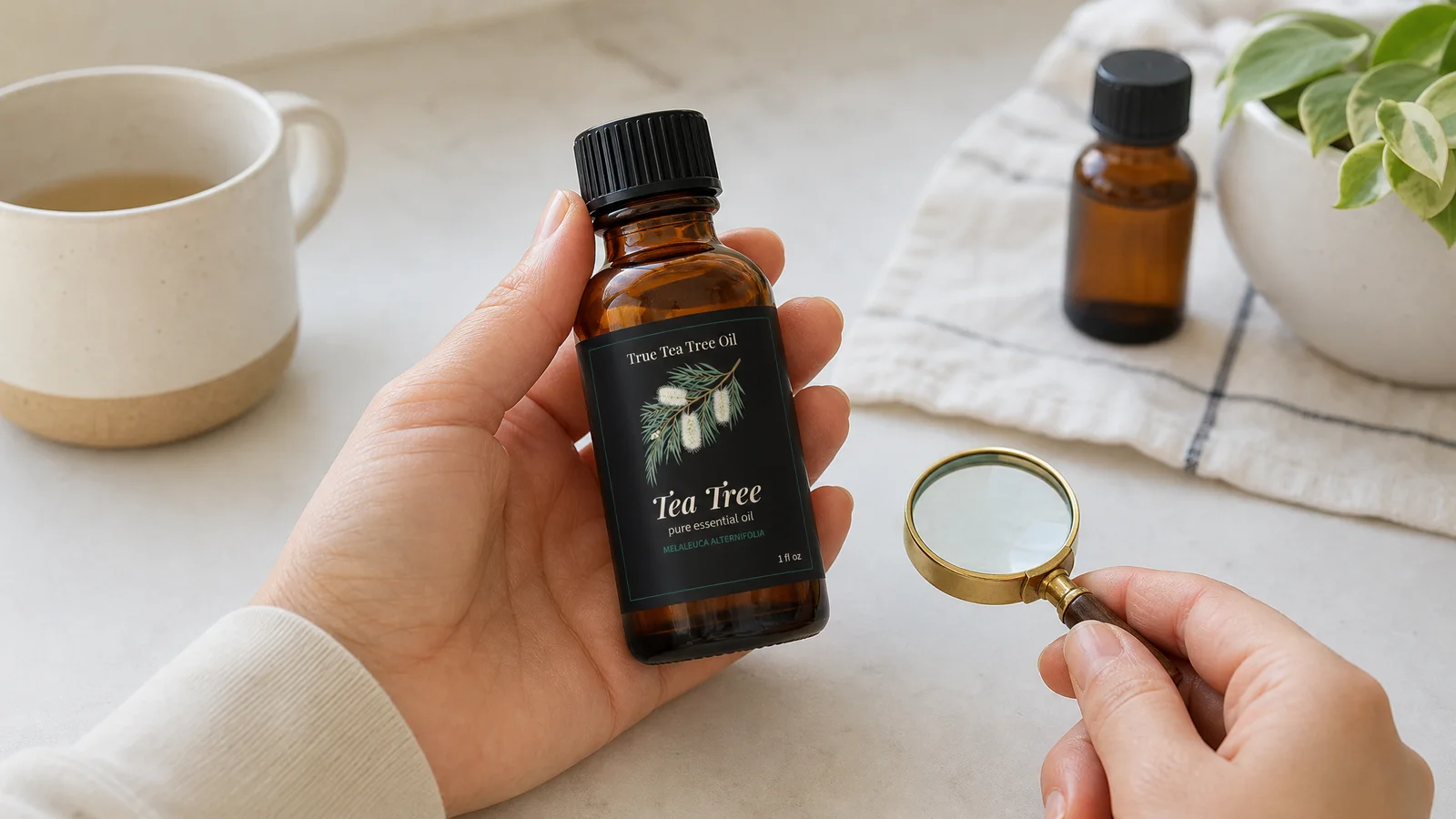
Oxidised tea tree oil is the version most likely to bother skin. A 2016 review of contact allergy found that oxidation raises the oil's allergenic potency, and a 2023 safety review of adverse-reaction reports noted skin problems especially when the oil had been exposed to light or air. Keep the cap tight, store it cool and dark, and mix small batches. Our storage guide, keeping your bottle fresh, has the details.
Test before you commit
Dilution lowers the odds of a reaction but does not remove them, so test your finished blend, not the oil on its own. Our walkthrough on how to patch test tea tree oil shows the steps. Pregnancy, young children and any medical condition are questions for a doctor, and pets should be kept away from the oil entirely. We sell an external cosmetic oil, and our two tea tree oils are sold neat, so the diluting is always yours to do.
Once you have your number, write it on the bottle. It saves guesswork the next time you reach for it.
Tea Tree Essential Oil
Tea Tree Essential Oil from our own shop, in sizes from 0.5 oz to bulk.
From $10.99
Shop Now →