How Tea Tree Oil Is Made: From Paperbark to Bottle
Tea tree oil begins life on a paperbark tree that grows wild in the creeks and swampy ground of northern New South Wales, and it ends in a small amber bottle after a surprisingly simple trip through a still. The story in between is a good one: a plant, a haircut, a cloud of steam and a skim of pale oil on water.

Tea Tree Essential Oil
Our own Tea Tree Essential Oil, in sizes from 0.5 oz to bulk.
From $10.99
Shop Now →A tree that likes being cut
Commercial tea tree farming is younger than most people expect. Plantations were established in the 1970s and 1980s, and today they grow in Western Australia, Queensland and New South Wales, according to the 2006 review by Carson, Hammer and Riley. The oil's modern reputation goes back further, to reports by Penfold in the 1920s. You may have heard that soldiers in the Second World War were issued tea tree oil. The same review looked for evidence of it and could not find any, so we treat that as a good story rather than a fact.
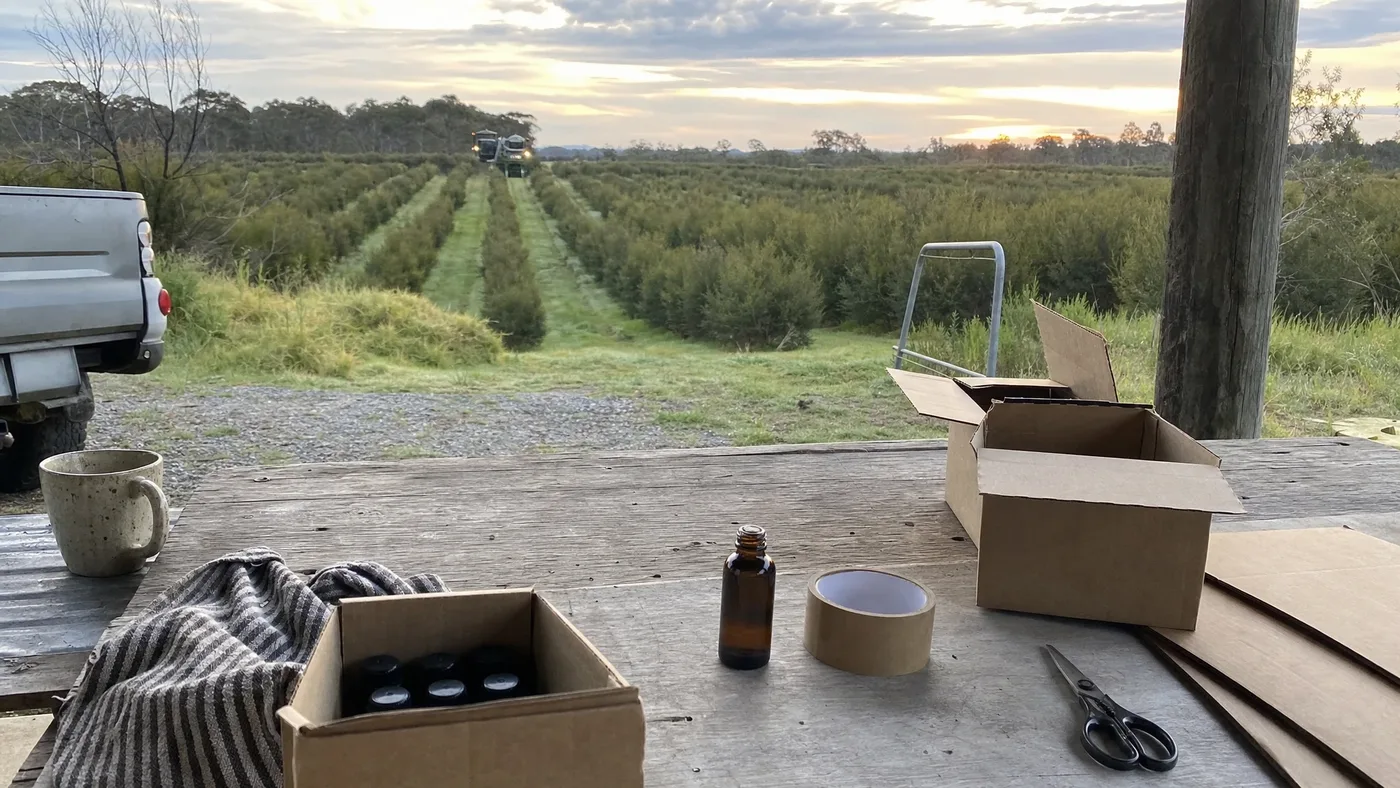
Growers plant seedlings at high density, and the first harvest comes a year to three years later depending on climate. The harvest is a coppice cut: the whole plant is cut off close to ground level, then chipped, and the stump regrows for the next round. That regrowth is what makes the tree such a good crop. Plantations also let growers mechanise the work, which is part of why the industry could scale up.
If you have ever walked through a stand of paperbark trees, you will know the bark by sight: it peels in thin, papery layers, pale and soft like old parchment. The leaves are narrow and fine, and when you crush one between your fingers it gives off a sharp, green scent that gives you a preview of the oil. That is the same aroma that ends up in the bottle, only far more concentrated.
Into the still
The chipped leaves and fine branches go into a still, and steam does the work. Steam passes up through the plant material, picks up the volatile aroma compounds and carries them out as a vapour. The vapour is cooled back to liquid in a condenser, and because oil and water do not mix, the two separate on their own. The oil is clear to pale yellow and floats where it can be drawn off. According to the same review, a typical yield is only 1 to 2 percent of the weight of the fresh plant material, so a lot of leaf is needed for every bottle.
That small yield is a nice thing to keep in mind when you smell the finished oil. Crisp, green and camphorous, with a little earthy depth, it is a very concentrated version of the tree's leaves.
It is worth picturing the still itself, since the idea is simple enough to hold in your head. Think of a kettle: water heated until it steams, a lid that catches the steam, and a pipe that carries it somewhere cool. Distillers use the same principle at a much larger scale. The aroma rides the steam, and cooling turns it back into liquid, where the oil settles on top.
What changed on the farm
Farm yields have climbed. AgriFutures Australia reports early plantations producing 100 to 150 kilograms of oil per hectare, against 350 to 450 for newer cultivars. That is a farming story, though, and it tells you how efficient a plantation is, not what is in a particular bottle. The part that decides what you smell and use is what happens after the still: how the oil is stored, and for how long.
After the still: keeping the oil lively
Light, heat, air and moisture all affect tea tree oil. The Carson review recommends dark, cool, dry storage in a vessel with little air, and notes that as oil ages, p-cymene rises while alpha- and gamma-terpinene fall. Oxidation products are also the main reason aged or poorly stored oil is more likely to bother skin, which is why the amber glass and tight cap on a bottle matter. We go over the habits in our guide to keeping your bottle fresh.
What to look for in your own bottle
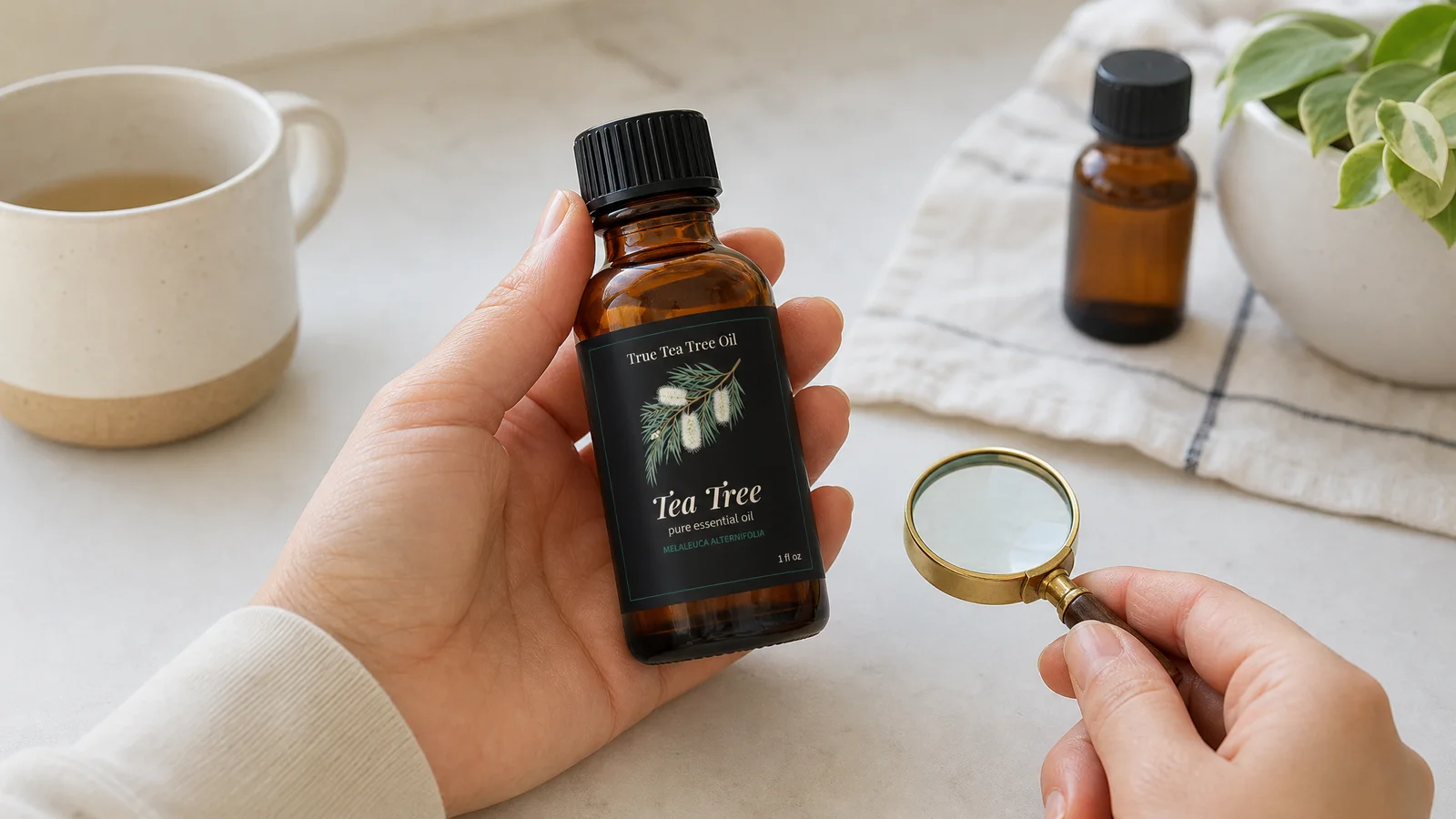
You can carry the story into your kitchen with a simple habit. Open the bottle, hold it a few centimetres from your nose, and take one slow breath. Notice the first sharp, green note, then the camphorous edge behind it, then whatever earthy depth lingers. Those three layers are what steam pulled out of a tiny amount of leaf. Do it again after a minute, and you will notice the top note fading, which is exactly what we mean when we call tea tree a top note oil.
It is also a good reminder to treat the oil with respect. A few drops are a lot of plant, so a small amount goes a long way.
Where our two oils come in
We sell two tea tree essential oils, both Melaleuca alternifolia, one listed as Australian and one as South African, and both are described as steam-distilled from the leaf. The Certificate of Analysis we publish for one batch of the Australian oil gives the extraction method as steam distilled and lists leaf and branch as the parts used, which fits the industry picture above. We bottle and ship from our US-based facility. If you would like to compare how the two oils smell, our scent profile is a good place to begin, and our overview of the plant goes deeper on the tree itself.
Next time you open a bottle, give it a slow sniff and picture the chain: a coppiced paperbark, a cloud of steam, and a skim of oil. It is a lot of plant in a few drops.
Tea Tree Essential Oil
Tea Tree Essential Oil from our own shop, in sizes from 0.5 oz to bulk.
From $10.99
Shop Now →