Tea Tree Oil in Shampoo: How Many Drops per Bottle?
For a standard 250 mL shampoo bottle, about 25 drops of tea tree oil gets you to 0.5 percent, and 50 drops reaches 1 percent. That is the whole answer in one line, and the rest of this page is about why we like measuring the whole bottle at once and how to scale it up or down.

Tea Tree Essential Oil
Our own Tea Tree Essential Oil, in sizes from 0.5 oz to bulk.
From $10.99
Shop Now →Drops by bottle size
Droppers vary, but 20 drops to a millilitre is the common planning figure, so the table below is our own arithmetic on that basis. Treat the numbers as close, not exact.
For a bottle that is not on the list, the rule is simple: millilitres of shampoo, times the percentage, gives millilitres of oil, and every millilitre is about 20 drops. A 400 mL bottle at 0.5 percent needs 2 mL of oil, which is about 40 drops.
| Bottle size | 0.5% (about 20 drops/mL) | 1% (about 20 drops/mL) |
|---|---|---|
| 100 mL (travel size) | 10 drops | 20 drops |
| 250 mL (standard bottle) | 25 drops | 50 drops |
| 500 mL (large bottle) | 50 drops | 100 drops |
| 1 litre (pump bottle) | 100 drops | 200 drops |
If you own a kitchen scale that reads to 0.01 g, weighing is even better. The Certificate of Analysis we publish for one batch of our Australian oil lists a relative density of 0.896, so a millilitre weighs a little under a gram. For a 250 mL bottle at 0.5 percent that works out to roughly 1.25 mL of oil, or about 1.1 g. We publish no density for our South African oil, so for that one the dropper or a weighed amount is the way to go.
Why we mix the whole bottle at once
A popular habit is adding a drop or two to the shampoo in your palm. It is easy to see why it is tempting, and the arithmetic shows why it wanders. A palmful is not a fixed amount: a small dollop might be 3 mL and a generous one 8 mL, and the same two drops would be roughly 3 percent in the first and about 1.2 percent in the second. Mixing the bottle once at a known ratio means every pump carries the same concentration, and you only do the maths one time.
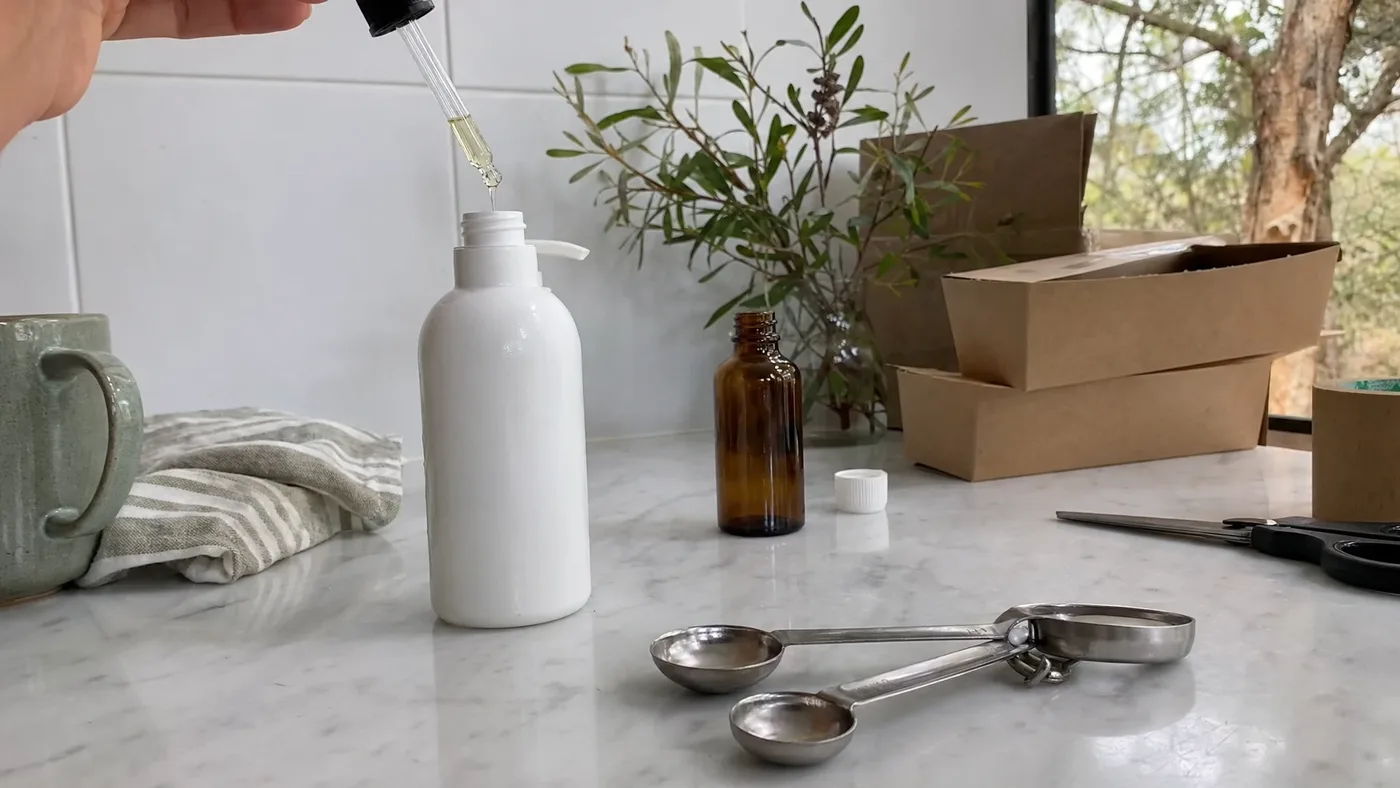
To mix it, pour a little shampoo out to make headroom, add the drops, cap the bottle and tip it gently a few times. Oils and water-based shampoos do not always stay blended on their own, so a shake before each use is a sensible habit.
Getting the drops right
Counting drops is easier when the bottle does not fight you. Hold the dropper bottle upright, close to the shampoo bottle opening, and squeeze slowly so each drop falls separately. Count out loud, and if you lose track, tip the bottle back and begin again with the batch in mind. For the bigger bottles it can help to count in tens, setting a finger or a tick mark on paper for each ten.
Work on a towel or a tray so a stray drip lands on something you can wipe up. Wash your hands afterwards, since the oil is concentrated and best kept off your eyes.
It also helps to pick a day for mixing. Do it when the bottle is nearly empty, rinse and dry anything you are reusing, and give yourself a calm few minutes at the sink. A rushed mix in a steamy bathroom is where drops get miscounted.
Choosing the strength
We would begin at 0.5 percent. It gives the crisp, green, slightly camphorous scent that tea tree is loved for without much fuss, and you can go up from there if you want more. The EU's consumer safety committee, the SCCS, put 2.0 percent as its upper figure for tea tree oil in shampoo, for adults and for oil whose composition conforms to ISO 4730:2017, and calls the oil a moderate skin sensitiser. Our own dilution guidance for skin is 0.5% to 2% in a carrier oil with a patch test first, and for a rinse-off product we prefer to stay toward the bottom of that range. A wash-off shampoo is gone in a minute or two, so extra drops mostly buy extra scent that rinses away.
A few practical notes:
- Choose an unscented or lightly scented shampoo from a pharmacy or grocery, so the tea tree is the star. We sell the oil only, not shampoo.
- Keep suds out of eyes. Rinse well if they get in.
- Do a small patch test at your chosen strength first, and stop if anything stings, itches or reddens.
- This blend is for adults. For children, pregnancy or any medical condition, ask your doctor before using essential oils, and never use it on pets.
If you want the bigger picture on percentages and carriers, our dilution guide covers it, and our walk through reading a tea tree shampoo label shows how ready-made bottles handle the same question.
Labeling the batch
Write the date, the bottle size and the number of drops on a strip of tape. When the shampoo is nearly gone, you will know exactly what to add to the next bottle. If you share a bathroom, a quick "tea tree, 0.5%" on the tape lets everyone know what is in it.
Once the bottle is mixed and labelled, you are done for the next few months. Write the date and the strength on a strip of tape so you remember the recipe.
Tea Tree Essential Oil
Tea Tree Essential Oil from our own shop, in sizes from 0.5 oz to bulk.
From $10.99
Shop Now →