How to Store Tea Tree Oil and Slow Down Aging
Tea tree oil does not go off the way milk does, but it does change. Open the bottle, let air and warmth and light have their way with it for long enough, and the mixture inside slowly drifts away from the one you started with. The good news is that the habits that slow this down cost nothing.

Tea Tree Essential Oil
Our own Tea Tree Essential Oil, in sizes from 0.5 oz to bulk.
From $10.99
Shop Now →What actually happens in the bottle
Tea tree oil is a blend of many small aromatic molecules, and several of them react with oxygen. A 2006 review of the oil's chemistry notes that its composition can change considerably in storage: p-cymene levels rise, while alpha- and gamma-terpinene fall. Light, heat, air and moisture all push that along, which is why the review recommends dark, cool, dry conditions and a vessel with as little air in it as possible. Those four words are, honestly, the whole storage lesson. The rest is making them easy to follow.
Why it matters for skin
This is more than a question of scent. A 2016 review of tea tree oil and contact allergy describes fresh oil as a weak to moderate sensitizer and says oxidation increases its allergenic potency. The European Commission's scientific committee on consumer safety reached a similar practical point in its 2025 opinion: because the oil's composition can change with light, heat, air and moisture, stability has to be maintained for its safety conclusions to hold. So an old, half-empty bottle that has lived on a sunny shelf is a different starting point than a newly opened one, and that is a good reason to treat the patch test as a habit for every new bottle. Our guide to patch testing tea tree oil walks through it.
Four habits that do the work
Cap it straight away
Every time the bottle is open, oxygen gets in. Put the cap back before you start measuring, not after.
Keep it dark and cool
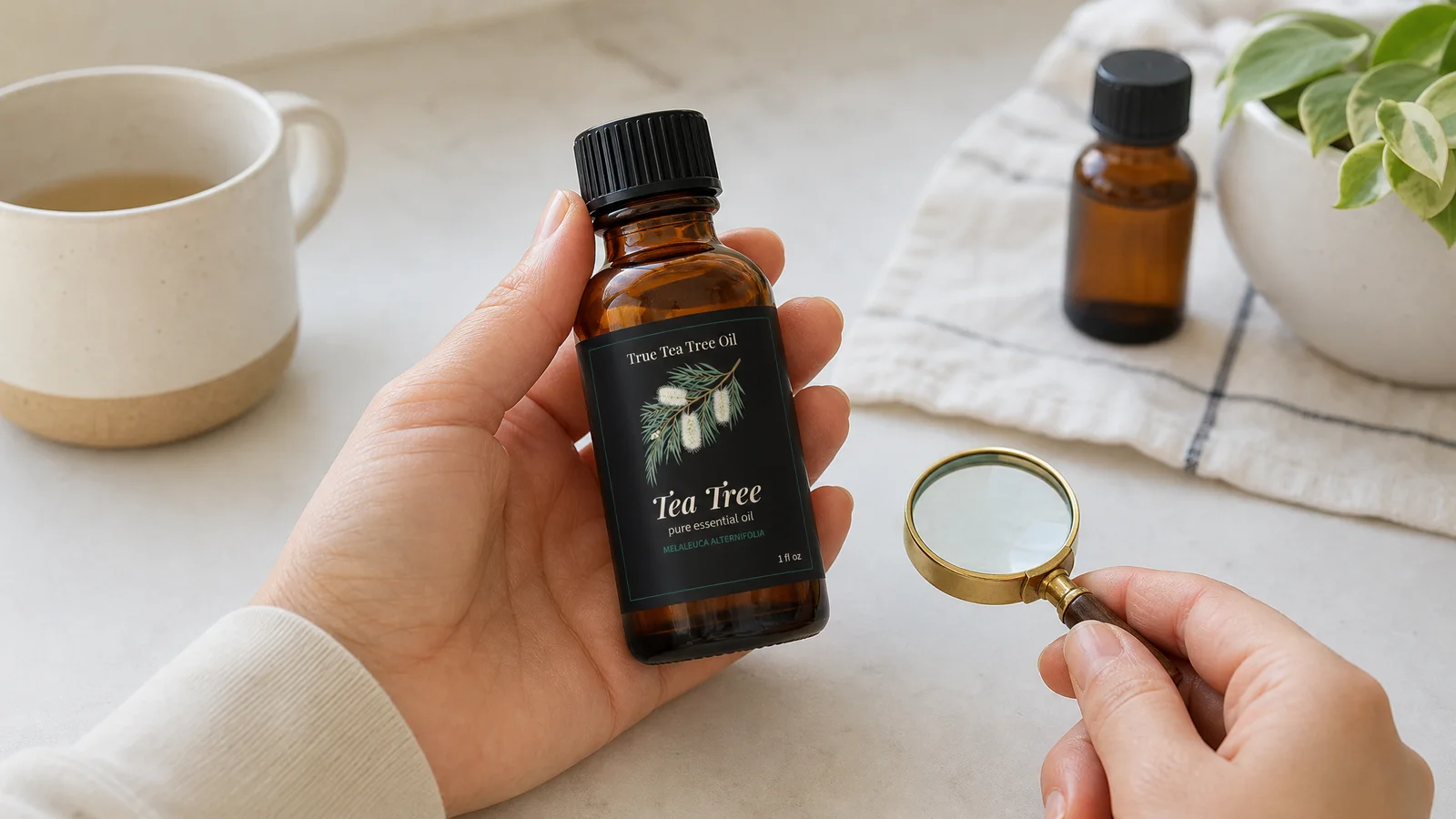
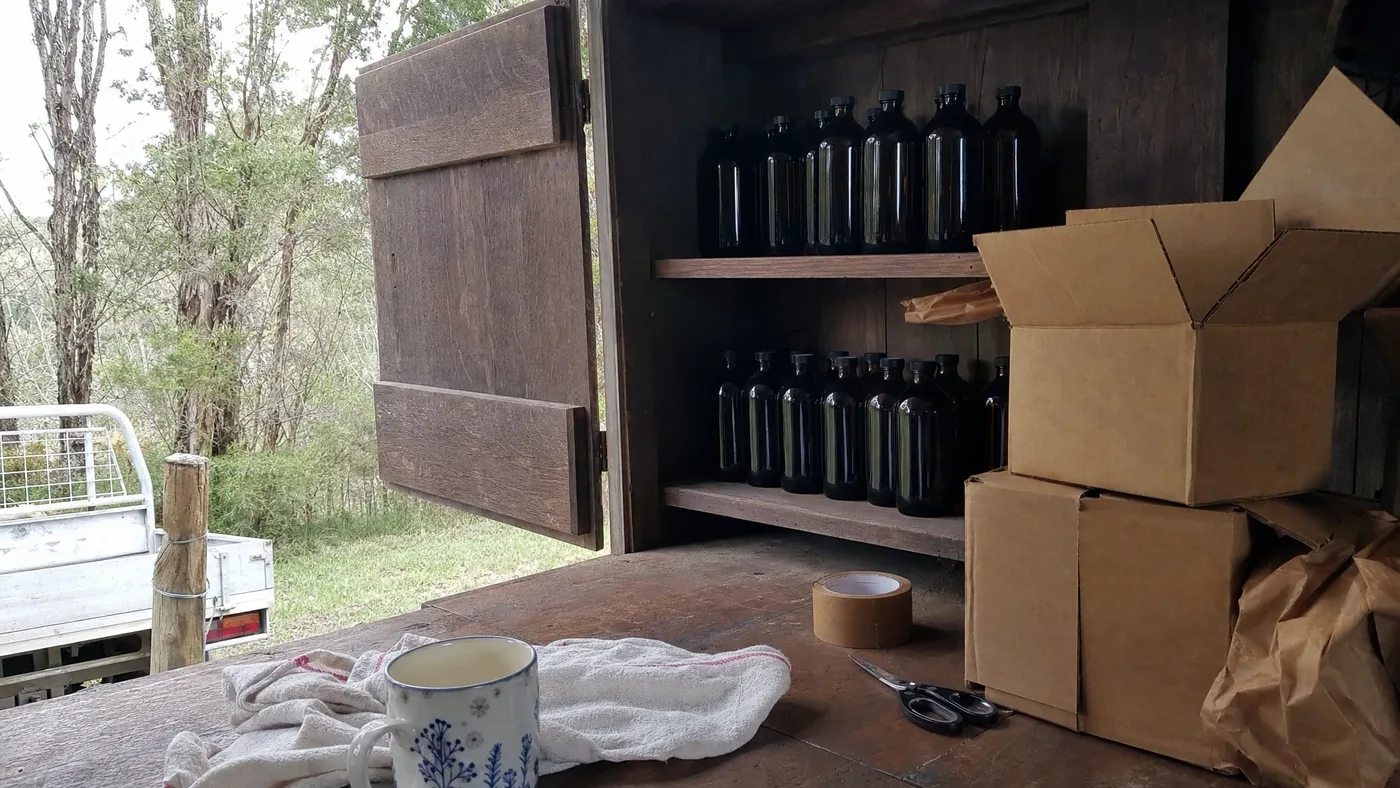
We bottle our tea tree oils in amber bottles with black caps for the same reason most oils come that way: tinted bottles cut down the light that reaches the oil. A closed cupboard away from the stove, a radiator or a window beats a bathroom shelf that steams up every morning. Our Australian oil's shelf life is listed at typically 2 to 3 years unopened, and our South African oil's at typically 1 to 2 years when sealed, both stored tightly capped in a cool, dark place away from direct sunlight.
Shrink the airspace
As a bottle empties, the air-to-oil ratio climbs. That is our own reasoning from the review's advice to use a vessel with little air, and it suggests moving what is left into a smaller, tightly closing amber glass bottle once you are down to the last fraction. If you buy in larger sizes, the same thinking applies: keep the big container sealed and decant a working amount into a smaller airtight bottle, which is how we suggest handling our bulk sizes too.
Choose glass, and write the date
The same review notes that tea tree oil is readily absorbed into plastics, so glass is the better home for it, so we would not leave it for weeks in a plastic spray bottle. Take a permanent marker and write the day you open the bottle on the label. We do not have a magic expiry date to give you for an opened bottle, which is exactly why a written date helps: it turns "I think I bought this last year" into something you can reason with.
Make a spot for it
The easiest storage habit is a permanent home. Pick one cupboard, shelf or box that stays cool and dark, away from the stove, the bathroom steam and the sunny windowsill, and always return the bottle there. When it has a home, you will never have to hunt for it, and it will rarely spend an afternoon in a warm, bright spot by accident.
A small box with a lid can double as a tidy home for your bottle, a dropper or two and a notebook of blend ratios. Everything you need stays in one place.
When to retire a bottle from skin use
There is no precise test you can run at the kitchen counter. Our suggestion, based on the sensitization finding above, is simple: if a bottle has been open a long time, has lived somewhere warm or bright, or smells noticeably different from when you opened it, take it off your skin list and keep it for non-skin jobs, or replace it. It costs very little to be conservative here, and a tidy habit of dating bottles makes the call easy.
Two safety notes belong next to the storage advice. Keep the bottle where children and pets cannot reach it, because the concentrated oil is not for swallowing and we say plainly that it is toxic to cats and dogs at the concentrations people casually use; our swallowing guide covers what to do if the worst happens. And keep it in its original labelled bottle, not a mystery jar, so the next person to pick it up knows what it is.
If you want to see what is inside the bottle before it starts ageing, our piece on terpinen-4-ol explains the chemistry in plain terms. A cool shelf, a dark glass bottle and a date on the label will do more for your oil than any gadget.
Tea Tree Essential Oil
Tea Tree Essential Oil from our own shop, in sizes from 0.5 oz to bulk.
From $10.99
Shop Now →Sources & Further Reading
- Carson CF, Hammer KA, Riley TV, "Melaleuca alternifolia (Tea Tree) oil: a review of antimicrobial and other medicinal properties", Clinical Microbiology Reviews, 2006
- de Groot AC, Schmidt E, "Tea tree oil: contact allergy and chemical composition", Contact Dermatitis, 2016
- Scientific Committee on Consumer Safety, "SCCS - Scientific Opinion on Tea Tree Oil (CAS/EC No. 68647-73-4 /285-377-1)", SCCS/1681/25, 2025