Is Your Tea Tree Oil What It Says? Reading the Proof
You cannot smell your way to certainty with tea tree oil. A crisp, green, camphorous aroma is exactly what we hope you find in the bottle, but a nose cannot tell you which species the oil came from or what else is in it. If you want proof, you have to look at paper, and it helps to know what good paper looks like.

Tea Tree Essential Oil
Our own Tea Tree Essential Oil, in sizes from 0.5 oz to bulk.
From $10.99
Shop Now →The name is a starting point
Look for Melaleuca alternifolia printed on the label, not just "tea tree" or "melaleuca oil". The shorter names are ambiguous: the genus also gives us cajuput and niaouli, which are chemically different oils, and the review we rely on points out that "melaleuca oil" is an official name in Australia for tea tree oil but can still be confusing. Both of our tea tree oils are listed as Melaleuca alternifolia, one from an Australian source and one from a South African source.
The Latin name matters, but it does not settle things on its own. The international standard for tea tree oil describes a chemical profile rather than a species, and the same review notes that oils meeting the standard have been distilled from other Melaleuca species, although in practice commercial oil comes from M. alternifolia. So the name tells you what the seller says it is, and the analysis tells you what the sample actually contains.
There is a quiet pleasure in doing this properly. Turn the bottle in your hand and read it the way you would read a food label: the Latin name, the size, and whatever it says about what is inside. A label that is short and specific is easier to trust than one crowded with adjectives, and it gives you something concrete to ask a seller about.
What a useful analysis shows
The report worth asking for is a gas chromatography-mass spectrometry (GC-MS) result. It is a fingerprint: it lists the oil's components and their percentages. The standard builds its profile around terpinen-4-ol, the leading component, with a minimum, and puts a ceiling on 1,8-cineole. In the 2004 edition summarised in that 2006 review the figures were a terpinen-4-ol floor of 30% and a cineole ceiling of 15%; the current edition is ISO 4730:2017, which the EU's consumer safety committee refers to, so read the current text for today's ranges. The same review adds a nice piece of myth-busting: cineole was long blamed for irritation, but the evidence for that was thin, so a bit more cineole is not automatically a red flag the way old advice suggests.
A report is only as useful as its link to your bottle. It should carry the batch or lot code of the oil you are actually buying, because the composition of a natural oil moves a little from batch to batch. A beautifully presented document for a different batch tells you about that batch. If you want a deeper tour of the chemistry itself, our piece on terpinen-4-ol covers it, and our guide to reading a tea tree oil label covers the other words on the bottle.
What we can show you
The Certificate of Analysis we publish is for one batch of our Australian oil (the batch code ends AU). It lists relative density, refractive index and optical rotation. Those are physical measurements, and they are a good consistency check, but they are not a component list and they do not replace GC-MS. We would rather say that plainly than leave you to assume more. If you need a GC-MS report, a document for our South African oil or details about a particular lot, ask us in writing through the contact page before you order and get the answer in writing before you rely on it.
Kitchen tests and price
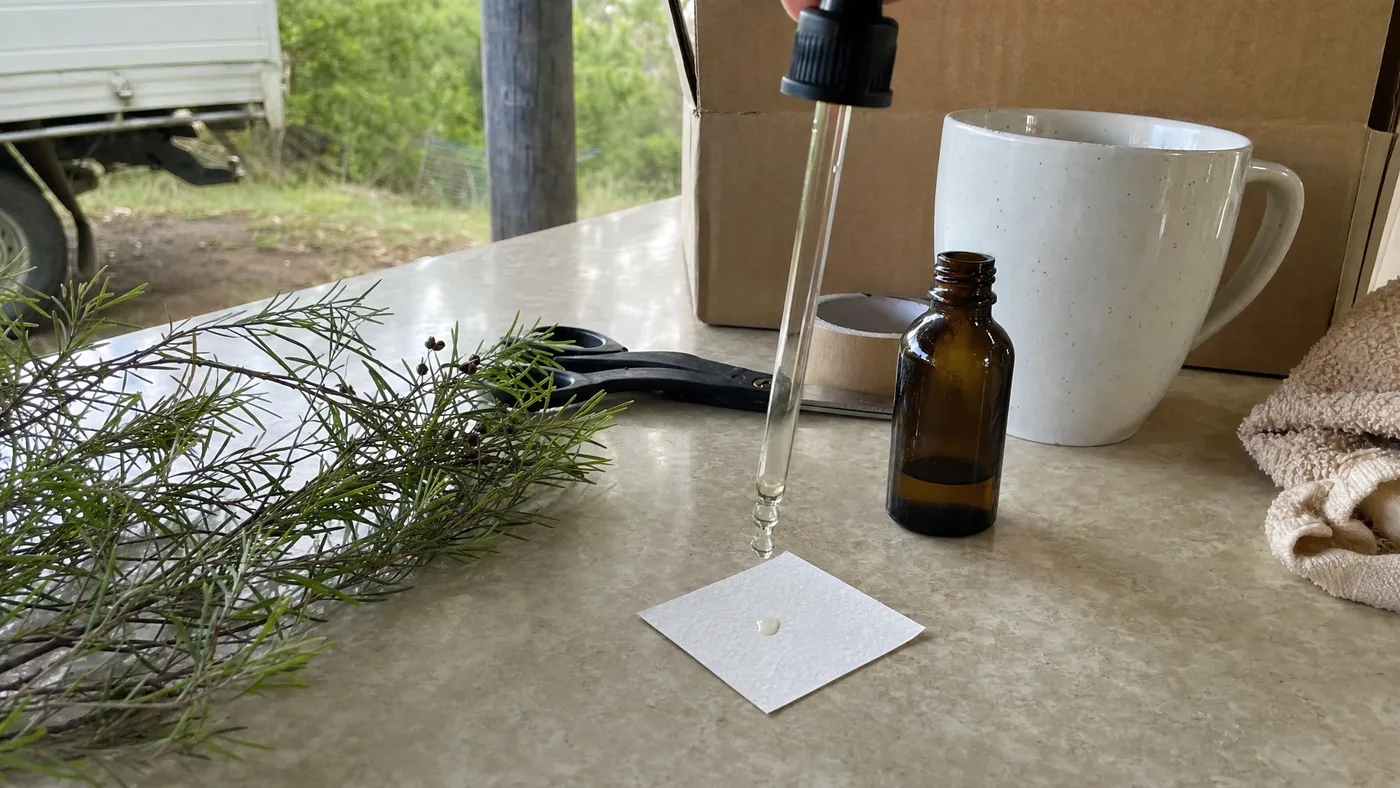
The popular home tests do not work as proof. The paper-ring test, for example, shows how an oil spreads and evaporates, and a carrier oil would leave a mark on paper, but nothing about a ring on a sheet of tissue identifies tea tree oil from another oil or measures its composition. That is reasoning from what the test actually observes, not a study. Price is equally slippery. A very low price is a reason to ask for documents, and a high price is not a document either. The decision rests on the paperwork.
It also helps to know what a lab report cannot do for safety. Quality and safety are separate questions: a well-made oil is still a concentrated ingredient that belongs diluted in a carrier, patch tested first, and away from children and pets, and our buying guide goes deeper on the grading language you will meet.
A short checklist to keep
- Write the Latin name you expect on a sticky note before you shop, so you are comparing like with like.
- Ask for the batch or lot code in writing, and check that any document you receive carries the same one.
- Keep the answers you are given. An email trail is paperwork too.
- Smell the oil last, and treat the aroma as a pleasant confirmation rather than as evidence.
None of this takes long, and it turns a vague feeling about a bottle into something you can actually point to.
So the order of checks is short: the species on the label, the batch code, an analysis that matches the batch, and a seller willing to put answers in writing. After that, the nose gets its turn.
Tea Tree Essential Oil
Tea Tree Essential Oil from our own shop, in sizes from 0.5 oz to bulk.
From $10.99
Shop Now →Sources & Further Reading
- Carson CF, Hammer KA, Riley TV, "Melaleuca alternifolia (Tea Tree) oil: a review of antimicrobial and other medicinal properties", Clinical Microbiology Reviews, 2006
- Scientific Committee on Consumer Safety, "SCCS - Scientific Opinion on Tea Tree Oil (CAS/EC No. 68647-73-4 /285-377-1)", SCCS/1681/25, 2025