Musty Towels? Where Tea Tree Oil Fits in Laundry
That damp, dishcloth smell that clings to a towel is one of the most common household puzzles, and it has little to do with how clean the towel looked when it went in. Tea tree oil has a crisp green aroma many people enjoy around the laundry, but it works best as the finishing touch, after the real cause is dealt with.

Tea Tree Essential Oil
Our own Tea Tree Essential Oil, in sizes from 0.5 oz to bulk.
From $10.99
Shop Now →Where a musty smell comes from
Researchers who studied washing machines and used towels from 20 households describe two kinds of laundry odor: sweat-related smells from microbes breaking down residue, and a pungent "wet and dustcloth" smell tied to the machine and possibly to low-temperature washing. They call malodor multifactorial, and they note that bacteria multiply on towels that stay damp. Their lab work suggests compounds such as dimethyl disulfide and indole give that wet-fabric smell its character, though the authors call their findings preliminary.
A broader review of laundry hygiene and odor makes a related point from the other direction: heat is the most important factor for removing microbes, and detergents help loosen what clings to fabric. Washes at lower temperatures lean more heavily on detergent chemistry. The takeaway is a routine, not a product.
A towel routine that makes sense
Reasoning from those findings, the habits that matter are ordinary ones. Hang towels flat and open so they dry fully between uses. Don't leave a damp load sitting in the drum. Wash at the warmest temperature the label allows, with enough detergent for the load size. Give the machine's door seal a wipe and leave the door ajar between loads. Gym clothes deserve the same treatment: out of the bag and into the wash the same day, not a day later.
Small things that make the routine stick
A few little habits turn the routine into something you do without thinking. Keep a hamper with air flow, not a closed bin where damp towels sit and wait. Do not overload the machine, because towels packed in tight come out damper than they should. Give the bath mat the same treatment as the towels: it is the item most people forget.
Think about where the towels live, too. A bathroom with no airflow keeps towels damp longer, so if you can, hang them on a rail that gets some air and give each person a hook of their own. Towels that overlap on one hook never fully dry on the inside fold.
The easiest test is your nose. Pick up a towel just after it has dried and smell it, and you will notice that a properly dry towel smells like almost nothing. That is the baseline to aim for before you think about adding a scent.
Where a little scent comes in
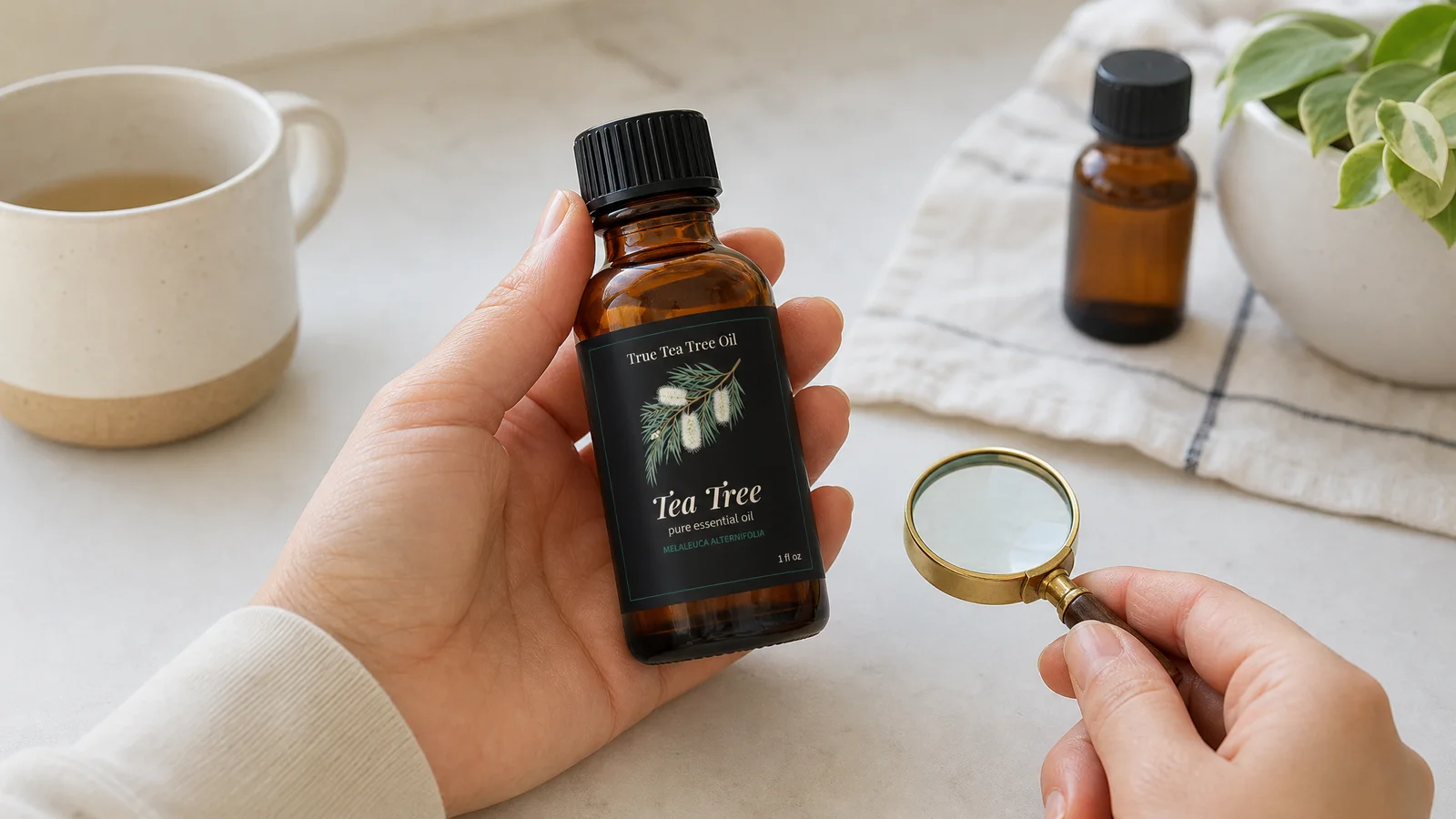
Once the laundry is clean and dry, scent is a pleasure of its own. We sell two tea tree essential oils, both Melaleuca alternifolia, with a green, camphorous aroma, and some people like a hint of it around a linen cupboard. A suggestion, not a tested method: put a drop or two on a cotton ball or a scrap of cloth and tuck it in a closet or the gym bag, away from skin, children and pets. We do not claim it removes or prevents odor. It is a fragrance on top of a properly washed, properly dried towel.
A few cautions keep it pleasant:
- Oil does not mix with water. The standard tea tree review notes its lipophilic nature causes miscibility problems in water-based products, so drops poured into the drum will not disperse evenly and may sit in spots on the fabric.
- Keep neat oil off clothes that touch skin. Our guidance is to dilute to 0.5% to 2% in a carrier oil for skin, and fabric that sits against you for hours is not a place for concentrated oil.
- Keep the bottle capped, cool and dark. Oxidized oil is more likely to irritate.
- Keep it away from pets, who sleep in towel piles. Ask a veterinarian about any pet question.
The aroma-first approach also fits the scent notes we list: crisp and green, with lavender, lemon, rosemary, eucalyptus and peppermint named as good partners. You will find those at a pharmacy or craft shop; we sell only tea tree.
What a scented linen cupboard feels like
If you do add a drop of tea tree to a cotton ball in the linen cupboard, notice how it changes the space when you open the door. There is a bright, green, camphorous lift first, and then it fades into the background within a few days. That is the nature of a top note, and it is why a fresh cotton ball every week or so does more than a heavier hand with the bottle.
Keep the cotton in a small dish or tin and set it on a shelf where it will not touch the towels, since the oil can mark fabric. A high shelf also keeps it where children and pets cannot reach it.
For related reading, see cleaning with tea tree oil, the moisture and mold basics and storing tea tree oil.
Think of it as two layers. The first is dryness: a towel that dries between uses starts out ahead, and the studies point to damp fabric as where trouble begins. The second is the scent you choose, which is simply a matter of taste. A towel that smells fresh because it is dry is hard to beat, and a hint of something green is a pleasant extra.
Tea Tree Essential Oil
Tea Tree Essential Oil from our own shop, in sizes from 0.5 oz to bulk.
From $10.99
Shop Now →Sources & Further Reading
- "A Comprehensive View of Microbial Communities in the Laundering Cycle Suggests a Preventive Effect of Soil Bacteria on Malodour Formation." Microorganisms, 2022
- "Laundry Hygiene and Odor Control: State of the Science." Applied and Environmental Microbiology, 2021
- Carson CF, Hammer KA, Riley TV, "Melaleuca alternifolia (Tea Tree) Oil: a Review of Antimicrobial and Other Medicinal Properties." Clin Microbiol Rev, 2006
- de Groot AC, Schmidt E, "Tea tree oil: contact allergy and chemical composition." Contact Dermatitis, 2016