Tea Tree Oil in Shampoo: Limits, Drops and Wash Day
Tea tree oil turns up on plenty of shampoo labels, which makes it tempting to add a few drops to your own bottle. It is a strong, concentrated oil, though, and the people who set limits for it have chosen small numbers. Knowing those numbers first makes wash day a lot easier to plan.

Tea Tree Essential Oil
Our own Tea Tree Essential Oil, in sizes from 0.5 oz to bulk.
From $10.99
Shop Now →What the limits look like
The European Commission's scientific committee on consumer safety reviewed tea tree oil in 2025 and considered it acceptable in four kinds of product, up to 2.0% in shampoo, 1.0% in shower gel, 1.0% in face wash and 0.1% in face cream. The pattern is easy to read: the longer a product stays on the skin, the lower the ceiling. A shampoo rinses off in a minute or two, so it gets the highest figure. A leave-on cream gets the lowest.
The committee attached conditions. The oil's composition has to conform to the international standard ISO 4730:2017, the products are for adults, and sprays or aerosols are left out because of inhalation. It also describes tea tree oil as a moderate skin sensitiser, which is a good reason to take the patch test seriously.
Our own guidance for skin is to dilute our oils to 0.5% to 2% in a carrier oil and patch test first. That is a leave-on recipe, a different thing from a rinse-off shampoo. We start at the low end, and for anything near the face the committee's 0.1% leave-on figure is a reason to go lighter still.
The drops, worked out
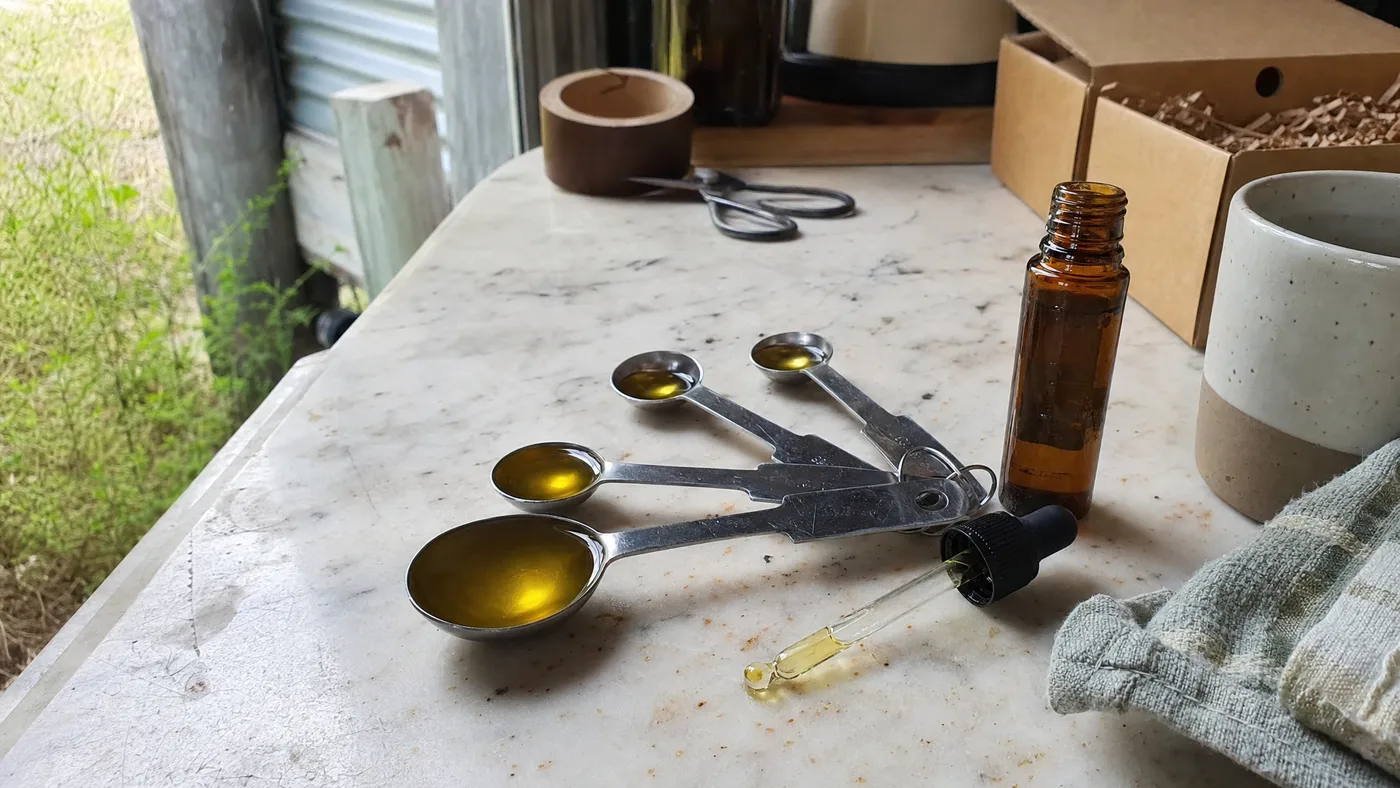
This is arithmetic, not a recipe from us. It assumes about 20 drops to a millilitre (droppers vary) and uses the density printed on the Certificate of Analysis for one batch of our Australian oil, 0.896 g/ml. We treat shampoo as roughly 1 g per ml.
| Amount of shampoo | Concentration | Oil, roughly |
|---|---|---|
| 250 ml bottle | 2.0% (the shampoo ceiling) | about 112 drops |
| 250 ml bottle | 1.0% | about 56 drops |
| 250 ml bottle | 0.5% | about 28 drops |
| 10 ml for one wash | 1.0% | about 2 drops |
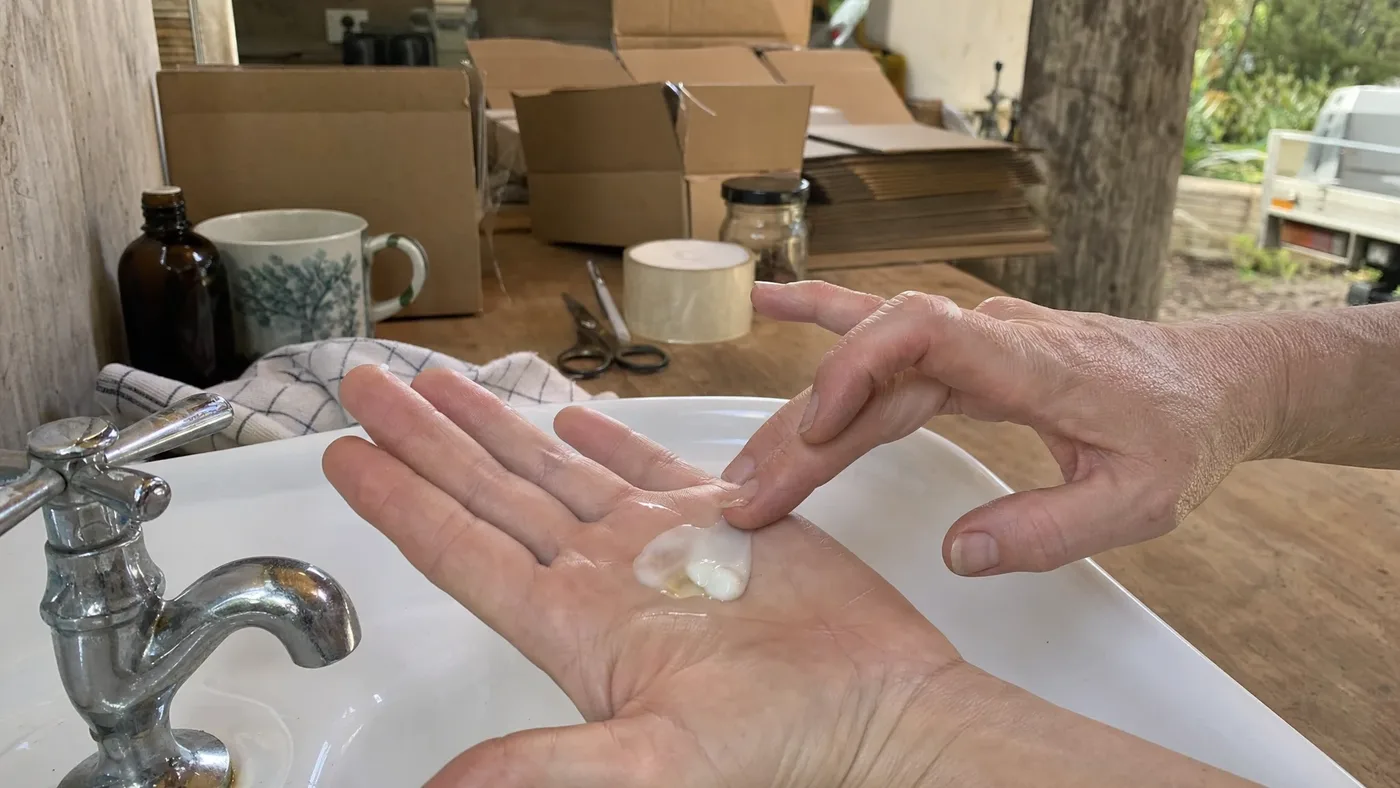
Two drops for one wash is the number to remember. Oil and water do not mix, a point the standard tea tree review makes in plain words: the oil's lipophilic nature causes miscibility problems in water-based products. Drop a whole bottle's worth into the shampoo and it will tend to float and separate, so the first pumps carry more than the last. Stirring a measured amount into a palmful, lathering and rinsing with your eyes closed keeps the dose where you meant it to be. If your shampoo already lists tea tree oil, remember you are adding to what is there.
What the well-known trial actually tested
The study people quote most is a 2002 trial of 126 people aged 14 and over with mild to moderate dandruff. They used a 5% tea tree oil shampoo daily for four weeks against a placebo shampoo. Scores on the severity scale improved by 41% in the tea tree group and 11% in the placebo group, and no adverse effects were reported.
It is a useful study to know about, but it describes one finished product, at 5%, which is more than twice the European ceiling for a shampoo, and it measured scalp flaking rather than the hair itself. We do not claim our oil does anything for scalp or hair. If flaking, redness or soreness sticks around, a dermatologist is the right person to ask, since several scalp conditions look alike.
Freshness belongs in the sum
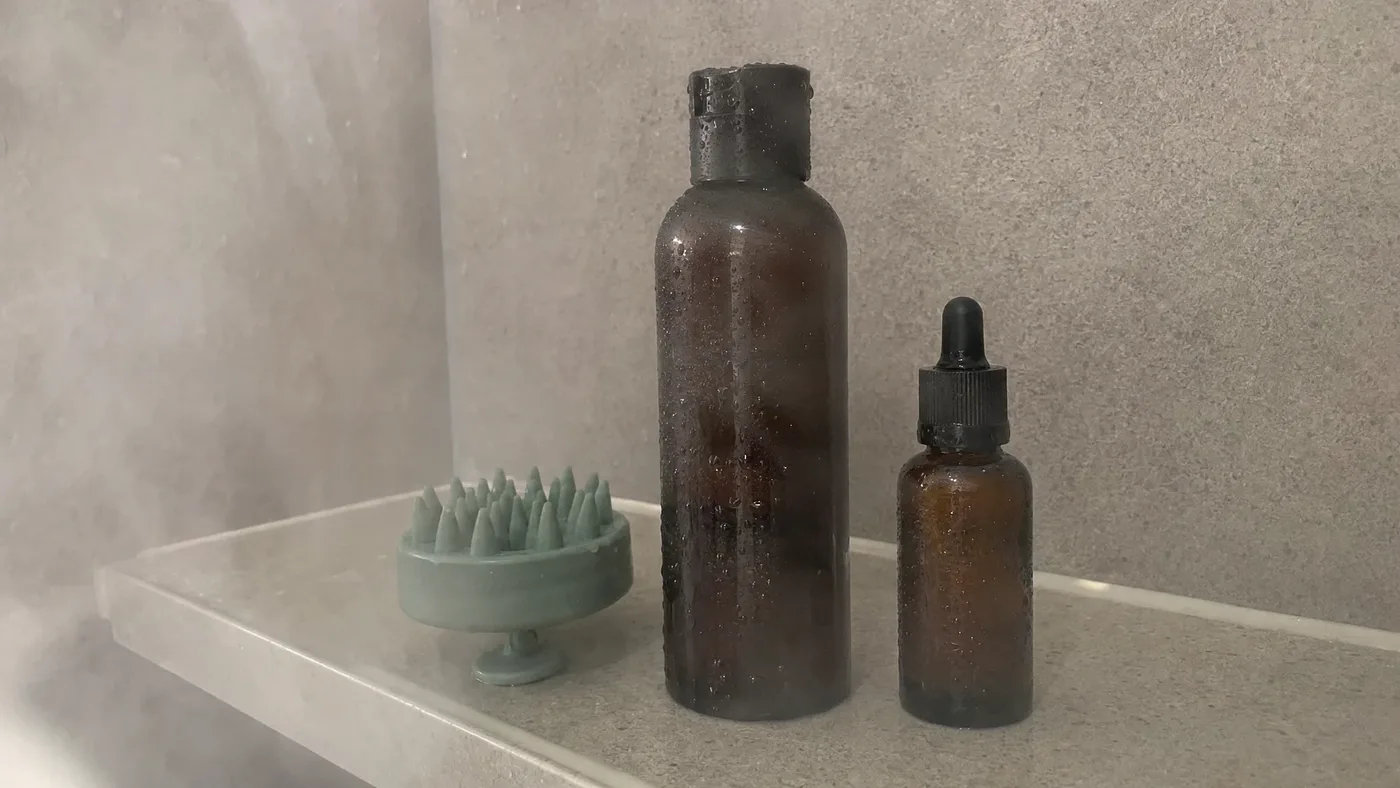
A bottle's age matters because tea tree oil changes with air, light and warmth. Work from the 1990s found that freshly distilled oil was a weak sensitiser while oil left in light and air was considerably stronger, and a 2016 review reports that fresh oil sensitises only weakly to moderately, with oxidation making reactions more likely and most reported cases coming from the neat oil. So a tightly capped bottle kept somewhere cool and dark is part of using it well, and a steamy bathroom shelf is the wrong home for it. We list a typical unopened shelf life of 2 to 3 years for our Australian oil and 1 to 2 years sealed for our South African oil; our guide to storing tea tree oil covers the rest.
Small habits that help on the day
Measure before you pour. A small cup or a spare bottle, clearly labelled, makes it easy to stir the oil into one wash's worth of shampoo, and a labelled container means nobody mistakes it for something else. Keep the oil bottle itself in a cool, dark cupboard outside the steam if you can. Rinse well with your eyes closed, and wash your hands afterwards, because the oil is concentrated and fingers carry it to the eyes surprisingly easily.
Who should sit this one out
The committee's figures are for adults, so ask a pediatrician about children. If you are pregnant or nursing, check with your doctor first. Skip it if you have reacted to tea tree oil or fragrance before, or if your scalp is broken or sore. Keep the open bottle where pets and children cannot reach it, and talk to a veterinarian about any pet question.
Before you start, run the 48-hour patch test, then see the drops-per-bottle guide for more ratios, or how two tea tree shampoo labels read. Because the committee's limits assume oil that meets ISO 4730, the practical step is knowing your oil's composition. The Certificate of Analysis for our Australian oil gives density, refractive index and optical rotation for one batch; if you need GC-MS for a formulation, ask us in writing through our contact page before ordering.
Tea Tree Essential Oil
Tea Tree Essential Oil from our own shop, in sizes from 0.5 oz to bulk.
From $10.99
Shop Now →Sources & Further Reading
- Scientific Opinion on Tea Tree Oil (CAS/EC No. 68647-73-4 / 285-377-1), SCCS/1681/25, final version, Scientific Committee on Consumer Safety, European Commission, 2025
- Satchell AC et al., "Treatment of dandruff with 5% tea tree oil shampoo." J Am Acad Dermatol, 2002
- Carson CF, Hammer KA, Riley TV, "Melaleuca alternifolia (Tea Tree) Oil: a Review of Antimicrobial and Other Medicinal Properties." Clin Microbiol Rev, 2006
- Hausen BM et al., "Degradation products of monoterpenes are the sensitizing agents in tea tree oil." Am J Contact Dermat, 1999
- de Groot AC, Schmidt E, "Tea tree oil: contact allergy and chemical composition." Contact Dermatitis, 2016