Tea Tree Oil Cleaning Spray Ideas, Room by Room
Open a bottle of tea tree oil over a bucket of mop water and the whole room changes: sharp, green, a little camphorous, the smell of a place that has been properly looked after. That scent is what tea tree oil brings to the cleaning caddy, and it is a good enough reason to keep a bottle there. The scrubbing is done by the vinegar, the soap and the elbow grease. The oil is the finishing touch.

Tea Tree Essential Oil
Our own Tea Tree Essential Oil, in sizes from 0.5 oz to bulk.
From $10.99
Shop Now →Where scent ends and disinfecting begins
We sell tea tree oil as an aromatic oil, and we hold no EPA registration for it, so we do not present it as a disinfectant or a sanitizer. EPA treats disinfectants as pesticides and identifies each registered product by its registration number; the label also gives a contact time, and the surface has to stay visibly wet for that whole period. If a job needs real disinfecting, such as a board that has held raw poultry, reach for a registered product and follow its label. The blends below are for the ordinary cleaning where a fresh scent is the point.
Mixing it so it actually mixes
Tea tree oil is only sparingly soluble in water, so in a spray it floats. Shake the bottle before every use. The drop counts in this guide are arithmetic on a rough 20 drops to the millilitre, and they are formulations built to be light, not recipes we have a measured result for. Mix small batches in a clean spray bottle, label them with the date, and plan to use them up within a couple of weeks, since homemade water-based sprays have no preservative.
Kitchen: the everyday spray
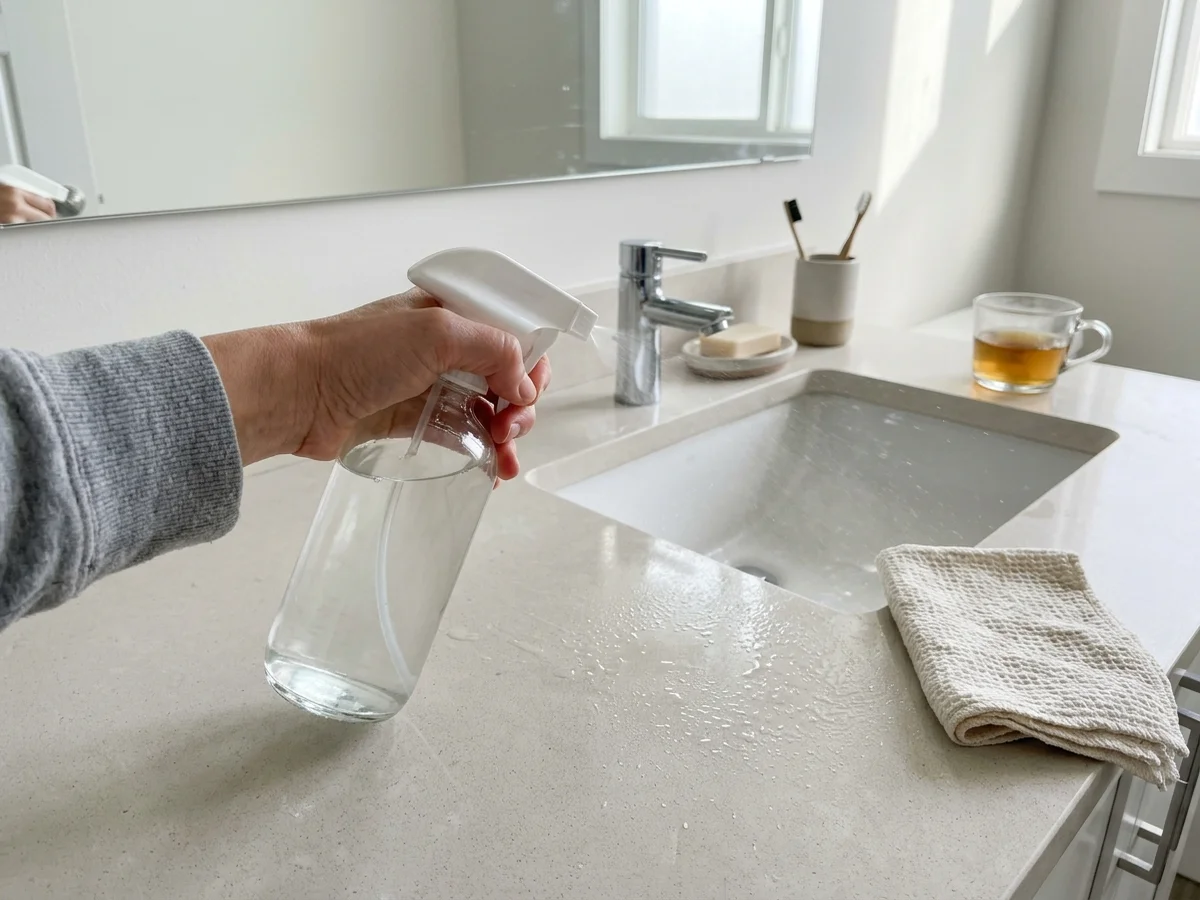
Combine one cup of water, one cup of white vinegar and about 15 drops of tea tree oil in a vinegar-safe bottle. That works out to well under a fifth of a percent oil by volume, which is plenty for scent. Spray, give greasy spots a minute, and wipe. Choose either vinegar or soap as the base for a bottle. Vinegar is acidic, and acid and soap react to form a curdled film, so mixing the two gives you a worse cleaner.
Stone counters: soap instead of vinegar
Vinegar reacts with the calcium carbonate in marble and limestone and dulls the surface, so stone counters get the soap version: two cups of water, a tablespoon of liquid castile soap and about 10 drops of oil. Test it on a hidden corner first, and rinse with a damp cloth afterward.
Bathroom: tile, fixtures and drains
For tile and chrome, the kitchen formulation with up to 20 drops works well. For grout, stir a little baking soda and castile soap into a paste, add a few drops of oil, and work it in with a brush. A drain freshener is simple: half a cup of baking soda down the drain, then half a cup of vinegar with five drops of oil stirred in, followed by hot water after a few minutes.
Floors and laundry
A gallon of warm water with a quarter cup of vinegar or castile soap and 10 to 15 drops of oil will scent a sealed hard floor. It is the one place we would skip entirely if there is a cat in the house, because cats groom their paws and tea tree oil can be harmful to them; keep it away from all pets and ask your veterinarian about any exposure. For the towel basket and gym bag, see tea tree oil in the laundry, and for what to expect on damp surfaces read tea tree oil for mold.
Little habits that make the caddy nicer to use
Start with one room, not all of them. Make a small bottle of the kitchen spray, use it for a week, and you will know whether you like the scent in your own house before you mix more. You will notice that the sharp vinegar smell goes first, and then a faint green note lingers in the room for a little while.
Label every bottle with what is in it and the date you mixed it, and keep the labels where you can read them. A spray bottle with no label is a hazard in a house with children, and a bottle you cannot date is one you will be tempted to keep too long.
Test a new mix on a hidden spot before you use it on a finished surface, and keep tea tree oil off anything you would hate to mark: painted trim, some plastics, lacquered wood. A damp cloth and a quick wipe-down after spraying is a good habit for any surface.
Handle the concentrate with care
Keep the bottle away from eyes, children and pets, ventilate the room while you clean, and wash your hands after handling the concentrated oil. Do not swallow it, and if it is swallowed or gets in an eye, call a poison control center or a doctor. Our dilution guide explains why the concentrate should not go on bare skin, and the everyday uses guide has more ideas for around the house. We sell the oil only; vinegar, castile soap, baking soda and spray bottles come from the grocery or hardware store.
Think of tea tree oil as the last note of a good clean: the surface does the work, and the scent tells you the job is done.
Tea Tree Essential Oil
Tea Tree Essential Oil from our own shop, in sizes from 0.5 oz to bulk.
From $10.99
Shop Now →Sources & Further Reading
- Selected EPA-Registered Disinfectants, US EPA
- Carson CF, Hammer KA, Riley TV. Melaleuca alternifolia (Tea Tree) Oil: a Review of Antimicrobial and Other Medicinal Properties, Clinical Microbiology Reviews, 2006