DIY Tea Tree Deodorant Balm: A 15-Minute Recipe
A deodorant balm is one of the friendliest first projects for tea tree oil: three pantry-style ingredients, a small pan, a jar, and a scent that is crisp, green and a little camphorous. It is also a good place to be careful, because underarm skin is thin, often freshly shaved, and meets the product every day. So this formulation keeps the oil light.

Tea Tree Essential Oil
Our own Tea Tree Essential Oil, in sizes from 0.5 oz to bulk.
From $10.99
Shop Now →What this is, and what it is not
This is a deodorant in the plain sense: it scents. It is not an antiperspirant and nothing in it is meant to change sweating. FDA's guidance on cosmetic labeling says a product promoted to change the body's structure or function, skin included, is a drug in the eyes of the law, so we keep the claims where they belong. The pleasure here is a dry-feeling balm and a clean aroma.
The formulation
This is worked out from published guidance and kitchen arithmetic, not a recipe we have a result for. It makes about 70 g, enough for a 2-ounce jar:
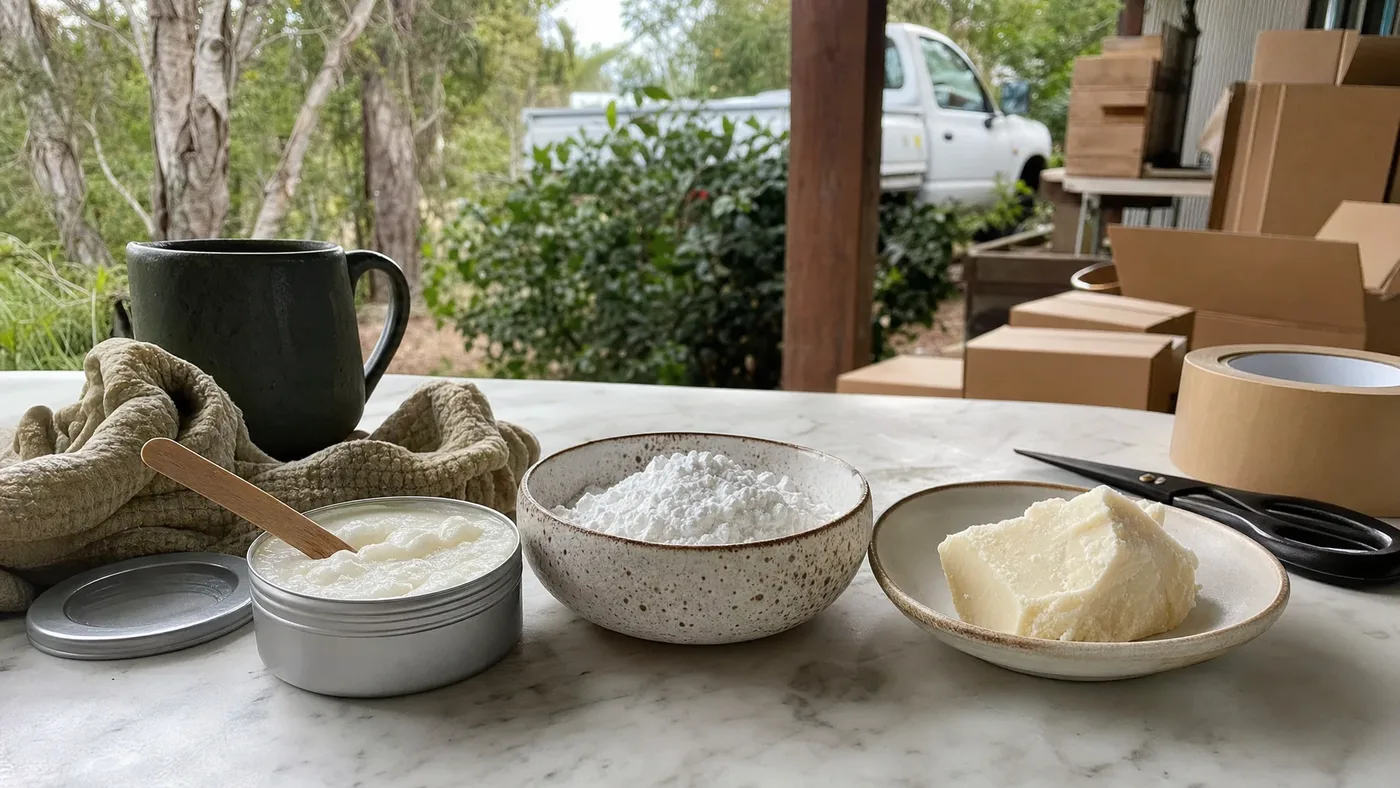
- 40 g coconut oil, the main fat, soft and glidey on warm skin
- 15 g shea butter, to firm the balm so it holds its shape
- 15 g arrowroot powder, which gives the balm a drier, less greasy feel
- Tea tree oil, 4 to 8 drops, added at the end
We leave baking soda out. It is alkaline, and a study of 330 people found natural skin surface pH averages about 4.7, with skin below pH 5.0 showing better barrier function and moisture. Underarm skin works hard enough without being pushed the other way. We do not sell coconut oil, shea or arrowroot; a grocery, pharmacy or craft shop has them.
Why so few drops
The only leave-on figure in the European Commission's 2025 opinion on tea tree oil is 0.1% in face cream, and that opinion, which covers adults and oil conforming to ISO 4730:2017, says nothing about underarm products. Our general guidance for tea tree oil on skin is to dilute to 0.5% to 2% in a carrier, and with a daily leave-on product in a sensitive area, we begin at the bottom of that range. Arithmetic: 0.5% of 70 g is 0.35 g of oil, a little over a third of a millilitre, or about 8 drops at roughly 20 drops to the millilitre; 0.25% is about 4 drops. We would start with 4 and add more only if your skin is calm after a week or two. A scale that reads to a tenth of a gram makes this easy, though counting drops works.
Gathering what you need
Everything on the ingredient list is simple to find. Beyond the ingredients, set out a heatproof bowl, a small pan with an inch or two of simmering water, a spoon or small whisk, a kitchen scale and a clean 2-ounce jar with a lid. Wash and dry the jar well, since a damp jar can undo the balm's good texture. Having it all laid out before you start is what makes this a 15-minute project rather than a scramble.
Method
- Melt the coconut oil and shea butter together in a heatproof bowl over barely simmering water until liquid, not hot.
- Take the bowl off the heat and whisk in the arrowroot until smooth.
- Let the mixture cool until it is just warm. Tea tree oil is volatile, and a hot base will carry some of the aroma into the air.
- Stir in the drops, then pour into a clean jar and let it set at room temperature, or for a little while in the fridge.
Warm a pea-sized amount between your fingertips and smooth it on. In a hot room the balm will soften, and a cooler spot will firm it up again.
Texture troubleshooting
Every kitchen is different, so the first batch may need a small adjustment. If the balm feels too soft in your hands, a little more shea will firm it. If it feels stiff, a touch more coconut oil will loosen it. Make the change in the next batch, in small steps, and write the amounts down so you can repeat the version you like. You will notice that the balm softens in a warm bathroom and firms up again in a cool cupboard, which is just how fats behave.
Keep the jar lidded and away from heat. A small jar is easier to use up while it is still pleasant than a large one.
Patch test, then be gentle
Put a little of the finished balm on the inner forearm and leave it for 48 hours before it goes anywhere near the underarm; our guide to patch testing tea tree oil shows what to look for. Skip it on freshly shaved or nicked skin, and stop if irritation appears. Use fresh oil, since oxidized tea tree oil is more likely to cause reactions, as our storage guide explains. If you are pregnant, nursing or managing a skin condition, ask your doctor first, and this balm is not meant for children. Keep the jar and the oil away from pets, and ask a veterinarian if one has been exposed.
If you make the balm as a gift, tuck in a card with the date, the ingredients and a short reminder to patch test before using it. People appreciate knowing exactly what is in a jar, and it saves the recipient from guessing.
For other ways to use the oil safely, our dilution guide covers ratios and carriers. A small jar, a light hand with the oil and a patient patch test make a deodorant balm you can feel good about.
Tea Tree Essential Oil
Tea Tree Essential Oil from our own shop, in sizes from 0.5 oz to bulk.
From $10.99
Shop Now →Sources & Further Reading
- Cosmetics Labeling Claims, FDA
- SCCS - Scientific Opinion on Tea Tree Oil (CAS/EC No. 68647-73-4 /285-377-1), European Commission
- Lambers H, Piessens S, Bloem A, Pronk H, Finkel P. Natural skin surface pH is on average below 5, which is beneficial for its resident flora, International Journal of Cosmetic Science, 2006