Tea Tree Foot Soak: How to Mix It Properly
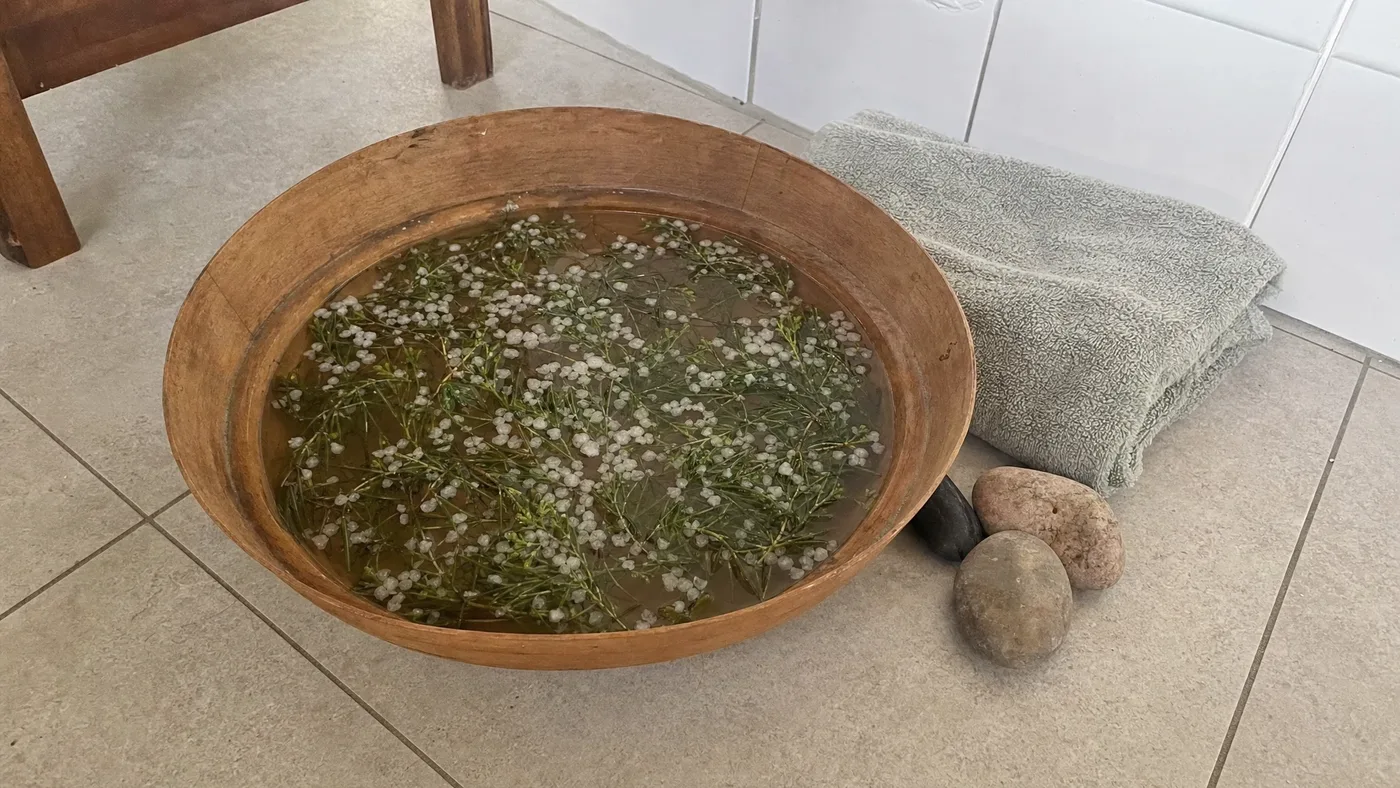
The best part of a tea tree foot soak is the first lungful: a warm basin, a crisp green steam rising off it, and fifteen minutes with nowhere to be. The way you mix it decides whether that scent spreads evenly through the water or sits in beads on top, so we start there.

Tea Tree Essential Oil
Our own Tea Tree Essential Oil, in sizes from 0.5 oz to bulk.
From $10.99
Shop Now →Why the oil should never go in the water first
Oil and water do not mix. Tea tree oil is lighter than water and floats in small beads, and those beads drift until they land on a foot at full strength. Epsom salt, which dissolves happily in water, does nothing to change that, so a recipe that lists the salt and the oil in the same breath is slightly misleading. The fix is to put the oil into something first, which keeps any droplet that touches your skin diluted.
Here is the formulation we would follow, built from our dilution guidance and nothing more:
- A basin of comfortably warm water, about half full, with half a cup of Epsom salt stirred in.
- In a small dish, stir 3 to 6 drops of tea tree oil into one tablespoon of a carrier oil, or into a teaspoon of unscented liquid castile soap.
- Pour the blend in and swirl it through with your hand before your feet go in.
The arithmetic: a tablespoon is about 15 ml, and at roughly 20 drops to a millilitre (a rough convention, since droppers vary), 3 drops is about 1 percent and 6 drops about 2 percent. That keeps the carrier blend inside our 0.5% to 2% guidance for skin before it meets the water. The carrier will still float as a thin film, and soap helps spread the oil through the basin, since soap molecules are built to sit between oil and water. We reason that a soap-based blend spreads more evenly than a carrier alone. Both ingredients, along with the Epsom salt, are easy to find at a grocery, pharmacy or craft shop, since we sell tea tree oil only. Our carrier oil comparison helps with the choice, and the dilution guide shows the percentages for other jobs.
The fifteen minutes
Fifteen to twenty minutes is plenty. Keep the water comfortably warm rather than hot; test it on the inside of your wrist. A towel within reach before you sit down saves a wet-footed hunt afterwards. Because a film of oil makes a basin and the floor around it slippery, step out slowly and hold on to something steady.
When you finish, dry carefully, pressing the towel between each toe in turn, since that skin stays damp longest. A pumice stone works best while skin is still soft from the water. Then slip into clean, dry socks. A patch test on a small area of skin is a good idea before the first soak, and our 48-hour patch test steps show how. A 2016 review of contact allergy found that tea tree oil has caused more published reactions than any other essential oil, with most coming from the neat oil, which is why we are so firm about dilution.
If you like a rounder aroma, lavender, lemon and eucalyptus are among the oils that blend well with tea tree. You would find those at a craft or supply shop, and any extra oil counts toward the same total, so keep the combined drops inside the carrier blend within the same 2 percent.
Set the scene
A foot soak feels better when everything is ready before you sit down. Lay a towel on the floor, put a chair or stool beside the basin, and bring a drink and something to read. Dim the lights if you like. When the setting is calm, fifteen minutes passes quickly and you stand up unhurried.
It also helps to wipe the basin first. A clean basin with no trace of cleaner or soap residue keeps the scent clear and means you start with plain warm water.
Who should skip the soak
If you have diabetes, check with your doctor or podiatrist first. The US National Institute of Diabetes and Digestive and Kidney Diseases advises people with diabetes to wash feet with soap in warm water and not to soak them, because soaking dries the skin. Anyone with cuts, cracked skin or persistent foot problems should also ask a doctor or podiatrist for advice, because a basin of essential oil is no stand-in for a diagnosis.
Afterwards, rinse the basin with warm water and a little mild soap so no oily film is left behind for the next person, and hang the towel to dry. It is a small tidy-up that keeps the bathroom pleasant and the next soak simple.
Habits that keep feet feeling fresh
A soak is a pleasant ritual, and the rest of the day makes it last. Rotating two pairs of shoes gives each pair a full day to dry before it is worn again, and putting on socks only after your feet are completely dry helps too. Those are our reasoned suggestions and not findings. The same crisp scent shows up in our deodorant guide, if you enjoy a theme.
Keep the bottle capped tightly in a cool, dark cupboard between soaks, and it will be ready for the next quiet evening.
Tea Tree Essential Oil
Tea Tree Essential Oil from our own shop, in sizes from 0.5 oz to bulk.
From $10.99
Shop Now →Sources & Further Reading
- Diabetes & Foot Problems, National Institute of Diabetes and Digestive and Kidney Diseases (NIDDK).
- Tea tree oil: contact allergy and chemical composition, Contact Dermatitis, 2016.