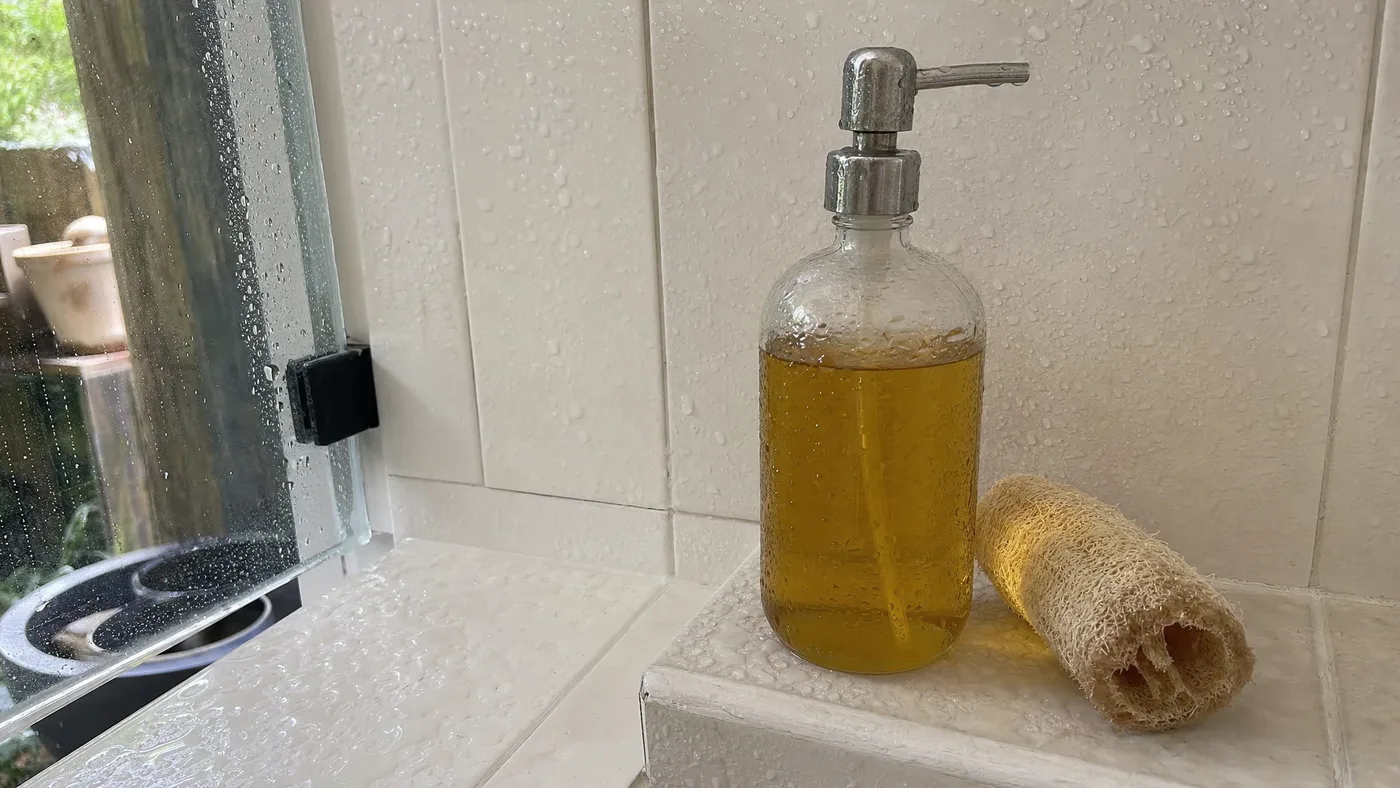
DIY Tea Tree Body Wash: Percentages, Drops, and Base
A recipe that says "20 drops of tea tree oil" tells you almost nothing until you know what the bottle holds. Twenty drops in a small travel bottle and twenty drops in a big pump bottle are very different washes. So we begin a body wash the way a formulator would: with a percentage, then work back to drops you can count.

Tea Tree Essential Oil
Our own Tea Tree Essential Oil, in sizes from 0.5 oz to bulk.
From $10.99
Shop Now →The number to anchor on
In October 2025 the European Commission's Scientific Committee on Consumer Safety finished its opinion on tea tree oil. It considered the oil safe up to 2.0% in shampoo, 1.0% in shower gel, 1.0% in face wash and 0.1% in face cream. The conditions matter. The opinion covers oil that conforms to ISO 4730:2017, adults only, and not aerosol or spray formats, and it says the oil's stability must hold in the finished product.
For a body wash, the shower-gel figure of 1.0% is the one to look at. We give our general skin guidance as 0.5% to 2% in a carrier oil, but a wash is a different product from an oil blend, so the top of that range does not belong here. Our suggestion for a body wash is 0.5%, with 1.0% as the outer limit. Because the committee's figure assumes a characterized oil, remember what we can show: the Certificate of Analysis we publish covers one batch of the Australian oil and lists density, refractive index and optical rotation. If you want composition figures or anything for the South African oil, ask us in writing through the contact page.
From percent to drops
Percent here means grams of oil per 100 grams of finished wash. The batch on our certificate has a relative density of 0.896, so a millilitre weighs about 0.9 g, and at a rough 20 drops to the millilitre the sums for a 250 g batch look like this:
| Share of batch | Oil in 250 g | About this many drops |
|---|---|---|
| 0.5% | 1.25 g | 28 |
| 1.0% | 2.5 g | 56 |
Droppers vary, so use the drop count as an estimate and weigh the oil if you have a small scale. It also shows why recipe numbers often mislead: 20 drops in a 12-ounce bottle of wash comes to well under half a percent.
The base matters more than the oil
A body wash is mostly water, and water is where trouble grows if nothing protects the product. A 2023 analysis of 140 online essential oil recipes noted that a common characteristic of most was the absence of any antimicrobial agents or antioxidants. A few tenths of a percent of essential oil is there for scent, so the sensible reasoning is to start from a ready-made unscented body wash base whose supplier says it is already preserved, and stir the oil in. Do not thin it with extra water, which dilutes the preservative along with the soap.
We do not sell bases, bottles or carrier oils; a soapmaking or cosmetic supply shop does, and their product pages can tell you the preservative system. Skin pH is the other thing to ask about. In a study of 330 people the natural skin surface pH averaged about 4.7, and skin below pH 5.0 showed better barrier function and moisture, with soaps among the products that shift it. A base that states a mildly acidic pH is an easy choice on that evidence.
What to expect from the scent
At these small shares, tea tree is a hint rather than a headline. You will notice the crisp, green, slightly camphorous note when you first pump the wash into your hands, and then it softens in the steam of the shower. If you were hoping for something that fills the whole bathroom, remember that a stronger scent is not worth pushing the percentage past the numbers above. A gentle aroma that is still there when you step out is a good result.
Many people find that a plain, lightly scented base lets the tea tree come through more clearly. A base with its own strong fragrance competes for attention and tends to blur the green note.
A weighed example
This is a formulation worked out from the figures above, not a recipe we have a result for. Weigh 250 g of unscented, preserved base into a clean bottle. Add 1.25 g of tea tree oil, about 28 drops. Because the oil floats, put the cap on and roll the bottle gently end over end rather than shaking it into foam, and give it another roll before each use. Patch test the finished wash on the inner forearm first, keep it out of eyes, and rinse well.
Tea tree oil can sensitize skin in some people (our post on using it undiluted explains how), so stay at the lower number if your skin is reactive, skip it for children, and check with a doctor if you are pregnant, nursing or managing a skin condition. If you also make shampoo, the shampoo ratio guide does the same sums by bottle size. For the safety logic behind a patch test, see how to patch test tea tree oil, and for a gentler start on the scent itself, what tea tree oil smells like.
Labeling and keeping the batch
Write the date, the weight of the batch and the percentage on a strip of tape on the bottle. A pump bottle that lives in a damp shower deserves a tidy label, since it is easy to forget when you mixed it. Make a small batch you will finish rather than a big one that sits for months, and keep any spare base capped and out of the steam. If the wash ever looks or smells different from how you made it, retire it and mix a fresh bottle.
Get the percentage right and the rest is simple stirring, with a shower that smells crisp and green.
Tea Tree Essential Oil
Tea Tree Essential Oil from our own shop, in sizes from 0.5 oz to bulk.
From $10.99
Shop Now →Sources & Further Reading
- SCCS - Scientific Opinion on Tea Tree Oil (CAS/EC No. 68647-73-4 /285-377-1), European Commission
- Couteau C, Diarra H, Lecoq M, et al. The Role of Essential Oils in Homemade Cosmetics: A Study of 140 Recipes, Journal of Clinical and Aesthetic Dermatology, 2023
- Lambers H, Piessens S, Bloem A, Pronk H, Finkel P. Natural skin surface pH is on average below 5, which is beneficial for its resident flora, International Journal of Cosmetic Science, 2006