How Much Tea Tree Oil in Melt-and-Pour Soap?
Melt-and-pour soap is a lovely way into soapmaking: no lye, no waiting weeks for a cure, just a block, a pan and a mold. It does leave you with one real decision, which is how much tea tree oil to stir in, and that is worth getting right because a bar is handled several times a day.

Tea Tree Essential Oil
Our own Tea Tree Essential Oil, in sizes from 0.5 oz to bulk.
From $10.99
Shop Now →What you are actually melting
A melt-and-pour block has already been made into soap by someone else, and you are re-shaping it and adding fragrance. FDA's definition of soap is specific: the bulk of the nonvolatile matter has to be an alkali salt of fatty acids, and the product has to be labeled, sold and represented solely as soap. Many blocks include glycerin and other ingredients, so whether yours meets that test is a question for its supplier. For a home maker the practical point is simpler: call it soap and leave out claims. Words like "antibacterial" or "for acne" on a label change what a product is in law, and we make no claim of that kind for our oil.
We sell tea tree oil only, in two origins, Australian and South African, both Melaleuca alternifolia, undiluted. A soapmaking supply shop has bases, molds and colorants. Cold-process soap, which starts from lye, has its own safety rules and is a separate project. You can see both in our shop, and our bulk page and guide to buying tea tree oil in bulk cover larger sizes for regular soap batches.
How much oil
No safety opinion we read covers bar soap itself, so we reason from the nearest rinse-off figures. In its October 2025 opinion, the European Commission's Scientific Committee on Consumer Safety considered tea tree oil safe up to 2.0% in shampoo and 1.0% in shower gel and face wash, for adults, for oil conforming to ISO 4730:2017, and not in sprayed formats. A bar is not a shower gel, because you hold the product itself, but contact time is similar. Our general guidance is 0.5% to 2% in a carrier oil with a patch test; for soap we suggest 0.5%, and we would not go above 1.0%.
Here is the arithmetic for a 454 g (16 oz) block, at the 0.896 relative density on the Certificate of Analysis we publish for one batch of the Australian oil and a rough 20 drops to the millilitre:
- 0.5%: about 2.3 g of oil, roughly 50 drops, or half a teaspoon
- 1.0%: about 4.5 g, roughly 100 drops, or a teaspoon
- 2.0%: about 9 g, roughly 200 drops, or two teaspoons, which is double the shower-gel figure, so we skip it
Droppers vary, so treat the counts as estimates. If you need composition information for the oil, ask us in writing through the contact page.
A weighed batch
This is a formulation worked out from the figures above, not a recipe we have a result for. It makes four bars of about 113 g.
- Weigh 454 g of unscented melt-and-pour base and cut it into small cubes so it melts evenly.
- Melt it gently in short bursts or over a pan of hot water, stirring until just liquid. Tea tree oil is volatile, so we would avoid overheating the base.
- Take it off the heat and let it cool a little. Weigh 2.3 g of oil, about 50 drops, into a small cup.
- Stir the oil in for a full minute, then pour into the mold.
- Let the bars set undisturbed, unmold, and wrap them if they will not be used soon.
Make the 0.5% batch first and try a bar yourself before thinking about a stronger one. If a bar smells faint after a few weeks, that is the nature of a volatile top note, not a reason to add more.
Scent, color and a little patience
Tea tree oil is a top note, which is a perfumer's way of saying you smell it first and it lets go first. In a bar, that means the bright, green, camphorous opening is strongest when you first unwrap it, and it settles into the soap as the weeks go by. If you like that first lift, keep finished bars wrapped or in a lidded container so the scent has somewhere to stay until you need it.
Keep the rest of the bar simple. A plain white or pale base lets the scent be the point, and a tiny pinch of a soap-safe green colorant is plenty if you want the bar to look the way it smells. Bases, colorants and molds come from a craft or soapmaking supply shop; we sell the oil only.
If you like blends, tea tree goes well with lavender, lemon, rosemary, eucalyptus and peppermint, all of which you will find at a craft shop or pharmacy. If you add one, count it in your total so the combined amount stays inside the same careful ceiling, and remember that a second oil changes the scent more than you expect, so begin with a very small share.
Write the oil amount and the date on a label for each batch. A week from now you will not remember whether the good bar was the half-percent one, and a note on the wrapper saves you guessing.
Keep it gentle
Use fresh oil; oxidized tea tree oil is the more likely to cause reactions, as our storage guide explains. Patch test the first bar's lather on your inner forearm, and keep soap out of eyes. Check with a doctor if you are pregnant, nursing or have a skin condition, and do not make it for children. Keep the oil and finished bars away from pets. For more melt-and-pour ideas, see nine places in your home for a drop of tea tree oil, and for ratios in other products, how to dilute tea tree oil.
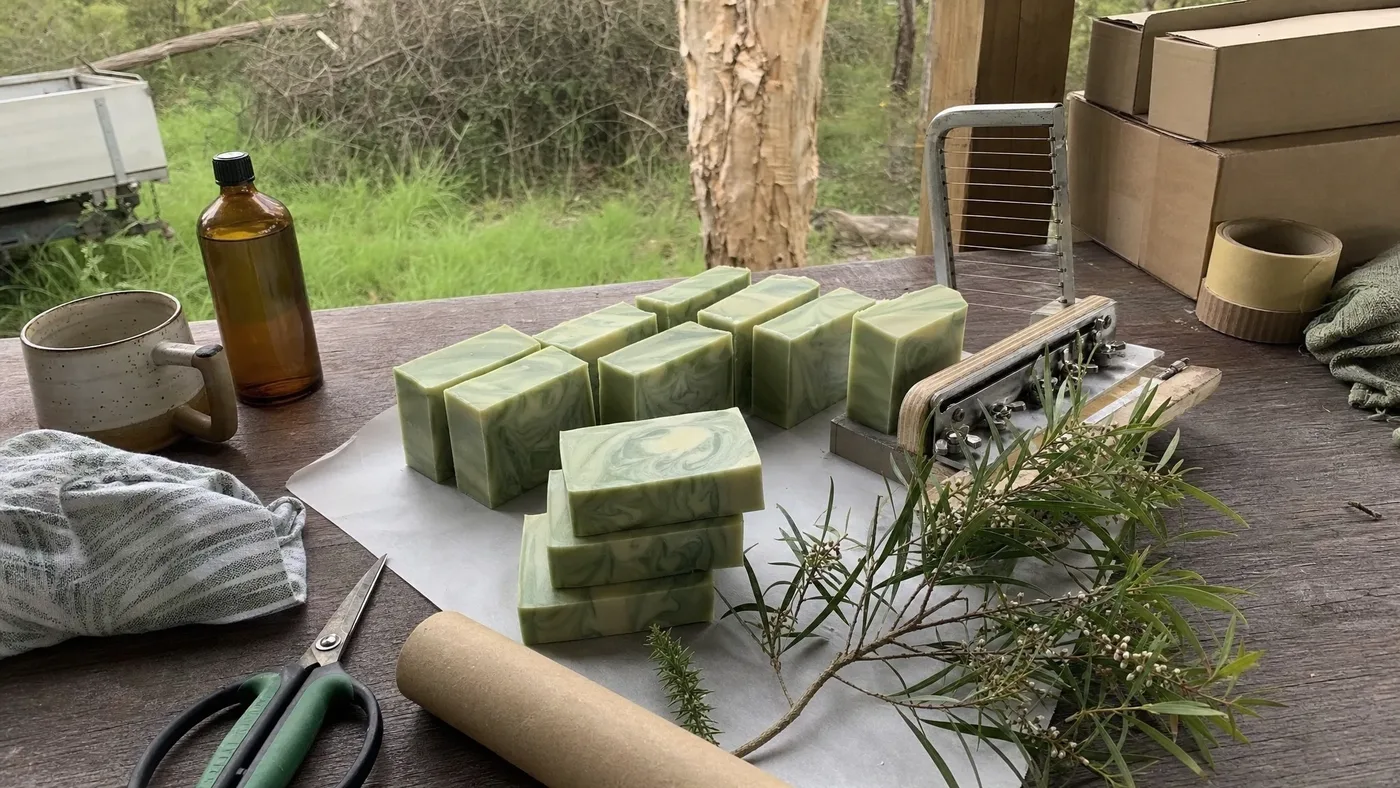
One careful number, a gentle stir, and you have a bar that smells like a walk past a stand of paperbark trees.
Tea Tree Essential Oil
Tea Tree Essential Oil from our own shop, in sizes from 0.5 oz to bulk.
From $10.99
Shop Now →Sources & Further Reading
- Is It a Cosmetic, a Drug, or Both? (Or Is It Soap?), FDA
- SCCS - Scientific Opinion on Tea Tree Oil (CAS/EC No. 68647-73-4 /285-377-1), European Commission
- Carson CF, Hammer KA, Riley TV. Melaleuca alternifolia (Tea Tree) Oil: a Review of Antimicrobial and Other Medicinal Properties, Clinical Microbiology Reviews, 2006