Swallowed Tea Tree Oil: What to Do and How to Prevent It
Tea tree oil is made for the outside of the body and the air of a room, and it should never be swallowed. If it has just happened, stop reading and call a poison center on 1-800-222-1222 in the United States, with the bottle in your hand. If the person collapses, has a seizure, has trouble breathing or cannot be woken, call 911 first. The rest of this page is for understanding and prevention.

Tea Tree Essential Oil
Our own Tea Tree Essential Oil, in sizes from 0.5 oz to bulk.
From $10.99
Shop Now →What the medical reports describe
Swallowed tea tree oil is rarely written up, which is partly why it deserves respect. Two case reports from the 1990s involve toddlers who got at a bottle of concentrated oil. A 23-month-old swallowed less than 10 mL of a commercial 100% melaleuca oil product, became confused and could not walk within 30 minutes, and was symptom-free within five hours. A 17-month-old who swallowed less than 10 mL developed unsteadiness (ataxia) and drowsiness. A 2006 review of the oil gathers the published poisonings in children and adults and reports that every patient responded to supportive care and recovered without apparent after-effects, with no human deaths reported in the literature it examined.
That is reassuring about the outcomes of the cases that were written up, and it is not a reason to relax. The pattern in every report is the same: a small amount of undiluted oil, a small child and a rapid effect on balance and alertness. None of these papers gives a dose that is safe, and nobody should treat "less than 10 mL" as a threshold. The sensible reading is the one the poison centers give: call, whatever the quantity, and let them judge it against age and weight.
Why a plant oil behaves like a concentrate
It is easy to assume that anything from a leaf is gentle. Steam distillation takes a large amount of leaf and condenses its aromatic compounds into a small bottle, so what comes out is far more concentrated than anything the plant itself would deliver. The 2006 review also lists animal data showing the oil can be toxic when swallowed, and the animals in it became lethargic and unsteady, which mirrors the toddler reports. Our reasoning from that is simple: the same concentration that makes a few drops go a long way in a diffuser or a diluted skin oil is what makes swallowing it a poison exposure.
"Just a drop in water" is still swallowing it
Recipes online sometimes suggest a drop of tea tree oil in a glass of water, a gargle or a mouthwash. Diluting in a drink does not turn the oil into food: the oil floats, and the first mouthful can carry more than you intended. We cover the mouth question in our piece on why we say keep it out of your mouth. Our own guidance for this oil is external use only: avoid internal use, dilute to 0.5% to 2% in a carrier oil for skin with a patch test first, and keep it away from eyes, children and pets. Our oils are sold as external-use essential oils, and nothing about them is meant for the kitchen.
If you are not sure what happened
Sometimes there is no clear moment, only a child with an open cap and an oily smell on their hands. Treat that the same way: do not wait for symptoms to appear. Call the poison center, say who it was, roughly how old or heavy they are and what the bottle says, and follow what they tell you. Do not try to make anyone vomit unless a professional tells you to.
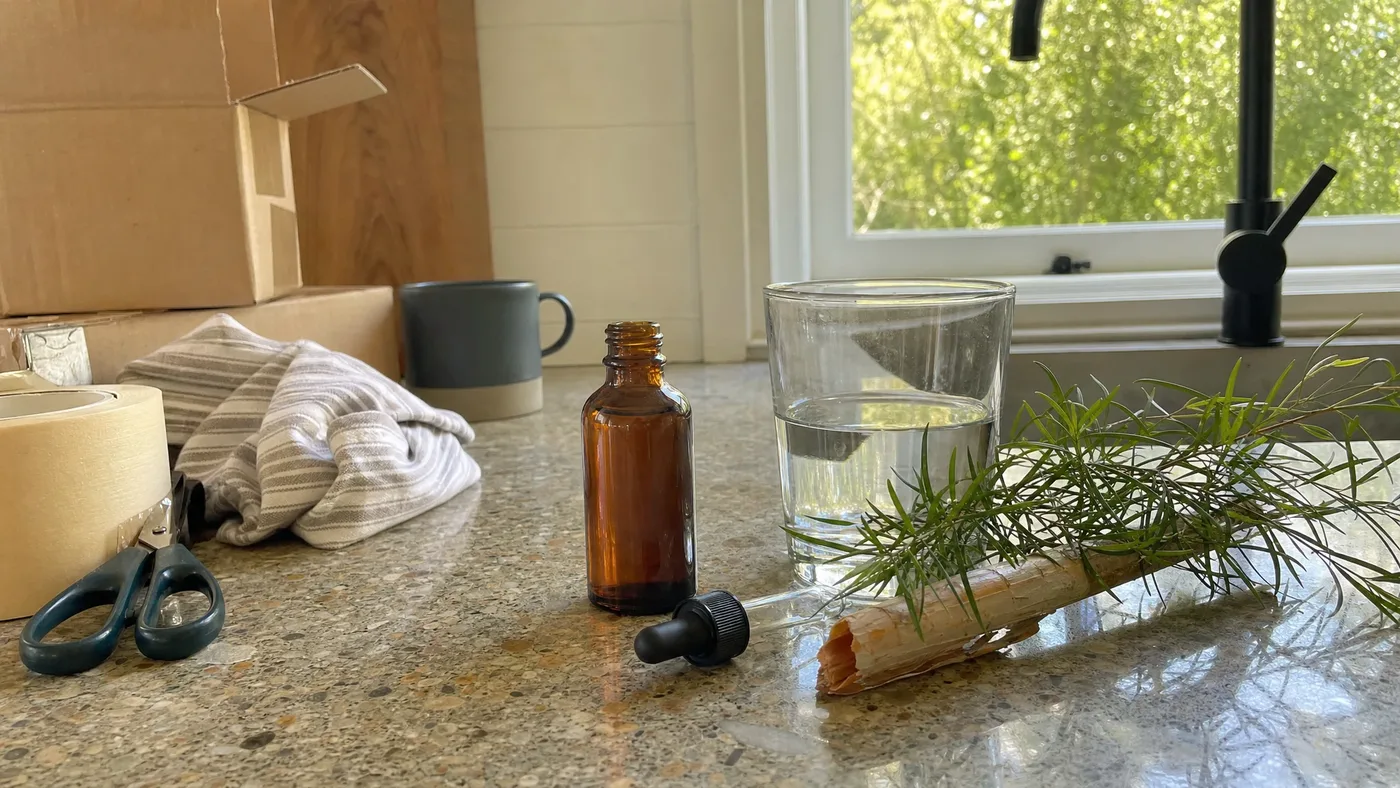
Having the bottle to hand matters because the person on the phone will want the name on the label. Ours reads Melaleuca alternifolia, along with the size, so keep the bottle or box rather than throwing it away in a panic.
Keeping the bottle out of reach
Most accidents are logistics, so this is where prevention pays off.
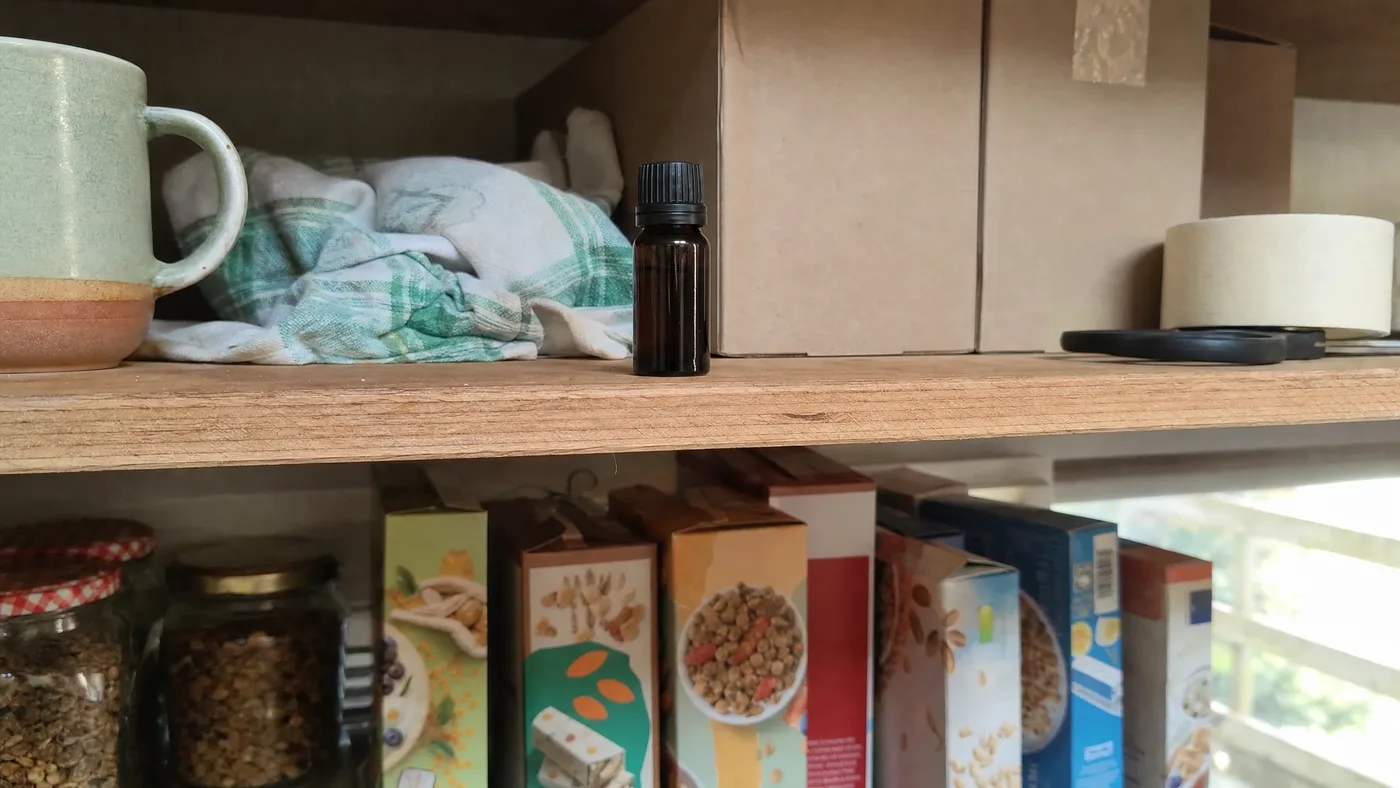
- Height and a closed door. A high shelf or a locked cabinet beats a bathroom counter. The two most likely places for a bottle to be used and left are the places toddlers reach.
- Original bottle, original label. Do not decant it into a drink bottle, a food jar or an unlabelled spray. If you make a diluted blend, label that container too.
- Do not rely on the cap. Child-resistant closures slow children down; they are not a guarantee, so pair them with out-of-reach storage.
- Remember pets. The same habits protect them, and our guides on dogs and cats explain how differently they respond.
If you are pregnant, nursing or managing a medical condition, speak to your physician before using essential oils at all, a line we repeat in our disclaimer. We sell an external cosmetic oil, and this page is not medical advice.
One more habit worth building
Put the phone number where you will see it. Saving 1-800-222-1222 as a contact called "Poison Control" takes ten seconds, and a magnet on the fridge takes less. A number that is already in your phone is one less thing to look up when you are anxious.
Visiting children are the other gap. A bag on the floor or a low guest-bathroom shelf is easy to overlook, so a quick look around before they arrive is worthwhile.
A bottle on a high shelf, in its own labelled container, is all this takes. If you ever need help, the number to remember is the same one at the top of this page.
Tea Tree Essential Oil
Tea Tree Essential Oil from our own shop, in sizes from 0.5 oz to bulk.
From $10.99
Shop Now →Sources & Further Reading
- Poison Control, "Poison Control | Your trusted resource"
- Jacobs MR, Hornfeldt CS, "Melaleuca oil poisoning", Journal of Toxicology: Clinical Toxicology, 1994
- Del Beccaro MA, "Melaleuca oil poisoning in a 17-month-old", Veterinary and Human Toxicology, 1995
- Carson CF, Hammer KA, Riley TV, "Melaleuca alternifolia (Tea Tree) oil: a review of antimicrobial and other medicinal properties", Clinical Microbiology Reviews, 2006