What Is Terpinen-4-ol? The Lead Compound in Tea Tree
Tea tree oil contains roughly a hundred different compounds, yet one of them gets its name on the quality sheet. Terpinen-4-ol is the lead note, the one chemists look for first, and it is a good key for understanding why the oil smells the way it does, why batches are comparable, and why a bottle that has been kept well behaves better than one that has not.

Tea Tree Essential Oil
Our own Tea Tree Essential Oil, in sizes from 0.5 oz to bulk.
From $10.99
Shop Now →A hundred compounds, one headline
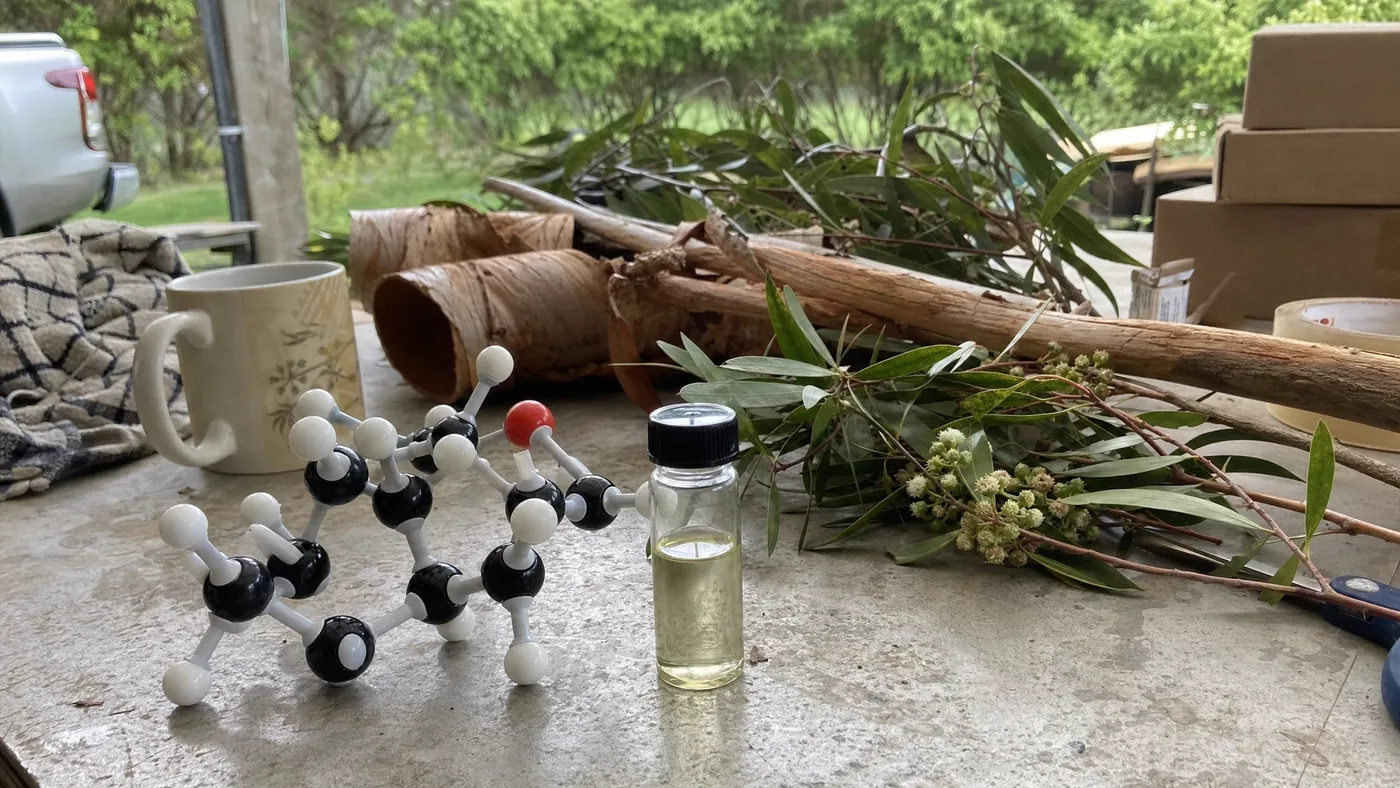
When researchers analysed more than 800 tea tree oil samples by gas chromatography, they found about a hundred components. Most appear in small amounts. The headline numbers belong to a handful of monoterpenes: terpinen-4-ol, then gamma-terpinene and alpha-terpinene, with smaller roles for terpinolene, p-cymene, alpha-terpineol and 1,8-cineole. Terpinen-4-ol is a monocyclic terpene alcohol, and PubChem's odor entry for it is a single word: pine. If you have ever smelled tea tree and thought of a clean, resinous, slightly medicinal green, that is it doing its work.
The industry standard for the oil, ISO 4730, was written around it. In the version summarised in a well-known 2006 review, terpinen-4-ol must be at least 30 percent and 1,8-cineole no more than 15 percent, with gamma-terpinene allowed between 10 and 28 percent. A 2024 European Food Safety Authority assessment of seven commercial batches shows how that plays out in practice: terpinen-4-ol ranged from about 37 to 42 percent, averaging 39.4, while cineole averaged only 2.4. The tight grouping is why two tea tree oils from different suppliers can be so similar to the nose.
Putting a name to the smell
You do not need a laboratory to appreciate what the lead compound does for the scent. Open a bottle and breathe in slowly. The first impression is a sharp, green, resinous brightness, with a gentler herbal note behind it. Our Australian oil is described as crisp, green and camphorous with a faint earthy undertone, and our South African oil as crisp and camphorous with a clean, fresh edge. Chemists would say you are meeting many compounds at once, but the one that leads the oil is the one most noses read as pine and herb.
Not every Melaleuca alternifolia is the same
The species has distinct chemical varieties. Researchers describe a terpinen-4-ol type, a terpinolene type and four types high in 1,8-cineole, and only the terpinen-4-ol type is used in commercial tea tree oil. That is why the Latin name alone does not tell you everything, and why the standard looks at composition. It is also a neat reminder that the chemistry belongs to the plant's genetics as much as to the distillery.
We sell two tea tree oils, one listed as Australian and one as South African, both Melaleuca alternifolia. The certificate of analysis we publish for one batch of the Australian oil lists its relative density, refractive index and optical rotation, which are physical checks that sit alongside composition. If you need a GC-MS report with percentages for a lot, ask us in writing through the contact page before you order.
What time does to the molecules
The terpinenes are the delicate part. Over storage, studies of the oil show p-cymene rising while alpha- and gamma-terpinene decline. Light, heat, air and moisture all push the change along. This matters for more than scent. The 2006 review notes that allergic reactions to tea tree oil have been linked mainly to oxidation products in aged or poorly stored oil, and Europe's Scientific Committee on Consumer Safety, which classes tea tree as a moderate skin sensitiser, stresses in its 2025 opinion that stability has to be maintained so the oil stays within the standard.
The everyday answer is simple: keep the bottle tightly capped in a cool, dark place, as we advise for both of our oils, and decant working amounts if you are using a large size. Our storage guide covers the details. A bottle whose smell has changed noticeably is best kept off skin.
Reading a report without a chemistry degree
If you ever receive a GC-MS report, a few habits make it readable. Find the batch or lot code first and check it matches your bottle. Then look for terpinen-4-ol near the top of the list, since it is the figure the standard cares about, and glance at the 1,8-cineole line to see that it is small. Do not worry about the long tail of tiny entries. If anything is unclear, ask the person who sent it to explain, in writing.
How it affects the way you use the oil
Terpinen-4-ol is only about 40 percent of the oil, so it is the whole mixture you are diluting. We recommend 0.5 to 2 percent in a carrier with a patch test first. The SCCS puts its maximums for finished cosmetics at 2 percent for shampoo, 1 percent for shower gel and face wash, and 0.1 percent for face cream, so we use the low end of our range for anything that stays on skin. How to dilute tea tree oil shows the arithmetic, and our comparison with eucalyptus shows how a different lead molecule changes the personality of an oil entirely.
Know the lead note, and the whole oil starts to make sense.
Tea Tree Essential Oil
Tea Tree Essential Oil from our own shop, in sizes from 0.5 oz to bulk.
From $10.99
Shop Now →Sources & Further Reading
- Melaleuca alternifolia (Tea Tree) oil: a review of antimicrobial and other medicinal properties, Clinical Microbiology Reviews, 2006
- Safety and efficacy of a feed additive consisting of an essential oil derived from leaves and terminal branchlets of Melaleuca alternifolia (Maiden & Betche) Cheel (tea tree oil) for use in all animal species (FEFANA asbl), EFSA Journal, 2024
- SCCS - Scientific Opinion on Tea Tree Oil (CAS/EC No. 68647-73-4 /285-377-1), European Commission, 2025
- Terpinen-4-ol (PubChem compound record, Odor section), National Library of Medicine