Tea Tree Oil in Skincare: Why the Dose Is So Small
The surprise in putting tea tree oil into a skincare routine is how little of it the regulators have in mind. We tend to think of this oil as something you add by the drop. The European Commission's scientific committee on consumer safety looked at it in 2025 and, for a face cream, landed on one tenth of one percent. That number changes how you think about every jar on your shelf.

Tea Tree Essential Oil
Our own Tea Tree Essential Oil, in sizes from 0.5 oz to bulk.
From $10.99
Shop Now →What the committee actually concluded
Its opinion considered tea tree oil safe in four specific cosmetic products, up to 2.0% in a shampoo, 1.0% in a shower gel, 1.0% in a face wash and 0.1% in a face cream. Three conditions come with that: the oil has to conform to the international standard (ISO 4730:2017), the products are for adults, and none of it applies to sprays or other formats that could put a mist in the air you breathe. The committee also described the oil as a moderate skin sensitizer and said its stability must be kept up in the finished product, because its composition can change with light, heat, air and moisture.
The pattern is easy to read. Products that rinse off can carry more. Leave-on products on the face carry far less. That tracks with a 2016 review of contact allergy, which found that most reactions came from applying the undiluted oil rather than from cosmetics, and that oxidation increases the oil's allergenic potency.
Turning percentages into drops
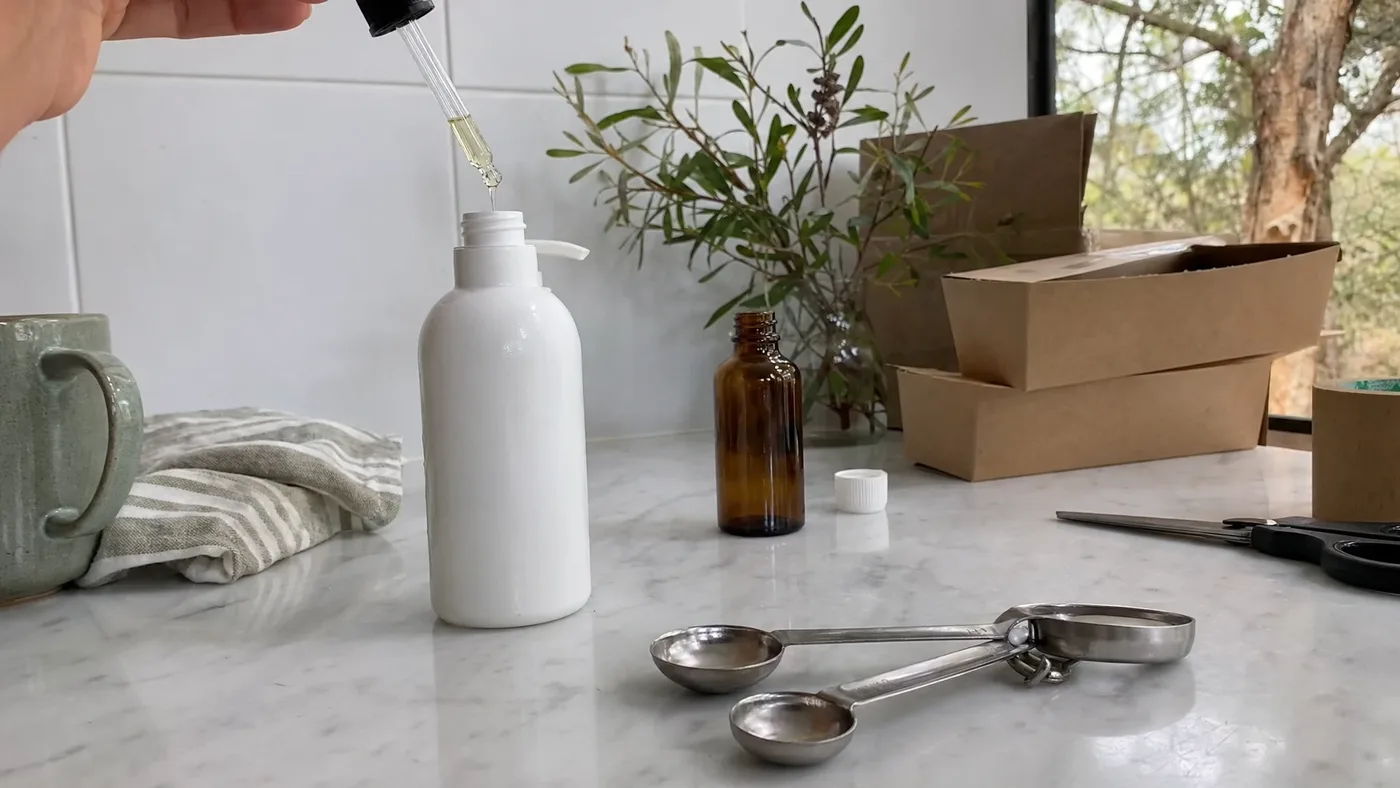
This is arithmetic, not a recipe. At the usual planning figure of about 20 drops to a milliliter, one drop is roughly 0.05 mL. That means one drop makes 0.1% in about 50 mL of a product (a little under 2 oz), 1% in about 5 mL (a teaspoon), and 2% in about 2.5 mL. Our own guidance for blending the oil into a carrier oil for skin is 0.5% to 2% with a patch test first. For anything that stays on your face we start well below that and follow the committee's lead: a single drop in a large jar, if at all, rather than a drop in your palm each morning.
Seen that way, a few drops stirred into a daily face moisturizer would sit far above the committee's figure. That is why we would rather you enjoy the oil where the dose is easy to control, in a rinse-off product you make from an unscented base, a diffuser, or a small amount of carrier oil blended for a patch of skin that is not your face.
Why oil and cream do not simply blend
Tea tree oil dissolves in oils, not in water. A 2006 review of the oil notes that its fat-loving nature causes miscibility problems in water-based products, and PubChem describes its main component, terpinen-4-ol, as slightly soluble in water and soluble in oils. In a water-based cream the oil can sit as droplets, so one scoop gets none and another gets a lot. Fixing that takes a proper emulsifier and a preservative system, which is a formulation job for a supplier or cosmetic chemist. A 2023 analysis of 140 homemade essential-oil recipes found that most called for no antimicrobial agent or antioxidant, which the authors flagged as a serious preservation problem. If you want to include tea tree oil in something with water in it, a ready-made product from a manufacturer is a safer route than a jar you spike yourself.
Carrier oils are the easy exception. Jojoba, sweet almond and similar oils mix fully with it, and you can buy them at a craft shop, pharmacy or grocery; we sell only the essential oils. A carrier blend is also easy to patch test, which is the step we would never skip. Our guides to diluting tea tree oil and patch testing cover both.
The pleasure of a small amount
There is something satisfying about a bottle that lasts. Because the sensible amounts are so tiny, the question shifts from "how much can I add?" to "how little will do?" Open the cap and you will notice the aroma is strong enough that a single drop makes itself known, which is a good reminder of why the numbers are small.
If you like keeping track, jot your routine in a notes app: the product, the date you added it and anything you changed. Two weeks later it is far easier to see what you are happy with than if you rely on memory.
Adding it to a routine sensibly
- Add one new thing at a time and give it a couple of weeks before judging or adding anything else. If skin reacts, you will know which product to blame. That is common sense rather than a finding.
- Choose rinse-off first. It matches where the higher numbers sit in the committee's list.
- Keep it in good shape. An old, oxidized bottle is a different starting point from a new one, so see our notes on storage.
- Stay alert if your skin is sensitive, stop if you notice irritation, and ask a dermatologist or pharmacist if you use prescription skin products.
One more thought from people who love the scent: if what you really want is the aroma on your bathroom shelf, you do not have to put it on your face at all. A short diffuser session in a ventilated room gives you the crisp, green character without any percentages to worry about. Follow your diffuser's own instructions, keep the bottle out of reach of children and pets, and ask a veterinarian first if animals share the space.
The takeaway is a pleasant one: a little of this crisp, green oil goes a long way, and the smart way to use it in skincare is to respect that.
Tea Tree Essential Oil
Tea Tree Essential Oil from our own shop, in sizes from 0.5 oz to bulk.
From $10.99
Shop Now →Sources & Further Reading
- Scientific Committee on Consumer Safety, "SCCS - Scientific Opinion on Tea Tree Oil (CAS/EC No. 68647-73-4 /285-377-1)", SCCS/1681/25, 2025
- de Groot AC, Schmidt E, "Tea tree oil: contact allergy and chemical composition", Contact Dermatitis, 2016
- Carson CF, Hammer KA, Riley TV, "Melaleuca alternifolia (Tea Tree) oil: a review of antimicrobial and other medicinal properties", Clinical Microbiology Reviews, 2006
- PubChem, "Terpinen-4-ol" (compound record CID 11230, Solubility section)
- Couteau C, Diarra H, Lecoq M, Ali A, Bernet M, Coiffard L, "The Role of Essential Oils in Homemade Cosmetics: A Study of 140 Recipes", Journal of Clinical and Aesthetic Dermatology, 2023