Is That Tea Tree Study Any Good? How to Read Research
Somewhere right now a bottle of tea tree oil is being sold with the words "studies show" next to it. There really are studies, plenty of them, but the phrase tells you almost nothing until you know what was tested, how much oil was used, and whether anyone has repeated it. Those three questions sort most of the hype from most of the substance.
Tea Tree Essential Oil
Our own Tea Tree Essential Oil, in sizes from 0.5 oz to bulk.
From $10.99
Shop Now →Was it a dish, an animal or a person?
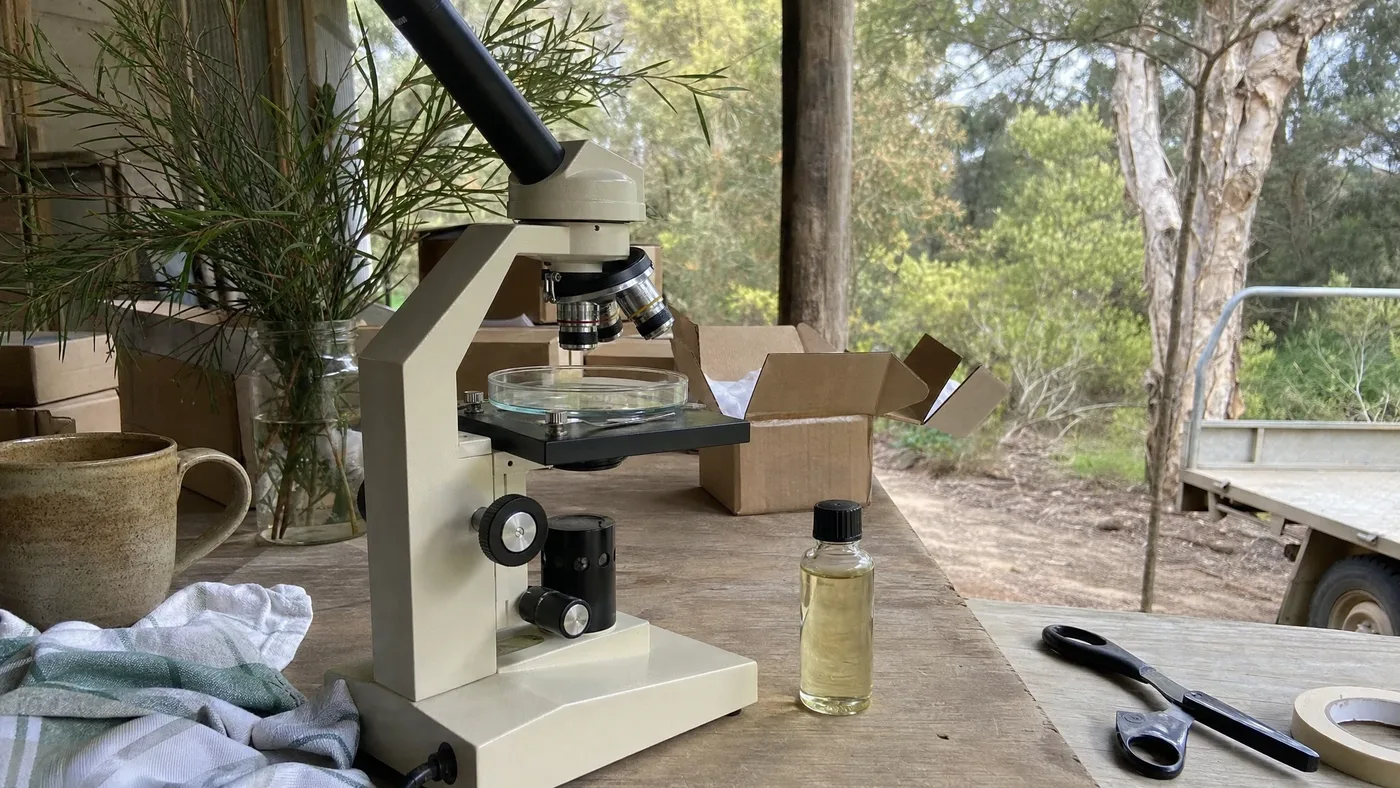
Most of the best-known tea tree oil work happened in laboratory dishes. A widely cited 2006 review of the whole literature describes antibacterial activity being measured by mixing the oil into agar or broth and seeing what grows. That is real science and a fair first step, but a dish has no skin, no sweat, no rinse-off and no immune system. The same review looked at the human trials available at the time and judged the clinical data promising but not yet adequate, calling for large randomized trials. It is a 2006 view, so newer trials may exist, and that is exactly the point: check the date and the design before you lean on a result.
Tea tree oil is also awkward to study fairly. One of the trials in that review noted that the oil's distinctive smell prevented patients from being blinded, since everyone could tell which cream they had been given. A study that cannot hide what it is testing is always a little easier to nudge toward the hoped-for answer.
How much oil, and what was it mixed into?
This is the check we find most useful, because the number is rarely in the marketing sentence. In the lab literature, many bacteria were held back at oil concentrations of 1% or less, while a few, including some skin staphylococci and Pseudomonas, needed more than 2%. To keep the oil spread through the liquid, researchers often added a surfactant to the test medium, because tea tree oil barely dissolves in water.
Now set that beside real products. When the European Commission's scientific committee on consumer safety reviewed tea tree oil in 2025, the maximum concentrations it considered safe in the cosmetic products it examined were 2.0% in a shampoo, 1.0% in a shower gel, 1.0% in a face wash and 0.1% in a face cream. A dish at 1% with a surfactant, a shampoo that rinses off, and a face cream at a tenth of a percent are three very different situations. When a claim quotes a dish number to sell a diluted product, ask whether the product ever reaches that concentration and how long it stays on skin. If the seller cannot say, the study is decoration. That is our reasoning from the two sources, not a finding of either.
Which oil was it, really?
"Tea tree oil" in a paper might mean the whole oil, or it might mean terpinen-4-ol, its leading component, tested on its own. Those are different experiments. The international standard for the oil sets a chemical profile, not a species, so a good study says what was in the vial and ideally shows a composition analysis. If you want the chemistry behind that profile, our look at terpinen-4-ol is a good companion, and the 2006 review also notes that fresh oil and aged oil are not the same mixture, which matters when a result came from one batch.
Case reports are a different kind of evidence
Not every useful paper is a trial. A retrospective series from the ASPCA's poison center looked at 443 dogs and cats exposed to undiluted tea tree oil and recorded what happened within hours. It tells you convincingly that harm occurs and what it looks like. It cannot tell you how often it happens per household, because it only counts the animals whose owners called. Good readers keep both halves of that sentence in mind, and we use it ourselves when we talk about pets, as in our piece on cats and tea tree oil.
Who is holding the citation?
A link on a sales page shows the seller found a paper, not that the paper says what the sentence above it says. The abstract is the easy part to read, and the concentration, the species and the control group are usually further down. Spending five minutes on those details will tell you more than any amount of "peer-reviewed" in the copy. It is also why we keep our own claims modest: we sell an aromatic oil for external use and we do not make medical claims for it, so there is nothing for a citation to prop up. Our walk-through of the repellent claims shows the same habit applied to one popular promise, and the guide to what counts as proof on a bottle applies it to labels.
A short checklist to keep nearby
If you like to keep things practical, copy these questions onto a sticky note. What was tested: the whole oil, or one part? Where: a dish, an animal, or people? How much oil, and in what? Who ran it, and has anyone repeated it? When was it published? Five questions, and you can answer most of them from the first page of a paper or the notes on a sales page.
You do not have to be a scientist to use them. You only have to be curious and a little stubborn.
Next time a label says "studies show", find the percentage, find out whether it was a dish or a person, and see whether anyone has done it twice. If all three answers are easy to find, it is probably a good source.
Tea Tree Essential Oil
Tea Tree Essential Oil from our own shop, in sizes from 0.5 oz to bulk.
From $10.99
Shop Now →Sources & Further Reading
- Carson CF, Hammer KA, Riley TV, "Melaleuca alternifolia (Tea Tree) oil: a review of antimicrobial and other medicinal properties", Clinical Microbiology Reviews, 2006
- Scientific Committee on Consumer Safety, "SCCS - Scientific Opinion on Tea Tree Oil (CAS/EC No. 68647-73-4 /285-377-1)", SCCS/1681/25, 2025
- Khan SA, McLean MK, Slater MR, "Concentrated tea tree oil toxicosis in dogs and cats: 443 cases (2002-2012)", Journal of the American Veterinary Medical Association, 2014