5 Tea Tree Oil Myths, Corrected
Tea tree oil has collected more folklore than almost any bottle on the shelf. Some of it is harmless, and some of it is worth correcting, so here are five claims we would happily retire, with what we say in their place.

Tea Tree Essential Oil
Our own Tea Tree Essential Oil, in sizes from 0.5 oz to bulk.
From $10.99
Shop Now →Myth one: a grade word on the label means something
Labels with the phrase are common. Robert Tisserand, one of the best-known writers on essential oil safety, has said plainly that there is no independent, industry standard behind that phrase. What does exist is an international standard, ISO 4730, which describes what a tea tree oil from Melaleuca alternifolia should contain, such as the range for components like terpinen-4-ol and cineole. A grade word on a label is marketing; a composition report is information. We call our oils Melaleuca alternifolia essential oil and leave the grade words out. The Certificate of Analysis for one batch of our Australian oil gives density, refractive index and optical rotation, and if you need GC-MS for your own formulation, ask us in writing through the contact page before ordering.
Before the list gets going, a word on why these ideas stick. Tea tree oil has a strong, memorable scent, and a strong scent feels like strong evidence. A sharp green smell seems as if it must be doing something, and a story that sounds plausible gets passed along until it is everywhere. None of that makes it true, and it is worth a minute to check.
Myth two: it is fine to swallow
It is not. Poison Control states that tea tree oil should not be taken by mouth for any reason, and it describes young children who became seriously ill after small amounts. Ours is an external, cosmetic oil, and our guidance is to keep it out of the mouth and away from children and pets. The full story is in our swallowing guide.
Myth three: stronger is better, so use it neat
A 2016 review of tea tree contact allergy found that tea tree oil has been linked to more reported allergic reactions than any other essential oil, and that most cases come from the undiluted oil rather than from cosmetics. A concentrated oil is a strong ingredient, and dilution is how it becomes pleasant to use. Our guidance is 0.5% to 2% in a carrier oil with a patch test first, and we suggest the low end to begin with. That works out, as arithmetic, to about 3 drops in a 30 ml bottle of carrier at 0.5% and about 12 at 2%, at roughly 20 drops per millilitre. Our dilution guide has the details.
Myth four: it is a cure-all
A 2023 systematic review pulled together 46 randomized trials from dentistry, dermatology, infectious disease and other fields. Its summary is measured: some uses look promising, the evidence for others is not strong enough yet, and overall research quality ranges from poor to moderate. Side effects turned up in about 60% of the studies, generally mild, though more serious with the oil at 25% or above on the skin. We do not sell a remedy of any kind, and we make no medical claims. What tea tree oil is good at, in our book, is its aroma: crisp, green and camphorous. Our guide to reading research without getting fooled shows how to weigh a claim.
Myth five: an old bottle is as good as a new one
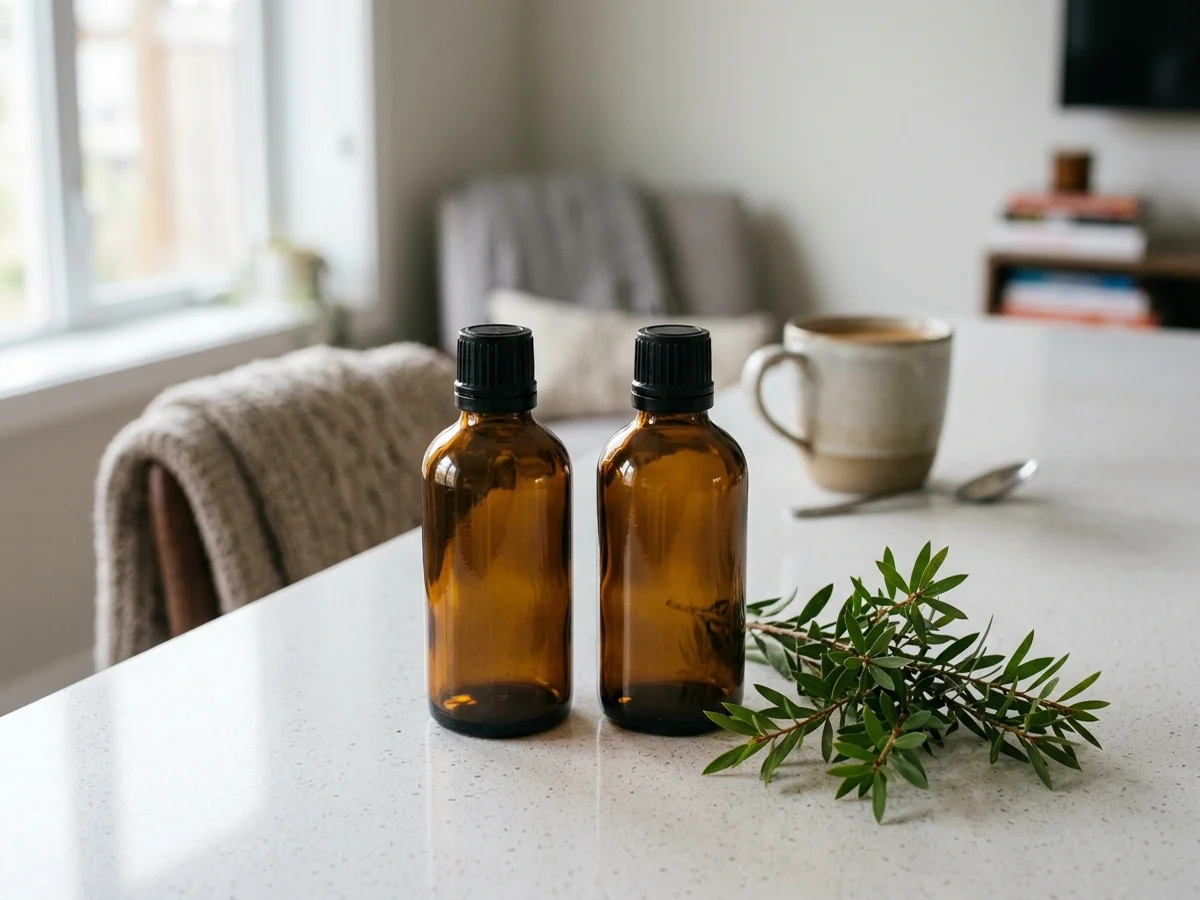
Tea tree oil changes with exposure to air, light and warmth. A study from 1999 found that freshly distilled oil was only a weak sensitiser, while oil stored in light and air produced degradation products that triggered reactions in oil-sensitive patients, and the 2016 review agrees that oxidation raises the likelihood of allergy. Hence the advice to keep the cap tight and the bottle in a cool, dark place. We list a typical unopened shelf life of 2 to 3 years for our Australian oil and 1 to 2 years sealed for our South African oil. See how to store it.
What we would tell a friend picking up a bottle
If a friend asked us how to start, the advice would be short. Look at the label for the species name, Melaleuca alternifolia, so you know what you are holding. Store it capped, cool and dark. Keep it out of the mouth and away from the eyes, children and pets. If you use it on skin, dilute it in a carrier and patch test first, starting at the low end of the range.
That is all there is to it, and none of it takes more than a minute. The rest is a matter of enjoying the scent.
When you do open the bottle, hold it a few inches from your nose and let the aroma come to you rather than sniffing hard. You will notice the sharp, green, camphorous lead first, and then a little warmth underneath. It is a strong scent, and a short sniff is plenty. If you want it in a room, a drop on a cotton ball in a dish on a high shelf does the job quietly, and it keeps the bottle capped and put away.
Take these five out of circulation and what is left is a pleasant, versatile oil with a distinct personality, to be diluted, stored sensibly and enjoyed for its scent.
Tea Tree Essential Oil
Tea Tree Essential Oil from our own shop, in sizes from 0.5 oz to bulk.
From $10.99
Shop Now →Sources & Further Reading
- Robert Tisserand, "Therapeutic grade oils - read all about it!" 2010
- "Tea tree oil: Remedy and poison," National Capital Poison Center (Poison Control)
- de Groot AC, Schmidt E, "Tea tree oil: contact allergy and chemical composition." Contact Dermatitis, 2016
- Kairey L et al., "Efficacy and safety of Melaleuca alternifolia (tea tree) oil for human health-A systematic review of randomized controlled trials." Front Pharmacol, 2023
- Hausen BM et al., "Degradation products of monoterpenes are the sensitizing agents in tea tree oil." Am J Contact Dermat, 1999