Is Tea Tree Oil Safe for Cats? What the Records Show
If you share your home with a cat, the short version is that tea tree oil and cats belong in different rooms. We love this oil, and we say plainly that it is toxic to cats and dogs at the concentrations people casually use, so we keep it well away from pets. The longer version is worth knowing, because it explains why cats are the ones to be most careful about.
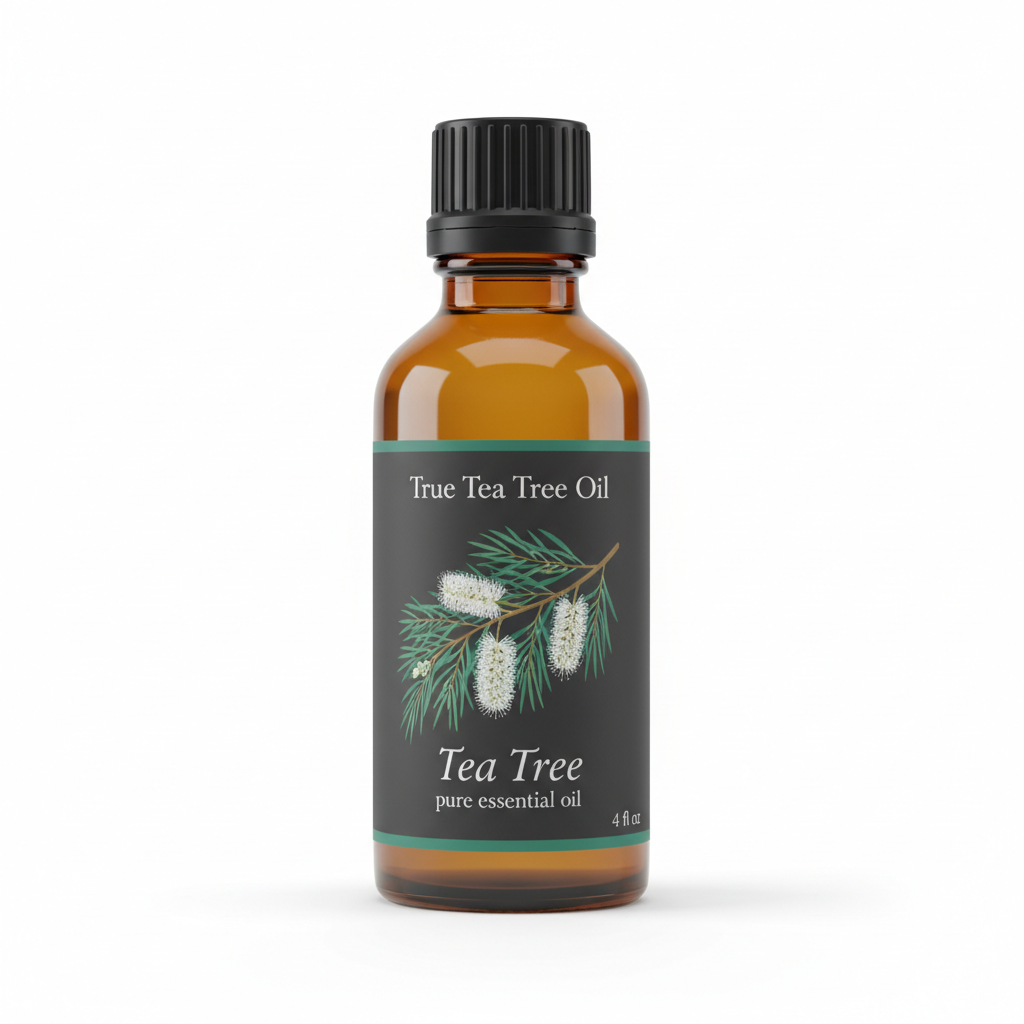
Tea Tree Essential Oil
Our own Tea Tree Essential Oil, in sizes from 0.5 oz to bulk.
From $10.99
Shop Now →What the poison records describe
A 2014 veterinary paper from the ASPCA Animal Poison Control Center reviewed 443 animals, 337 dogs and 106 cats, exposed to undiluted tea tree oil between 2002 and 2012. In nearly nine cases out of ten the oil had been used on the animal on purpose, usually by an owner trying to help. Amounts ranged from 0.1 to 85 mL, and signs appeared within 2 to 12 hours and could last up to 72 hours: drooling, lethargy or depression, weakness, loss of coordination and tremors. Younger and lighter cats were more likely to become seriously ill.
Earlier reports to the National Animal Poison Control Center described the same pattern after skin application, mostly at doses far too high, and a case summarised in a 2006 review of the oil describes three cats given about 120 mL of undiluted oil on shaved but intact skin: they developed low body temperature, incoordination, dehydration and trembling, and one died.
These records show that harm happens and what it looks like, not how often it happens, and they involve concentrated oil in amounts well above what a diffuser or a cleaning spray releases. That does not make any amount a known-safe amount.
Why cats in particular
Cats have an unusual liver. Many mammals clear foreign chemicals by attaching glucuronic acid to them, and cats do this poorly. In the domestic cat the gene for one enzyme in that pathway, UGT1A6, is a pseudogene, a switched-off copy, and cat liver samples showed more than ten times less activity than dog or human samples against acetaminophen. Both papers tested acetaminophen, not tea tree oil, so applying them here is an inference. The European Food Safety Authority makes the same inference: in its 2024 opinion on tea tree oil as a feed additive it applied an extra safety factor of 5 for cats because of their low capacity to process aromatic compounds, and its maximum safe feed concentration came out at 0.9 mg/kg for cats against 5.3 mg/kg for dogs. Those figures are for food, not skin or air.
What this means around the house
There is no established safe amount for a household cat, and we will not invent one. The ASPCA says concentrated tea tree oil may cause problems with only seven or eight drops, and Pet Poison Helpline says even a few concentrated drops on the skin or swallowed can cause severe poisoning. The same helpline notes that pet shampoos below 1 to 2% are generally considered non-toxic when used as labelled, but that sentence is about products made for pets and does not make a bottle on your shelf safe.
Diffusers are the question we hear most. The ASPCA says a diffuser running for a short time in a closed room the pet cannot enter is not likely to be an issue. A 2025 household simulation measured the air from two diffuser types with tea tree oil: an ultrasonic diffuser kept terpene levels below applicable limits, while a heat diffuser produced concentrations about ten times higher, some above long-term levels set for people. The study did not involve animals. We are a little more cautious than the ASPCA statement: in a home where a cat roams freely, skip tea tree oil in the diffuser, and if you use it anyway, avoid heat diffusers and keep the bottle and any spill well out of reach.
Because cats groom, anything left on paws or fur ends up in the mouth. We are reasoning here, since we found no study of the exposure from diluted household products, but it points to simple habits: keep cats out of a room while a freshly treated surface dries, wipe floors rather than leave a film, and never apply the oil to a cat for fleas or skin problems. Most of the 443 poisonings came from exactly that kind of well-meant application. Our cleaning guide has more on floors, and our look at tea tree oil and dogs covers the other household animal.
Loving the scent in a home with a cat
A lot of people who love fragrance share their homes with cats, and we get it. Our approach is plain: the bottle lives in a closed cabinet, the door stays shut when it is out, and we wash our hands after handling it before we touch the cat. If you want to know which scented products are fine to use around your own cat, your veterinarian is the right person to ask, because the answer depends on the animal and the product.
It also helps to tell everyone in the household. A partner, a housemate or a guest who does not know the rule can undo the best arrangement in one thoughtful moment, so a quick word is worth it.
If your cat is exposed
Call your veterinarian or an animal poison line straight away rather than waiting to see how the cat looks. The ASPCA Animal Poison Control Center lists (888) 426-4435 and Pet Poison Helpline lists (855) 764-7661; Pet Poison Helpline lists an incident fee. Have the bottle and a rough idea of how much and when. Signs can take hours to appear, so do not wait for them.
The simplest rule is the one we follow: a bottle of tea tree oil lives on a high shelf behind a closed door, and the cat never meets it.
Tea Tree Essential Oil
Tea Tree Essential Oil from our own shop, in sizes from 0.5 oz to bulk.
From $10.99
Shop Now →Sources & Further Reading
- Khan SA, McLean MK, Slater MR, "Concentrated tea tree oil toxicosis in dogs and cats: 443 cases (2002-2012)", Journal of the American Veterinary Medical Association, 2014
- Villar D, Knight MJ, Hansen SR, Buck WB, "Toxicity of melaleuca oil and related essential oils applied topically on dogs and cats", Veterinary and Human Toxicology, 1994
- Carson CF, Hammer KA, Riley TV, "Melaleuca alternifolia (Tea Tree) oil: a review of antimicrobial and other medicinal properties", Clinical Microbiology Reviews, 2006
- Court MH, Greenblatt DJ, "Molecular genetic basis for deficient acetaminophen glucuronidation by cats: UGT1A6 is a pseudogene, and evidence for reduced diversity of expressed hepatic UGT1A isoforms", Pharmacogenetics, 2000
- Court MH, Greenblatt DJ, "Molecular basis for deficient acetaminophen glucuronidation in cats. An interspecies comparison of enzyme kinetics in liver microsomes", Biochemical Pharmacology, 1997
- EFSA FEEDAP Panel, "Safety and efficacy of a feed additive consisting of an essential oil derived from leaves and terminal branchlets of Melaleuca alternifolia (Maiden & Betche) Cheel (tea tree oil) for use in all animal species (FEFANA asbl)", EFSA Journal, 2024
- ASPCA, "Is the Latest Home Trend Harmful to Your Pets? What You Need to Know!", 17 January 2018
- Pet Poison Helpline, "Tea Tree Oil Is Toxic To Dogs"
- Zisook RE, Nembhard MD, Bandara SB, Gaffney SH, "Volatile organic compound and particle emissions from the use of tea tree oil in essential oil diffusers", Journal of Occupational and Environmental Hygiene, 2025