Diffusing Tea Tree Oil: What to Know Before You Start
Tea tree oil in a diffuser smells like a window thrown open: crisp, green and camphorous, with a faint earthy undertone in our Australian oil and a fresh, medicinal-herbal edge in our South African one. It is a top note, which means it greets you first and then fades, so a small amount does a lot. A few habits make the experience better still, and most of them take about five minutes to put in place before the first bottle goes on the shelf.

Tea Tree Essential Oil
Our own Tea Tree Essential Oil, in sizes from 0.5 oz to bulk.
From $10.99
Shop Now →Start with who shares the room
The ASPCA says that concentrated tea tree oil can cause problems for pets with as few as seven or eight drops, though that is about oil on a pet and not vapour. On diffusers specifically, its Animal Poison Control Center says that running one briefly in a room your dog or cat cannot enter is not likely to be an issue, that pets with breathing problems may do better without one, and that birds are best kept away from diffusers because their respiratory tracts are very sensitive. Pet Poison Helpline lists the signs of tea tree poisoning, including drooling, stumbling, tremor and low body temperature, and in cats liver injury. Neither source gives a safe vapour level for tea tree, so the sensible approach is a closed door, short sessions and a conversation with your veterinarian if you share your home with a cat, dog or bird. Droplets from a tipped or overfilled diffuser can land on surfaces an animal walks across and then licks, which is one more reason to place the device out of reach. Our posts on cats and dogs go further.
The machine matters as much as the oil
A 2025 pilot study simulated tea tree oil diffusing in a household, using an ultrasonic diffuser in one test and a heat diffuser in another. Terpene levels with the ultrasonic device stayed below the exposure limits the authors compared them with. With the heat diffuser they ran about ten times higher, and several terpenes passed long-term reference levels. It was a single small study on particular devices, so read it as a nudge and not a verdict. A separate chamber study of ultrasonic diffusers with other oils found that tap water raised fine-particle emissions fivefold compared with deionised water for eucalyptus oil, though tea tree was not one of its test oils. From the two together, we would reason this way: choose an ultrasonic diffuser, run it for short sessions in a room you can air out, and follow the amount your diffuser's manual prints. Neither study offers a drop count, so we will not invent one.
Listen to your own nose
European regulators describe tea tree oil as an irritant to skin and eyes and as a dermal and respiratory sensitiser, in a 2024 opinion about the handling of the concentrated oil. That is a reason to take a cough, headache or stinging eyes as a signal to stop and open a window. Anyone with asthma should check with their physician before diffusing any essential oil. When it is time to refill, keep the neat oil off your skin. If you want to use tea tree on skin, our guidance is 0.5% to 2% in a carrier oil with a patch test first, and our dilution guide shows how.
Setting up the room
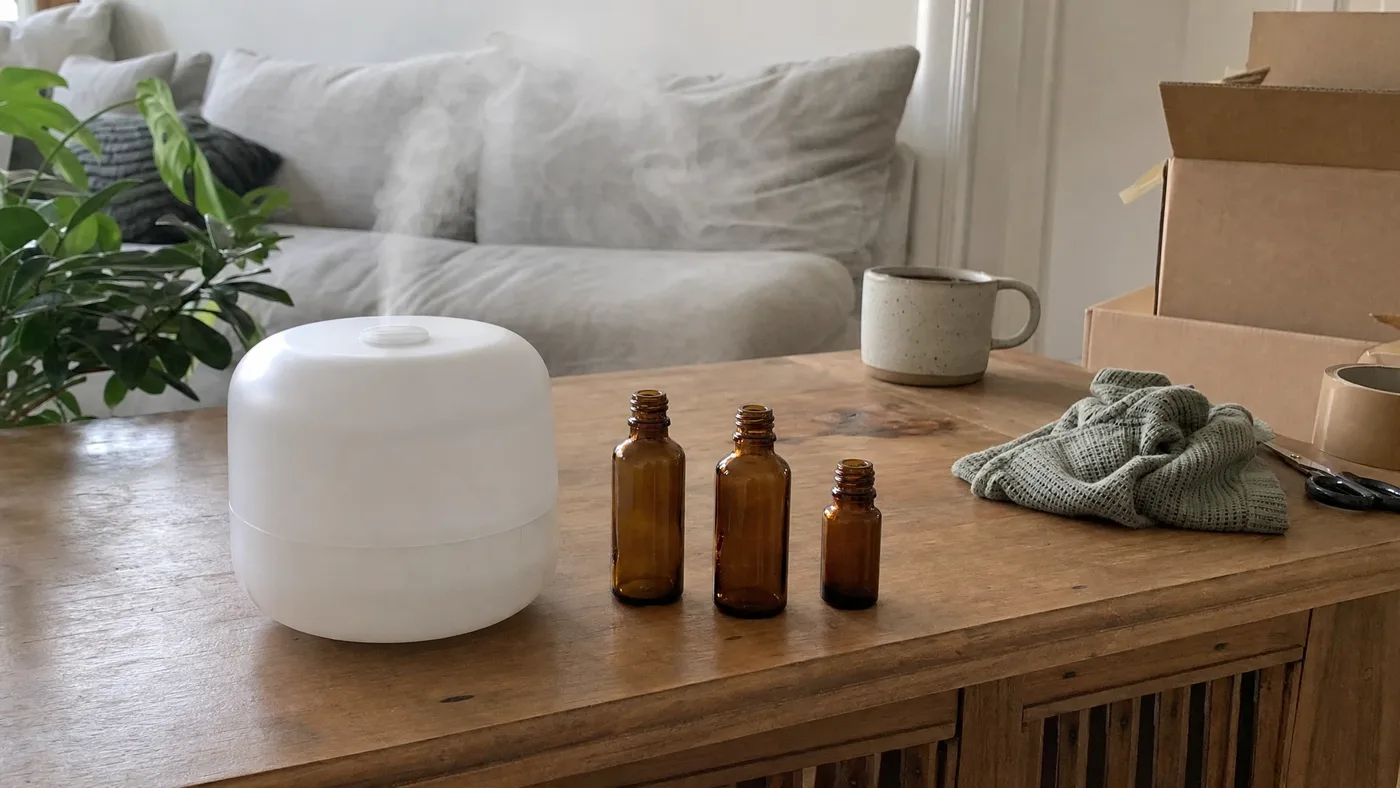
Where you put the diffuser changes how the scent feels. Set it on a stable, flat surface away from the edge of a table, with a little space around it, and not directly beside a pet's bed. A mid-height shelf lets the scent drift through the room instead of landing in one spot. Keep it away from wood finishes and electronics, since a stray splash or an overfilled tank can leave marks.
It is also worth pausing at the doorway after a few minutes. Walk into the room as if you were a guest, and notice whether the scent is a soft hint or a wall. Tea tree is bright and quick to arrive, so many people find a light touch more pleasant than a heavy one. If it feels like too much, stop the session and open a window.
Pairings that suit the aroma
This is the fun part. We list lemon, lavender, rosemary, eucalyptus and peppermint as oils that blend well with our Australian tea tree, and cedarwood joins the list for the South African one. We sell tea tree oil only, so you will find those other oils at a craft or supply shop. Our scent pairings guide explores why they work together, and the aroma profile describes the oil on its own.
Keeping the diffuser itself tidy
A diffuser is only as pleasant as it is clean. After a session, pour out the leftover water and wipe the tank with a soft cloth, following your device's manual. If you switch to a different oil next time, a quick rinse keeps the scents from muddling together. It takes two minutes and means the next session starts with a clear, clean aroma.
Buy for the bottle you will finish
Diffusing uses so little oil that one bottle can last a long time. Oil changes with air and light: in a 1999 study, oxidised tea tree oil was about three times stronger as a skin sensitiser than fresh oil. We list the Australian oil at typically 2 to 3 years unopened and the South African oil at 1 to 2 years sealed. A smaller bottle, tightly capped and kept somewhere cool and dark, suits an occasional diffuser better than a large one. Our sizes guide helps match a bottle to your habit.
With the pets sorted, a sensible machine and a few drops of the bottle, a diffuser is a simple way to give a room that bright, clean tea tree character.
Tea Tree Essential Oil
Tea Tree Essential Oil from our own shop, in sizes from 0.5 oz to bulk.
From $10.99
Shop Now →Sources & Further Reading
- Is the Latest Home Trend Harmful to Your Pets? What You Need to Know!, ASPCA, 17 January 2018.
- Tea Tree Oil Is Toxic To Dogs, Pet Poison Helpline.
- Volatile organic compound and particle emissions from the use of tea tree oil in essential oil diffusers, Journal of Occupational and Environmental Hygiene, 2025.
- Volatile organic compound and particulate matter emissions from an ultrasonic essential oil diffuser, Indoor Air, 2021.
- Safety and efficacy of a feed additive consisting of an essential oil derived from leaves and terminal branchlets of Melaleuca alternifolia (Maiden & Betche) Cheel (tea tree oil) for use in all animal species (FEFANA asbl), EFSA Journal, 2024.
- Degradation products of monoterpenes are the sensitizing agents in tea tree oil, American Journal of Contact Dermatitis, 1999.