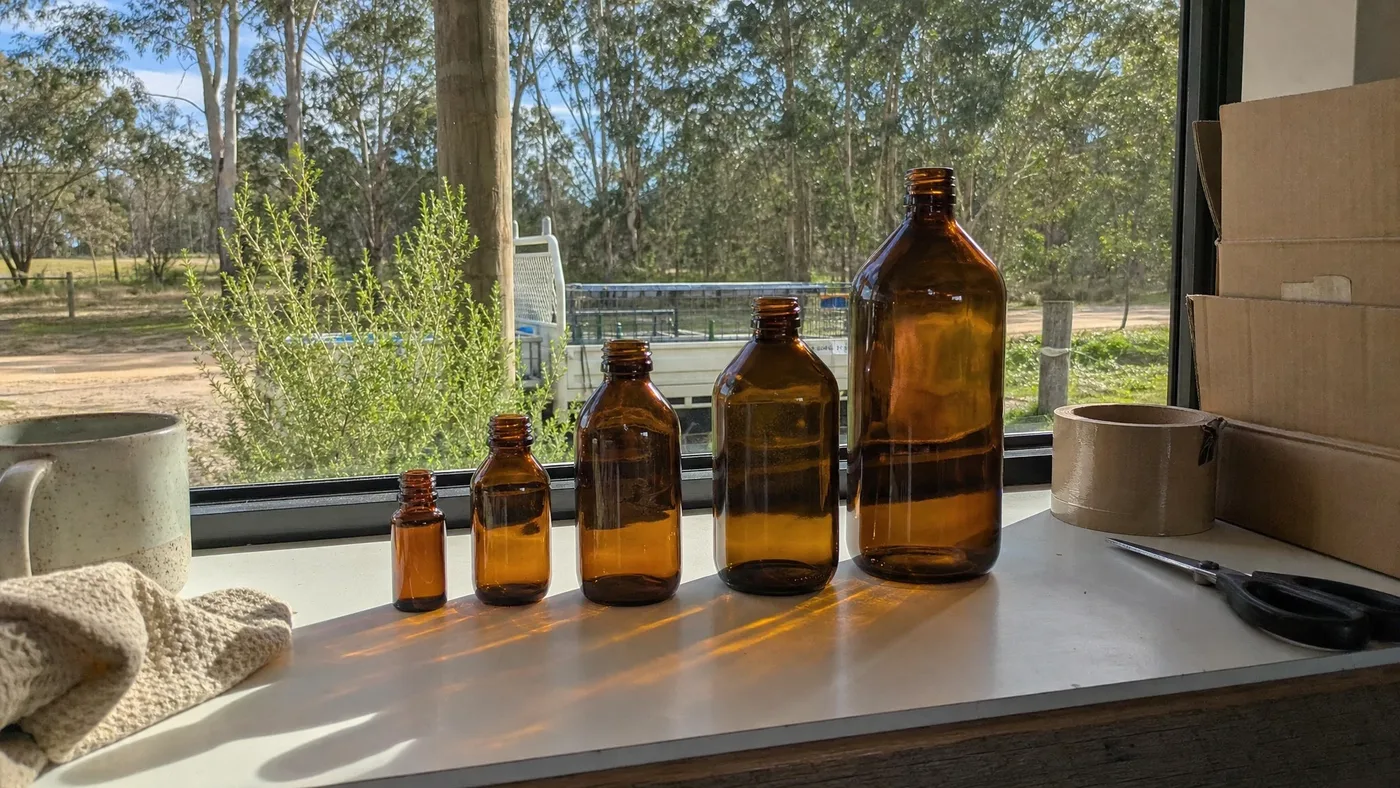
Which Tea Tree Oil Bottle Size Should You Choose?
There is a quiet temptation when you buy tea tree oil: the bigger bottle always looks like the smarter choice. It is not wrong, exactly. It is just that a bottle of tea tree oil is a long-lasting ingredient that keeps changing slowly after you open it, so the best size is the one you will finish while it still smells bright. Here is how to work that out for yourself.

Tea Tree Essential Oil
Our own Tea Tree Essential Oil, in sizes from 0.5 oz to bulk.
From $10.99
Shop Now →Start with how long a bottle really lasts
Our bottles are measured in fluid ounces, and a little arithmetic shows how far each goes. At roughly 20 drops to the milliliter (a convention; droppers vary), a 1 oz bottle holds about 590 drops. If you make a 1% blend in a 1 oz carrier bottle, you need about 6 drops, so one ounce of oil covers on the order of 100 such blends. A 0.5 oz bottle is about 50. Even a gentle habit, say 5 drops at a time in a scent dish, gets you through more than a hundred uses from one ounce.
By weight, the batch on the Certificate of Analysis we publish for the Australian oil has a relative density of 0.896 at 20 C, so 1 oz weighs about 26.5 g. We do not publish a density for the South African oil; for a rough guide, the international range quoted by Carson, Hammer and Riley is 0.885 to 0.906, so the figures will be similar.
Why age belongs in the decision
Tea tree oil changes with air, light and warmth. Hausen and colleagues stored it on a window sill and found peroxides rising from under 50 parts per million to over 500 within four days, and their oxidized oil was about three times stronger as a sensitizer in guinea pigs. Carson and colleagues report that the reactions seen with the oil are caused mainly by oxidation products in aged or improperly stored oil. Those are experiments with oil left in sunshine, not a description of a capped bottle in a cupboard. They do explain why we put so much weight on storage.
We list the shelf life of the Australian oil as typically 2 to 3 years unopened, and of the South African oil as typically 1 to 2 years when sealed, with both kept tightly capped in a cool, dark place away from sunlight or heat. That gives you a practical test for any size: could you use it up well within that window once it is open? Opening also adds air, and a nearly empty bottle holds mostly air. That is our reasoning rather than a measured result, but it is another reason to size sensibly.
Matching a size to your use
Trying it for the first time. The smallest bottles suit you. A half ounce or one ounce is plenty for a first body oil, a scent dish and a spray. You will learn how strong a scent you like and whether you reach for it weekly or monthly before committing to more.
A regular at home. If tea tree is a staple, say in a cleaning spray, a laundry rinse or a regular blend, the 2 oz to 4 oz range tends to hit the sweet spot, because you will finish it comfortably inside the shelf life we list and still avoid reordering every few weeks.
A maker with a steady project. If you make soaps, sprays or blends regularly, 8 oz and 16 oz make sense. Once you are on the pound sizes, the practical habit is the one we recommend for bulk: store the sealed container in a cool, dark place and decant working amounts into smaller airtight bottles, so you are opening only what you need.
A business. Our larger sizes run 5, 25, 100 and 400 lb for each oil. For scale, 5 lb is roughly 2.5 liters of oil at those densities. It helps to try before you commit: our wholesale page offers sample bottles, and our bulk page lists the sizes. Private label, custom formulations and quantities above 400 lb are available by contacting us.
Reading the bottle in your hand
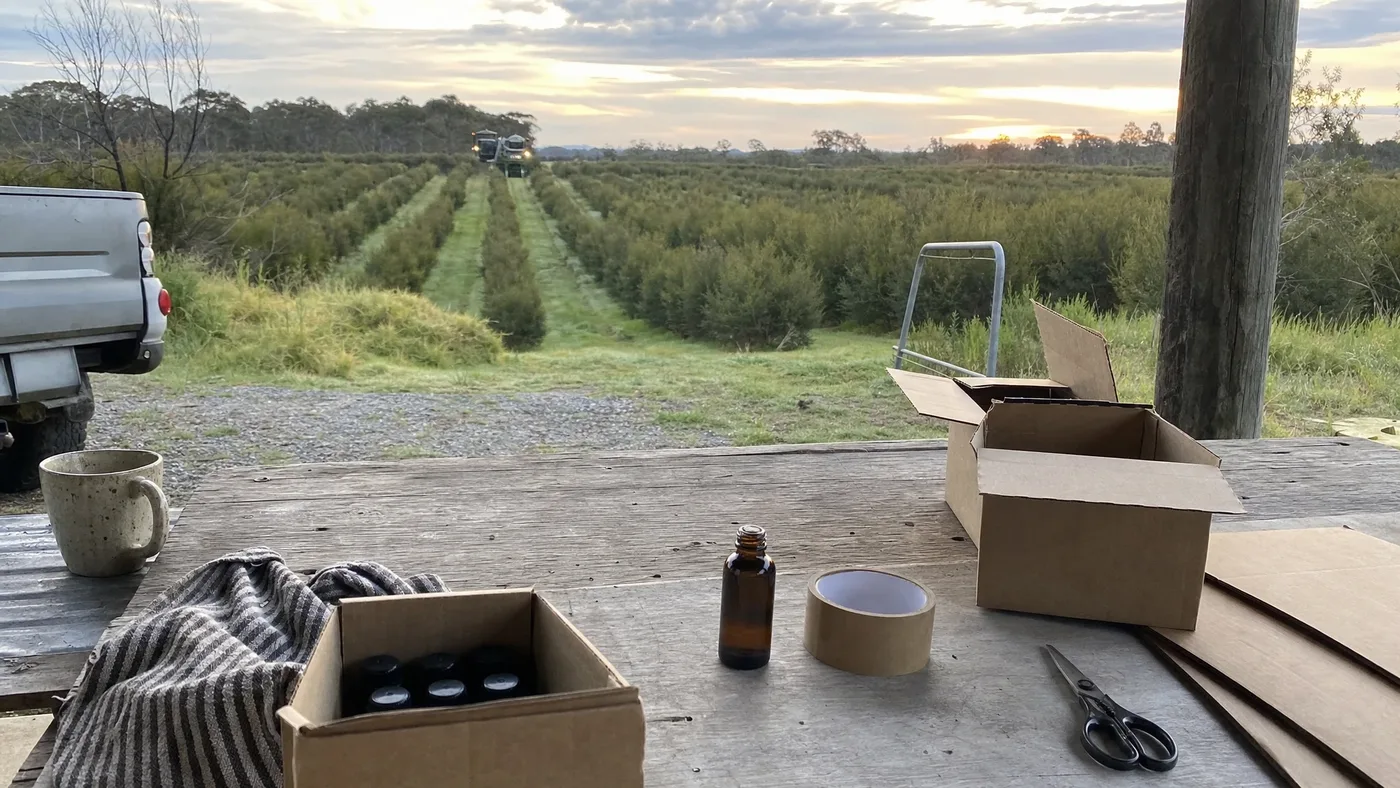
Our bottles are amber glass with a black cap and a black label. The label shows the name, the species, Melaleuca alternifolia, and the size in fluid ounces, so it is worth checking the size on the label before you plan a blend, especially if you are working in grams or milliliters at the kitchen scale.
When you pick a size, think in projects, not in months. Ask yourself what you plan to make in the next season, how many times you will make it, and where the bottle will live between uses. If the honest answer is "one soap and a scent dish," a small bottle is the right one, and it leaves you free to try the other oil next time.
A few habits that stretch a bottle
- Cap it tightly right after use, and keep it out of the car and off sunny windowsills.
- Measure with a scale or a clean dropper rather than pouring.
- Write the date you opened it on the bottle.
- Keep every bottle out of reach of children and pets. The ASPCA warns that concentrated tea tree oil can cause problems for animals with just a few drops.
If you want to go deeper, our guide to storing the oil and our walkthrough of ratios and carriers pair well with this one, and so does our comparison of undiluted and pre-diluted formats. For skin use, our guidance is 0.5% to 2% in a carrier oil with a patch test first.
The size that suits you is usually smaller than the one that looks like the bargain, and a bottle you enjoy from the first drop to the last is always the better buy.
Tea Tree Essential Oil
Tea Tree Essential Oil from our own shop, in sizes from 0.5 oz to bulk.
From $10.99
Shop Now →Sources & Further Reading
- Hausen BM, Reichling J, Harkenthal M. Degradation products of monoterpenes are the sensitizing agents in tea tree oil. American Journal of Contact Dermatitis, 1999
- Carson CF, Hammer KA, Riley TV. Melaleuca alternifolia (Tea Tree) oil: a review of antimicrobial and other medicinal properties. Clinical Microbiology Reviews, 2006
- ASPCA. Is the Latest Home Trend Harmful to Your Pets? What You Need to Know!