Tea Tree Oil FAQ: Answers Before You Choose a Bottle
Most tea tree oil questions come down to three things: what is in the bottle, how old it is, and how much of it touches your skin. These are the ones we would answer first for anyone choosing a bottle, with the sources behind the answers so you can read further.

Tea Tree Essential Oil
Our own Tea Tree Essential Oil, in sizes from 0.5 oz to bulk.
From $10.99
Shop Now →What you are buying
What is tea tree oil, and which plant makes it?
It is the oil steam-distilled from the leaves and terminal branches of Melaleuca alternifolia, and it takes a lot of plant for a little oil: a typical yield is 1 to 2 percent of the wet plant weight. Common names are loose, so the Latin name on the label is the thing to check. We sell two tea tree oils, one listed as Australian and one as South African, both Melaleuca alternifolia. That is the same plant as "Melaleuca oil", and a different one from cajeput and niaouli.
Does the country on the label tell me everything?
It tells you something, though not everything. Commercial plantations in Australia were established in the 1970s and 1980s, and most are around the Lismore region of New South Wales. The oil is also made elsewhere: a 2024 European safety assessment says its raw material came from China, New Caledonia and Australia. Our origin comparison looks at how much origin matters.
What should the oil contain, and can I check?
The international standard, ISO 4730, sets ranges and not a single recipe: terpinen-4-ol at least 30 percent and 1,8-cineole at most 15 percent, as summarised in a 2006 review. Seven batches analysed for the European assessment averaged 39.43 percent terpinen-4-ol and 2.40 percent cineole, so real batches sit comfortably inside those limits.
The Certificate of Analysis we publish covers one batch of our Australian oil and lists relative density (0.896), refractive index (1.478) and optical rotation. Those describe the whole oil rather than one compound, so they cannot confirm a terpinen-4-ol level on their own. If you need GC-MS data, or a document for our South African oil, ask us in writing through the contact page before you order. Our label and lab guide explains what each kind of paperwork can show.
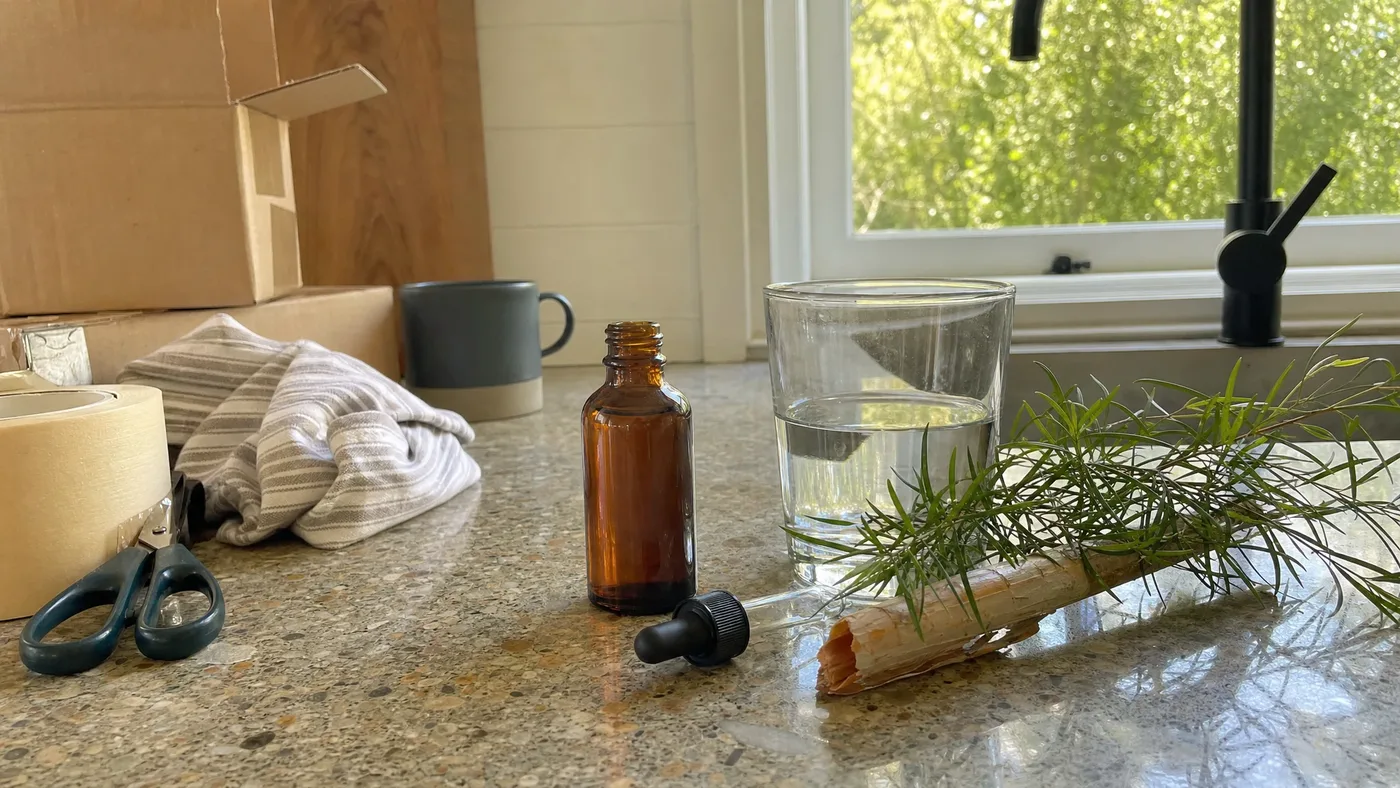
A small habit makes all of these answers easier to use: note which bottle you opened and when. A strip of masking tape on the box with the month written on it is plenty. It costs nothing, and when you wonder how long a bottle has been open, you will not be guessing from memory.
Using it on skin
Can I put it on neat?
We recommend never applying it undiluted. The reason is sensitisation and not only stinging: a 2016 review found that tea tree oil has caused more published contact allergy than any other essential oil, and that most reactions came from the neat oil. The longer answer is in our neat-use guide.
How much should I dilute it?
Our guidance is 0.5% to 2% in a carrier oil, with a patch test first and the eyes avoided. Europe's consumer-safety committee found the oil safe for adults, in oil that meets ISO 4730:2017 and not in sprays, at up to 2.0 percent in shampoo, 1.0 percent in shower gel and face wash, and 0.1 percent in face cream. We do not call 2 percent safe for everyone, and on the face we start much lower. The arithmetic is in our dilution guide.
Is it a skin or hair remedy?
We make no such claim for our oils. A 2023 systematic review of randomised trials found 46 eligible articles of poor to modest quality and said more evidence is needed on acne and on effects on skin. A dermatologist is the right person for any skin or scalp concern.
Freshness, storage and safety
Does it go off?
It changes with light, air and warmth. In a 1999 guinea-pig study, fresh oil was a very weak sensitiser and oxidised oil about three times stronger. We list our Australian oil at typically 2 to 3 years unopened and our South African oil at 1 to 2 years sealed. Keep either one tightly capped in a cool, dark place, and read our storage guide for the details.
What about pets, children and swallowing?
Keep the bottle out of reach of both. Pet Poison Helpline says higher concentrations are toxic to pets, and a few concentrated drops applied or swallowed can cause severe poisoning. For people, a 2023 review concluded tea tree oil should never be taken by mouth. If someone swallows some, call Poison Control at 1-800-222-1222. We have separate posts on cats, dogs and swallowed oil.
Which bottle?
How do your two oils differ?
Both are sold neat, in ten sizes from 0.5 oz up to 400 lb, and each oil comes from one standard batch across its sizes. Our Australian page describes the aroma as crisp, green and camphorous with a faint earthy undertone. Our South African page calls it crisp, green and camphorous with a fresh, clean edge, closer to medicinal-herbal freshness than sweetness. We invite you to compare the two in your own formulas. We sell the oils only, with no carrier oils, blends or products made with them. Our sizes guide can help you pick a bottle that you will finish while it is still fresh.
It also helps to decide what you want the oil for before you pick a size. A small bottle suits someone who wants to smell it, try a diffuser session and decide whether it is for them. A larger one suits someone with a regular plan for it. Either way, open the cap, take one slow sniff, and let your nose tell you whether the crisp, green character is the one you were after.
If a question did not make the list, write to us through the contact page and we will do our best to answer it.
Tea Tree Essential Oil
Tea Tree Essential Oil from our own shop, in sizes from 0.5 oz to bulk.
From $10.99
Shop Now →Sources & Further Reading
- Melaleuca alternifolia (Tea Tree) Oil: a Review of Antimicrobial and Other Medicinal Properties, Clinical Microbiology Reviews, 2006.
- Safety and efficacy of a feed additive consisting of an essential oil derived from leaves and terminal branchlets of Melaleuca alternifolia (Maiden & Betche) Cheel (tea tree oil) for use in all animal species (FEFANA asbl), EFSA Journal, 2024.
- SCCS - Scientific Opinion on Tea Tree Oil (CAS/EC No. 68647-73-4 /285-377-1), European Commission, SCCS/1681/25.
- Tea tree oil: contact allergy and chemical composition, Contact Dermatitis, 2016.
- Efficacy and safety of Melaleuca alternifolia (tea tree) oil for human health-A systematic review of randomized controlled trials, Frontiers in Pharmacology, 2023.
- Degradation products of monoterpenes are the sensitizing agents in tea tree oil, American Journal of Contact Dermatitis, 1999.
- Safety assessment and adverse drug reaction reporting of tea tree oil (Melaleuca aetheroleum), Phytotherapy Research, 2023.
- Tea Tree Oil Is Toxic To Dogs, Pet Poison Helpline.
- Essential oils: Poisonous when misused, Poison Control (National Capital Poison Center).