Tea Tree Oil and Dogs: How to Keep Them Apart
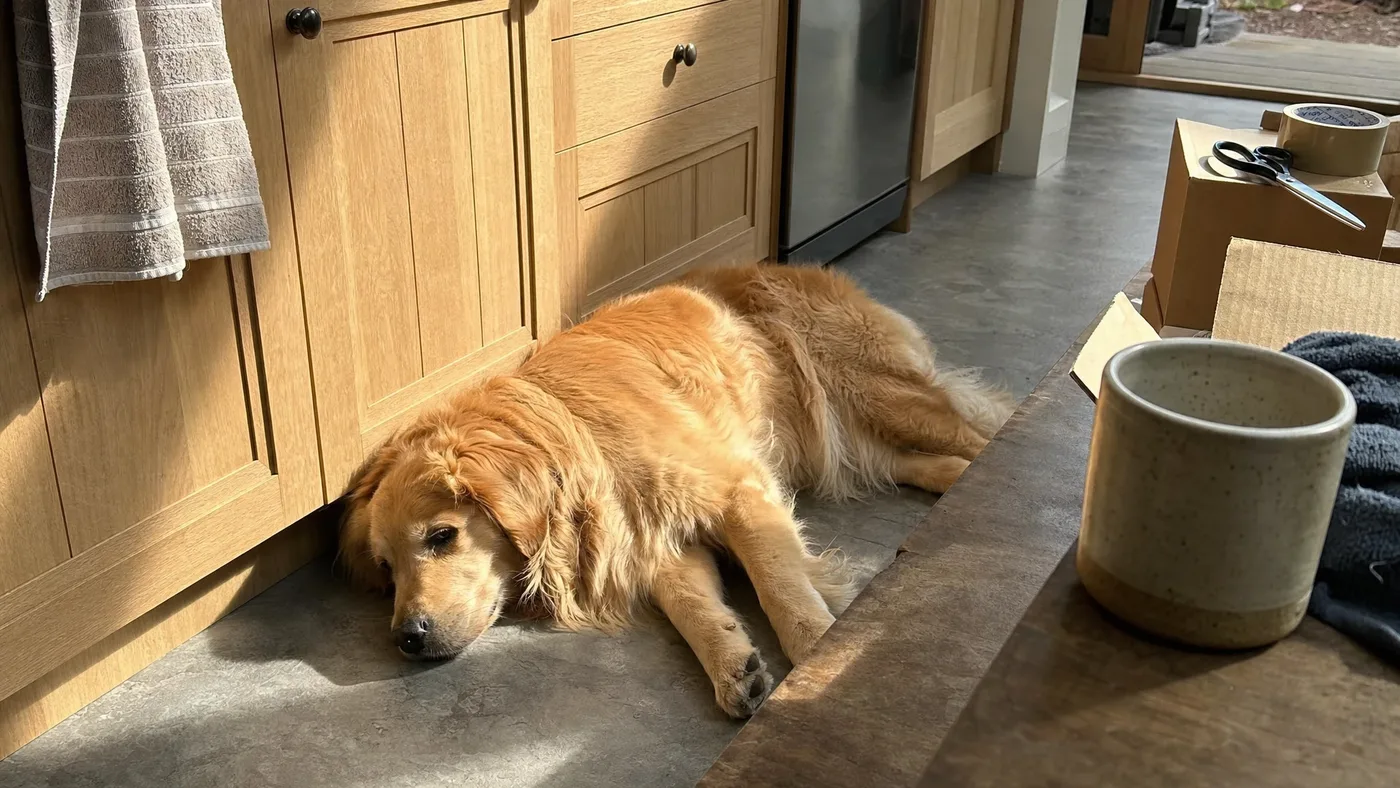
Dogs find things. A bottle knocked off a bathroom shelf, a tote bag left on the floor, a rag that smells interesting: that is how most dogs meet essential oils, and it is why the sensible answer to "is tea tree oil safe for dogs?" is really a plan for keeping the two apart. We say plainly that tea tree oil is toxic to cats and dogs at the concentrations people casually use, so our rule is that it stays away from pets entirely.

Tea Tree Essential Oil
Our own Tea Tree Essential Oil, in sizes from 0.5 oz to bulk.
From $10.99
Shop Now →What dogs in the records went through
The biggest dataset is a 2014 review of ASPCA Animal Poison Control Center cases: 443 animals, 337 of them dogs, exposed to undiluted tea tree oil over ten years. The detail that stands out is that in about nine cases out of ten the oil had been put on or given to the animal deliberately, usually as a home remedy. Amounts ranged from 0.1 to 85 mL, and the animals showed drooling, sleepiness or depression, weakness, wobbliness and tremors within 2 to 12 hours, sometimes lasting up to three days. A 1994 report of skin applications to dogs and cats described the same signs and recovery with supportive care within two to three days.
That is a record of harm, not a rate. It cannot say how many households use a drop safely, and it deals with concentrated oil in meaningful amounts. But it does explain why veterinary poison services are so consistent: the ASPCA says concentrated tea tree oil may cause problems for pets with only seven or eight drops, and Pet Poison Helpline says even a few concentrated drops applied to the skin or swallowed can cause severe poisoning.
Are dogs less sensitive than cats?
Somewhat, in one specific sense. In its 2024 opinion on tea tree oil as an animal feed additive, the European Food Safety Authority set a maximum safe feed concentration of 5.3 mg/kg for dogs against 0.9 mg/kg for cats, after applying an extra safety factor for cats' limited ability to process aromatic compounds. That is a feed number, not guidance for skin or air, and it is not an invitation to experiment: dogs sit lower on that scale than cats, not at zero. Our companion piece explains the cat side in its own article.
Where dogs actually meet the oil
Thinking through the routes is more useful than a list of rules, and these are our reasoning, not findings from a study.
- The bottle itself. Chewed, dropped or opened by a curious dog. A closed cabinet or high shelf solves this, and a dog-proof bag handles the one you carry.
- Floors and fabric. Dogs lick paws and coats, so oil on a surface they walk across can end up in the mouth. Wipe rather than leave a film, and keep dogs out of a room while a treated surface dries.
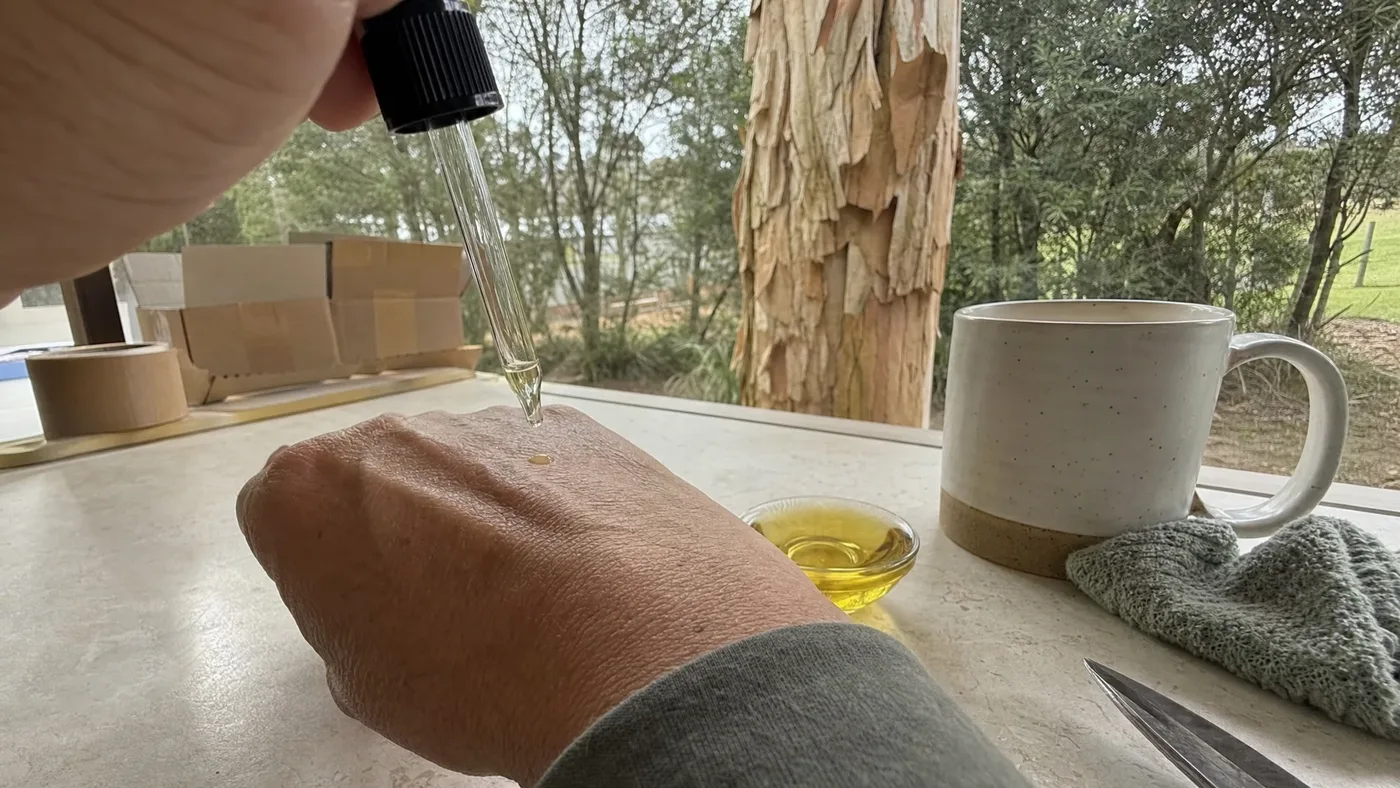
- Your hands. If you have been handling the oil, wash before cuddling a dog that licks.
- The diffuser. The ASPCA says a diffuser run for a short time in a secured space the pet cannot enter is not likely to be an issue. A 2025 household simulation found an ultrasonic diffuser kept tea tree terpenes below applicable exposure limits while a heat diffuser produced roughly ten times more, some above long-term levels set for people. The study did not look at animals, so it is background rather than a green light.
- Remedies and sprays. Never apply it to a dog for fleas, skin trouble or anything else. If a dog has a skin problem, a veterinarian can choose something made for dogs.
What about dog shampoos that list tea tree oil?
Pet Poison Helpline notes that pet products containing less than 1 to 2% are generally considered non-toxic when used according to their directions. Read that as a statement about products designed and labelled for pets, not as a measure that makes your own blend safe. The skin guidance we give, 0.5% to 2% in a carrier oil with a patch test first, is for people only. It was never meant for animals, and we will not invent a figure for them.
Small habits for a dog-friendly home
Most of the work is in the routine, not in any one rule. Put the bottle back in its cabinet the moment you finish using it, instead of leaving it on the counter while you answer the door. Keep tote bags and purses that hold a bottle zipped and off the floor. If you have a young dog who investigates everything, treat the bottle like a dropped pill: always assume it will be found.
It also helps to decide, as a household, where the oil is used. A bathroom with a door that closes works better than a living room where the dog sleeps. Tell guests and housemates the rule so that nobody sets the bottle down in the wrong place.
If a dog gets into it
Call your veterinarian or an animal poison line immediately. The ASPCA lists (888) 426-4435 and Pet Poison Helpline lists (855) 764-7661. Have the bottle to hand so you can say what it was, how strong it was and roughly how much is missing, and do not wait to see whether symptoms appear. Signs developed within a couple of hours in some dogs and not for up to twelve in others.
Our guide to swallowing covers the human side of the same problem, and the storage advice in our storage article doubles as pet-proofing. If you love the crisp, green scent of tea tree oil and share your home with a dog, the kindest compromise is to enjoy it somewhere the dog never goes, and to keep the bottle where nobody small, furry or otherwise can reach it.
Tea Tree Essential Oil
Tea Tree Essential Oil from our own shop, in sizes from 0.5 oz to bulk.
From $10.99
Shop Now →Sources & Further Reading
- Khan SA, McLean MK, Slater MR, "Concentrated tea tree oil toxicosis in dogs and cats: 443 cases (2002-2012)", Journal of the American Veterinary Medical Association, 2014
- Villar D, Knight MJ, Hansen SR, Buck WB, "Toxicity of melaleuca oil and related essential oils applied topically on dogs and cats", Veterinary and Human Toxicology, 1994
- EFSA FEEDAP Panel, "Safety and efficacy of a feed additive consisting of an essential oil derived from leaves and terminal branchlets of Melaleuca alternifolia (Maiden & Betche) Cheel (tea tree oil) for use in all animal species (FEFANA asbl)", EFSA Journal, 2024
- ASPCA, "Is the Latest Home Trend Harmful to Your Pets? What You Need to Know!", 17 January 2018
- Pet Poison Helpline, "Tea Tree Oil Is Toxic To Dogs"
- Zisook RE, Nembhard MD, Bandara SB, Gaffney SH, "Volatile organic compound and particle emissions from the use of tea tree oil in essential oil diffusers", Journal of Occupational and Environmental Hygiene, 2025