Tea Tree Oil and Kids: Storage and Safety Habits
If there is a bottle of tea tree oil in your home and a child under your roof, the most useful safety tool you own is a shelf. Where the bottle lives, and how out of sight it is, does more than any dilution chart. That is why we put storage first, and why the rest of this guide is short, practical and calm.
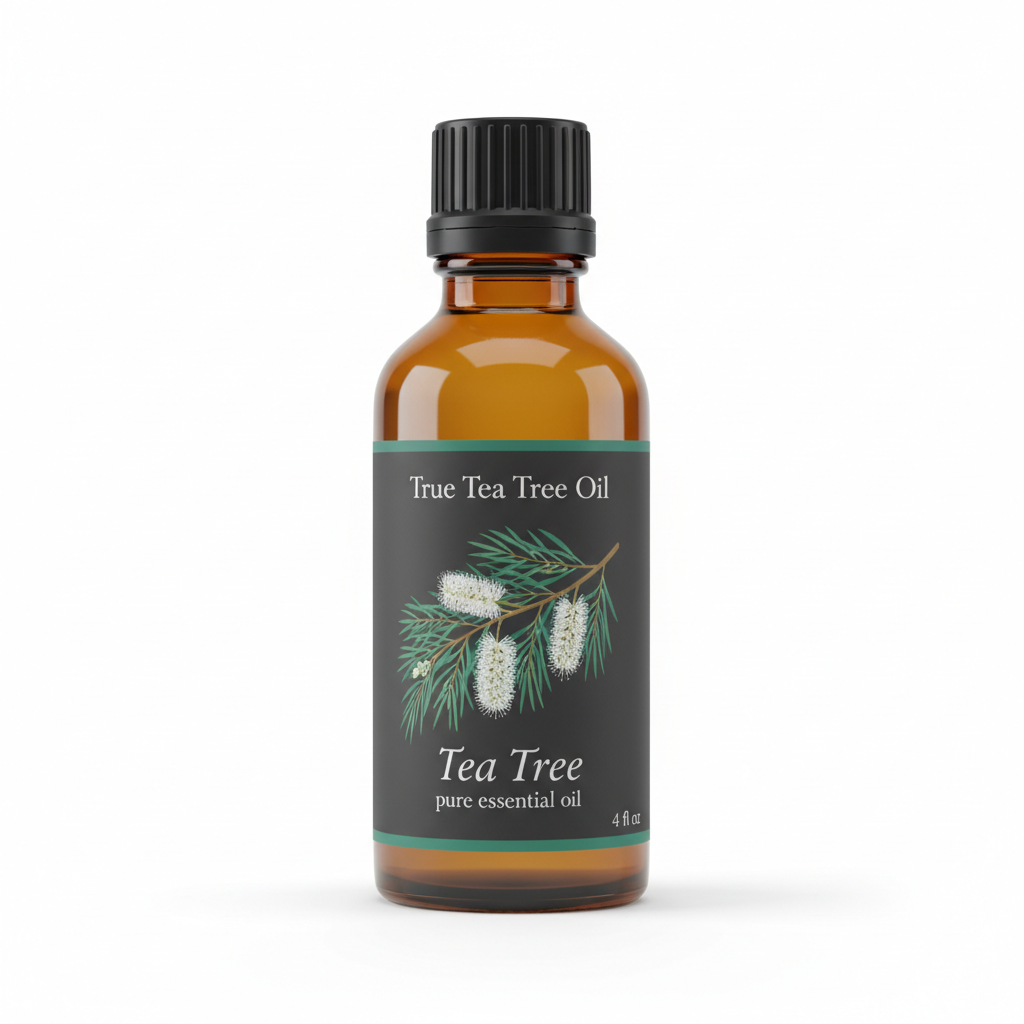
Tea Tree Essential Oil
Our own Tea Tree Essential Oil, in sizes from 0.5 oz to bulk.
From $10.99
Shop Now →Store it like something you want to keep
Poison Control, the US National Capital Poison Center's service, is direct about essential oils in homes with small children: keep them locked up, out of the sight and reach of children and pets, and consider discarding them if you have very young ones. It also notes that children have thin skin and immature livers, which may make them more susceptible to toxic effects than adults.
In practice, high and closed beats clever. A cabinet above shoulder height that a climbing toddler cannot reach with a stool is the baseline. Out of sight helps as much as out of reach: a bottle a child has never noticed is safer than one on a low shelf, even a locked one. A child-resistant cap is a useful backup and no substitute for placement, and a cap left loose after use gives no protection at all. A tightly capped bottle also stays in better shape, because oil changes with light and air. Our storage guide covers that side of things.
If a child swallows some
Swallowing is the situation worth rehearsing once, calmly, before it ever happens. Poison Control says that if someone swallows an essential oil you should use its online tool or call 1-800-222-1222, where expert guidance is free, confidential and available around the clock. Do that before searching the internet. A 2023 safety review of 159 adverse-event reports concluded that tea tree oil should never be taken by mouth, because it can lead to central nervous system depression and pneumonitis. Poison Control adds that choking while swallowing an oil can send some into the lungs, which can cause pneumonia. Our guide on swallowed tea tree oil goes through what to have ready when you call.
Why we keep the tone calm
None of this is meant to frighten anyone. Plenty of households keep a bottle of tea tree oil and never have a moment's trouble, because the bottle lives somewhere sensible and everyone knows the rules. A calm, steady routine is more reliable than worry, and it leaves you free to enjoy the scent when the house is quiet.
Skin, babies and the bath
Here we keep things simple. The European consumer-safety opinion on tea tree oil, from October 2025, sets its limits for adults only. For children, there is no figure we can offer, and we do not give one. Our own guidance of 0.5% to 2% in a carrier oil with a patch test first is written for adult skin. For babies and children, we recommend leaving tea tree oil off and, if you are curious, asking your child's pediatrician before using it at all.
A few other habits follow naturally. Oil floats on bathwater in small undiluted beads that can touch skin at full strength, so the bath is a poor place for it. The face is close to the eyes, nose and mouth, and a small child cannot be expected to protect them, so we would keep tea tree away from a young child's face altogether. If a rash or any skin reaction appears, Poison Control says to stop and wash the oil off gently. Damaged skin is never the place for an essential oil. For finished products that contain tea tree oil, such as shampoos, the guidance from Poison Control is to use them according to the label directions, so follow the age advice printed there and ask your pediatrician about anything that is unclear. If you want the adult routine, our patch test steps and dilution guide are the ones to follow.
Habits that make it easy to remember
Safety around kids is mostly a matter of routine, so make the routine simple. Put the bottle back the moment you are done with it. Keep the poison control number, 1-800-222-1222, saved in your phone so it is there when you need it. Zip bags that hold a bottle and keep them off the floor, and tell grandparents and babysitters where things live.
As children get older, a calm explanation does more than a scolding. Tell them that the bottle is not a toy and not a perfume, that it is strong, and that grown-ups handle it. A plain rule that everyone knows is safer than a clever one that only you remember.
Air in a family home
Diffusing is a separate conversation. Poison Control notes that vaporizers add only small amounts of oil to a large volume of water, and also that reed diffuser liquid is an essential oil in rubbing alcohol that must stay out of children's reach. If you diffuse, ventilate the room, keep sessions short, and put the device where a child cannot knock it over. A pediatrician is the right person to ask about a baby's room. Our diffuser guide covers the machine side.
A tea tree bottle can sit happily in a family bathroom cabinet: closed, high up and on the list of things only adults handle.
Tea Tree Essential Oil
Tea Tree Essential Oil from our own shop, in sizes from 0.5 oz to bulk.
From $10.99
Shop Now →Sources & Further Reading
- Essential oils: Poisonous when misused, Poison Control (National Capital Poison Center).
- Safety assessment and adverse drug reaction reporting of tea tree oil (Melaleuca aetheroleum), Phytotherapy Research, 2023.
- SCCS - Scientific Opinion on Tea Tree Oil (CAS/EC No. 68647-73-4 /285-377-1), European Commission, SCCS/1681/25.