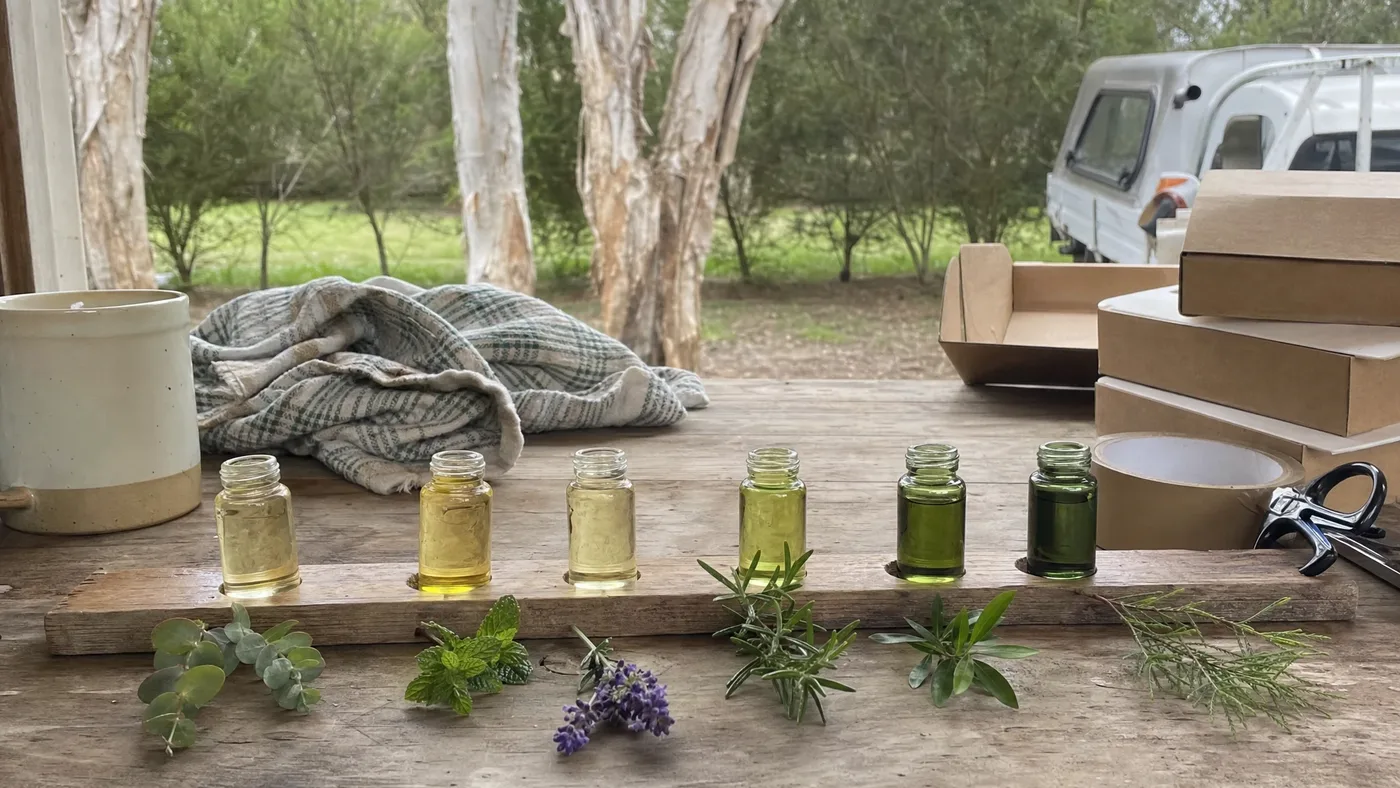
Tea Tree vs Eucalyptus, Lavender, Lemon and Peppermint
A shelf of essential oils is really a shelf of smells, and every bottle has a clear job once you know what is doing the talking inside it. Tea tree, eucalyptus, lavender, lemon and peppermint are five of the most reached-for oils, and each one gets its personality from a different lead molecule. Pick by that, and the question "which one?" mostly answers itself.

Tea Tree Essential Oil
Our own Tea Tree Essential Oil, in sizes from 0.5 oz to bulk.
From $10.99
Shop Now →Five bottles, five lead notes
Tea tree is built on terpinen-4-ol, around 40 percent of the oil in the European Food Safety Authority's batches. PubChem's odor entry for the compound reads simply "pine," and that fits the crisp, green, camphorous character we describe for our Australian and South African oils. It is clean and herbal rather than sweet.
Eucalyptus is almost entirely 1,8-cineole, about 80 percent on average in the batches EFSA analysed, and the odor entry for cineole is "camphor-like." It is the loudest of the group: a sweep of open, minty-camphor air.
Lavender is the soft one. Its oil is led by linalyl acetate and linalool, together nearly two-thirds of the oil in EFSA's batches, and linalool's records describe a floral, slightly spicy, woody smell.
Lemon is led by limonene, roughly 65 percent of expressed lemon oil in EFSA's ten batches, and limonene's odor entry is "citrus." Peppermint is led by menthol, around 40 percent, with menthone behind it, and menthol's records say "peppermint" and "cooling." The molecules map almost directly onto the way each bottle smells.
Matching oil to room
Because the lead notes differ, the oils cover different moods rather than competing. Lavender suits linen drawers and quiet corners. Lemon brightens a kitchen. Peppermint is a sharp, wakeful note for a desk. Eucalyptus fills big rooms and bathrooms with a clean, airy scent. Tea tree sits between them as the herbal, green option, and it is the one that makes the others better company. That is the reasoning behind the pairings we suggest for our tea tree oils: lemon, lavender, rosemary, eucalyptus and peppermint all blend well with it, and each adds something the others lack.
A practical way to build on that: start with tea tree for the green backbone, then add one oil from the list for a purpose. Lemon lifts it, lavender rounds it, eucalyptus opens it up, peppermint sharpens it. If you want a closer comparison of tea tree and lavender, our piece on tea tree and lavender goes through it, and the scent pairing guide has more combinations to try.
A shelf-side sniff test
The easiest way to learn these five is to smell them in a row. Put a drop of each on its own paper strip, write the name on it and wait a minute. Work from the gentlest to the strongest so the louder ones do not flatten your nose too early: lavender, lemon, tea tree, peppermint, eucalyptus is a sensible order. Between oils, take a breath of plain air. Write down one word for each, and you will have your own map of the shelf.
Small cautions worth knowing
A few notes keep this tidy. Cold-pressed citrus oils such as expressed lemon contain furocoumarins, which EFSA notes may cause phototoxicity on skin, so keep them off skin that will be in strong sun. Eucalyptus is the oil to keep away from babies' faces: the European Medicines Agency's assessment recommends that eucalyptus preparations not be applied to or near the face of babies and very young children, because of a risk of reflex spasm of the glottis. And with every oil here, dilute for skin, patch test, and keep bottles away from children and pets.
For our tea tree oils, we recommend 0.5 to 2 percent in a carrier. Europe's Scientific Committee on Consumer Safety set its 2025 maximums for finished products at 2 percent for shampoo, 1 percent for shower gel and face wash, and 0.1 percent for face cream, so we begin at the lower end and treat 2 percent as a ceiling to approach carefully, not a target. Our dilution guide shows the arithmetic.
Picking one for a purpose
- For a bathroom or gym bag: tea tree, for its clean, herbal edge.
- For a big, airy room: eucalyptus, which fills a space quickly.
- For a linen cupboard: lavender, for something soft and floral.
- For a kitchen: lemon, for brightness.
- For a desk: peppermint, for a sharp, minty note.
These are scent suggestions, not promises about what any oil will do for you, and the choice is yours. If you cannot decide, begin with the one that made you reach for the strip a second time.
What we sell, and where to find the rest
We sell tea tree essential oil, one listed as Australian and one as South African, both Melaleuca alternifolia. Lavender, lemon, peppermint and eucalyptus are on the shelves of craft and supply shops and many pharmacies, so you can shop for them there and bring them home to a tea tree base.
Choose the lead note you want in the room, and the bottle follows.
Tea Tree Essential Oil
Tea Tree Essential Oil from our own shop, in sizes from 0.5 oz to bulk.
From $10.99
Shop Now →Sources & Further Reading
- Safety and efficacy of a feed additive consisting of an essential oil derived from leaves and terminal branchlets of Melaleuca alternifolia (Maiden & Betche) Cheel (tea tree oil) for use in all animal species (FEFANA asbl), EFSA Journal, 2024
- Safety and efficacy of a feed additive consisting of an essential oil derived from Eucalyptus globulus Labill. (eucalyptus oil) for all animal species (FEFANA asbl), EFSA Journal, 2023
- Safety and efficacy of a feed additive consisting of an essential oil derived from the flowering tops of Lavandula angustifolia Mill. (lavender oil) for use in all animal species (FEFANA asbl), EFSA Journal, 2024
- Safety and efficacy of feed additives consisting of expressed lemon oil and its fractions from Citrus limon (L.) Osbeck and of lime oil from Citrus aurantiifolia (Christm.) Swingle for use in all animal species (FEFANA asbl), EFSA Journal, 2021
- Safety and efficacy of a feed additive consisting of an essential oil derived from the aerial parts of Mentha × piperita L. (peppermint oil) for use in all animal species (FEFANA asbl), EFSA Journal, 2025
- Linalool (PubChem compound record, Odor section), National Library of Medicine
- 1,8-Cineole (PubChem compound record, Odor section), National Library of Medicine
- (+)-Limonene (PubChem compound record, Odor section), National Library of Medicine
- Menthol (PubChem compound record, Odor section), National Library of Medicine
- Terpinen-4-ol (PubChem compound record, Odor section), National Library of Medicine
- Assessment report on Eucalytus globulus Labill., Eucalyptus polybractea R.T. Baker and/or Eucalyptus smithii R.T. Baker, aetheroleum, European Medicines Agency
- SCCS - Scientific Opinion on Tea Tree Oil (CAS/EC No. 68647-73-4 /285-377-1), European Commission, 2025