Tea Tree vs Eucalyptus Oil: Which One Fits Your Room?
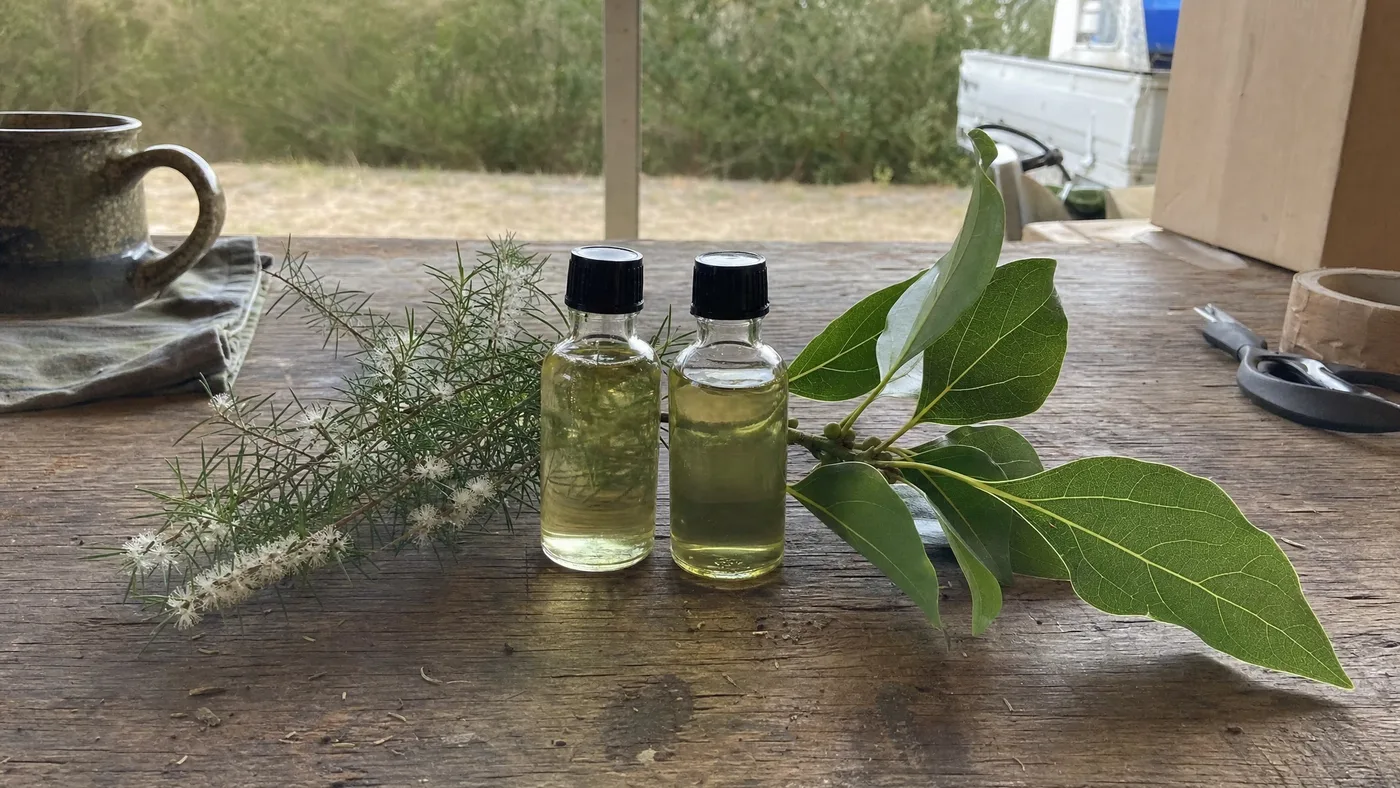
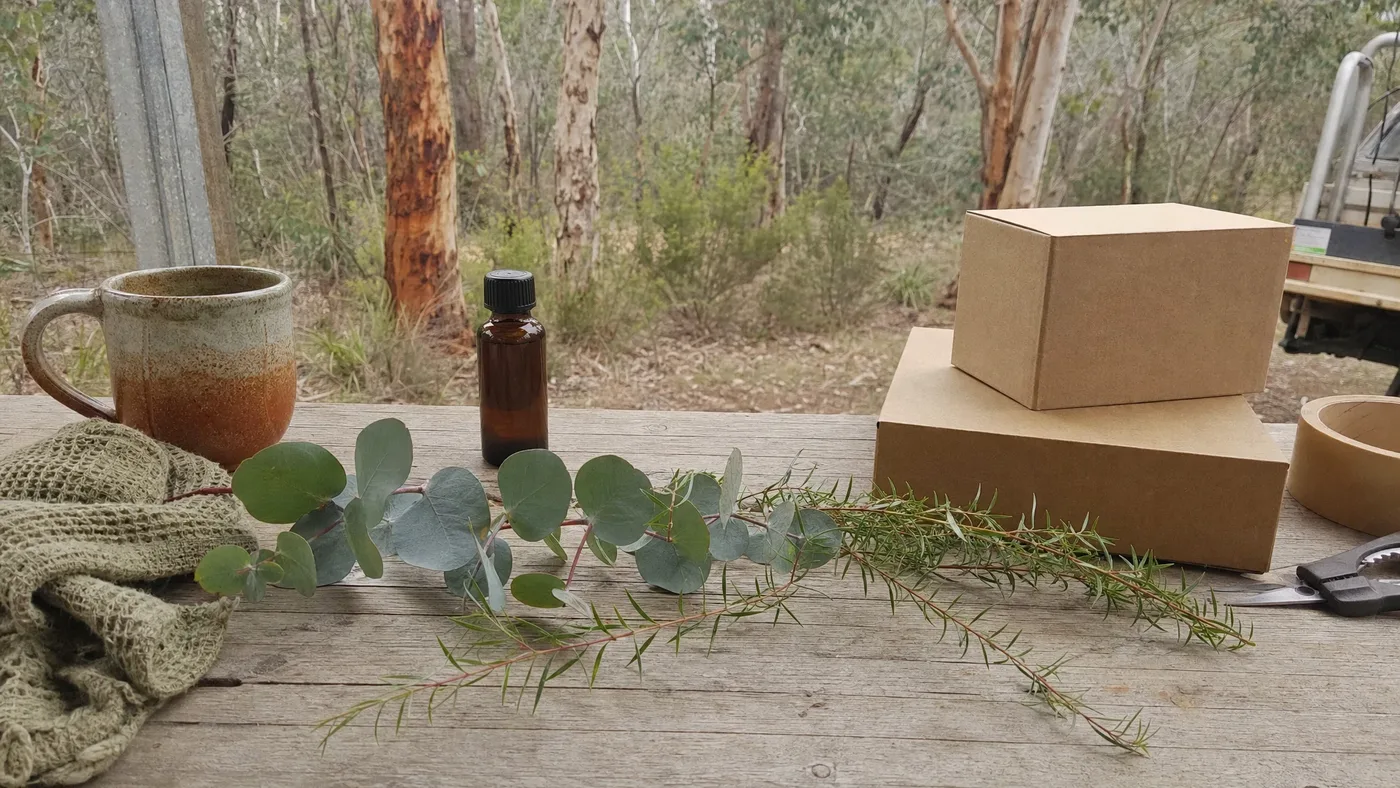
Tea tree and eucalyptus are the two greens on most oil shelves, and they get compared constantly: both clean, both bracing, both happy in a diffuser. The difference becomes obvious the moment you smell them side by side. Tea tree is resinous and herbal, a little like pine and camphor. Eucalyptus is airier and louder, a camphor-like sweep that fills a room. Chemistry explains why, and it also tells you where each one fits at home.

Tea Tree Essential Oil
Our own Tea Tree Essential Oil, in sizes from 0.5 oz to bulk.
From $10.99
Shop Now →One shared molecule, very different amounts
Both oils contain 1,8-cineole, which is where much of the family resemblance comes from. The amounts, though, are worlds apart. In the European Food Safety Authority's batch analyses, tea tree oil averaged about 2.4 percent cineole, with terpinen-4-ol around 39 percent as the lead. Eucalyptus globulus oil averaged about 79.5 percent cineole across seven batches, with limonene and alpha-pinene as supporting players. The European Pharmacopoeia sets the minimum for the oil at 70 percent. One is a blend led by an alcohol with some pine character, and the other is practically one compound with a few helpers.
PubChem's odor records sum it up neatly: terpinen-4-ol is "pine" and 1,8-cineole is "camphor-like." That is the difference you smell, and it is why eucalyptus is often the first oil people notice from across a room. Our tea tree scent guide describes what to expect from the other side.
Which green for which room
Our Australian tea tree is described as crisp, green and camphorous with a faint earthy undertone, and our South African oil as crisp and camphorous with a fresh, clean edge. That makes tea tree a flexible, mid-weight scent: it works in a small diffuser session, in a diluted body oil and in a cleaning spray, and it is the kind of oil that sits nicely with others. Eucalyptus is the bigger gesture. In a large living room or a bathroom, it fills the space quickly. In a small, closed room it can become a lot very fast.
Which should you choose? For a scent you will live with daily, a steady, herbal tea tree is the easier companion. For an occasional burst of open, minty air, eucalyptus. And since both of them appear in the list of oils that blend well with our tea tree, you can use them together; the Southern Cross blend shows one way to balance them, with eucalyptus as the smallest part.
Picture each one in use
It helps to imagine a specific moment. Take a small bathroom after a shower: a short diffuser session with tea tree, following your diffuser's own guidance, gives a gentle, herbal freshness that stays in the background. Eucalyptus in the same room announces itself the moment you open the door. Neither is better; it is a question of how much presence you want.
The same goes for a desk, a hallway or a gym bag. Tea tree tends to read as clean and tidy, and eucalyptus reads as open air and wide windows. If you share a space with other people, start with the quieter one and let them tell you whether it needs more.
Where the safety notes differ
Both oils are for outside the body and both belong away from children and pets. Past that, the details diverge. For tea tree, we recommend diluting to between 0.5 and 2 percent in a carrier with a patch test, and we begin at the low end: Europe's Scientific Committee on Consumer Safety classes tea tree as a moderate skin sensitiser and, in 2025, set its limits for finished products at 0.1 percent in face cream, 1 percent in face wash and 2 percent in shampoo. Our dilution guide shows how to do the arithmetic.
For eucalyptus, the European Medicines Agency's assessment recommends that eucalyptus preparations not be applied to or near the face of babies and very young children, because the strong cooling smell can trigger a reflex spasm of the glottis. So a eucalyptus diffuser belongs well away from a baby's room and sleeping area, and we would hold off on both oils around infants. Households with pets should consult a veterinarian before diffusing anything, and any dog, cat or bird owner will find our posts on dogs and cats worth a read.
How to compare them yourself
The most reliable way to choose is to smell them one after the other. Put a drop of each on its own paper strip, label the strips, and wait about a minute so the first sharp burst settles. Sniff tea tree, take a breath of plain air, then sniff eucalyptus. Notice which one you want to smell again. That small, slightly silly exercise tells you more than any description, ours included.
Buying notes
We sell tea tree oil, in two listed origins, and no eucalyptus, so for eucalyptus you will look to a craft or supply shop or pharmacy. Look for the Latin name on the label: the monograph above covers Eucalyptus globulus, polybractea and smithii, and other eucalyptus species have different chemistry, so the botanical name is how you know what you are getting.
Two greens, two jobs: tea tree for the everyday companion, eucalyptus for the big open breath.
Tea Tree Essential Oil
Tea Tree Essential Oil from our own shop, in sizes from 0.5 oz to bulk.
From $10.99
Shop Now →Sources & Further Reading
- Safety and efficacy of a feed additive consisting of an essential oil derived from leaves and terminal branchlets of Melaleuca alternifolia (Maiden & Betche) Cheel (tea tree oil) for use in all animal species (FEFANA asbl), EFSA Journal, 2024
- Safety and efficacy of a feed additive consisting of an essential oil derived from Eucalyptus globulus Labill. (eucalyptus oil) for all animal species (FEFANA asbl), EFSA Journal, 2023
- Assessment report on Eucalytus globulus Labill., Eucalyptus polybractea R.T. Baker and/or Eucalyptus smithii R.T. Baker, aetheroleum, European Medicines Agency
- Terpinen-4-ol (PubChem compound record, Odor section), National Library of Medicine
- 1,8-Cineole (PubChem compound record, Odor section), National Library of Medicine
- SCCS - Scientific Opinion on Tea Tree Oil (CAS/EC No. 68647-73-4 /285-377-1), European Commission, 2025