Tea Tree Oil Country of Origin: Does It Matter?
Tea tree oil is one of those products where the country on the label gets a lot of attention, and it is easy to see why. Australia is where the industry began, and "Australian tea tree oil" has long been shorthand for quality. But the label tells only part of the story, and the more interesting part is what the oil is made of.

Tea Tree Essential Oil
Our own Tea Tree Essential Oil, in sizes from 0.5 oz to bulk.
From $10.99
Shop Now →The standard reads the chemistry, not the passport
The international standard for tea tree oil, ISO 4730, defines the terpinen-4-ol type by its composition. As Carson, Hammer and Riley lay out, it asks for at least 30% terpinen-4-ol, 10 to 28% gamma-terpinene, 5 to 13% alpha-terpinene and no more than 15% 1,8-cineole, among other ranges. Those numbers describe a chemical fingerprint, and an oil is measured against the fingerprint wherever the trees stand. That is why a certificate with real composition figures says more than a flag can.
It also explains why the species is only part of the answer. The same review describes six chemotypes of Melaleuca alternifolia, only one of which, the terpinen-4-ol type, is used for the commercial oil. Choosing the right planting stock matters as much as choosing the right country.
How the story spread beyond Australia
Australia built the industry. AgriFutures Australia describes a rise from a cottage industry to an export business with yields climbing from 100 to 150 kilograms of oil per hectare to 350 to 450 for newer cultivars. In 2005, He Chunmao of the Guangxi Forestry Research Institute wrote that Australia then held about 99% of the tea tree oil market and was regarded as the benchmark supplier for quality.
That same paper tells how production began elsewhere. Commercial development in Guangxi, China started in the mid-1990s from unselected seed of obscure identity, and the early oil came out in low yields with low terpinen-4-ol. A research program began in 1998 to bring in selected Melaleuca stock and refine Australian practice for local conditions. By the time of the paper, the institute reported 40 to 50 tons a year of what it called high quality oil, at 40 to 50% terpinen-4-ol and under 3% cineole, from selected planting stock. Those are the producer's own figures, so they deserve a note of caution, but they show the point clearly: a young industry in a new country could meet, and even beat, the standard's thresholds once the planting material was right.
What this means when you buy
Put those pieces together and a practical rule emerges. Origin is a useful clue about the supply chain, and a good starting question, but it does not guarantee what is in the bottle. Composition does. A buyer who cares about the details has two sensible habits:
- Look at what documentation exists. A gas chromatography report listing terpinen-4-ol, cineole and the other main components is the document that speaks to the standard directly.
- Remember that a document describes the batch it was made for. AgriFutures notes that substitution and misrepresentation have been on the rise, which is a good reason to ask for paperwork in writing.
Questions worth asking any seller
If you are comparing tea tree oils, a handful of plain questions will tell you a lot:
- What species is it, and does the label say so?
- What part of the plant was used?
- Is there a document, and which batch does it describe?
- Can the seller put the answer in writing?
- What does the document actually list: composition, or only a few physical properties?
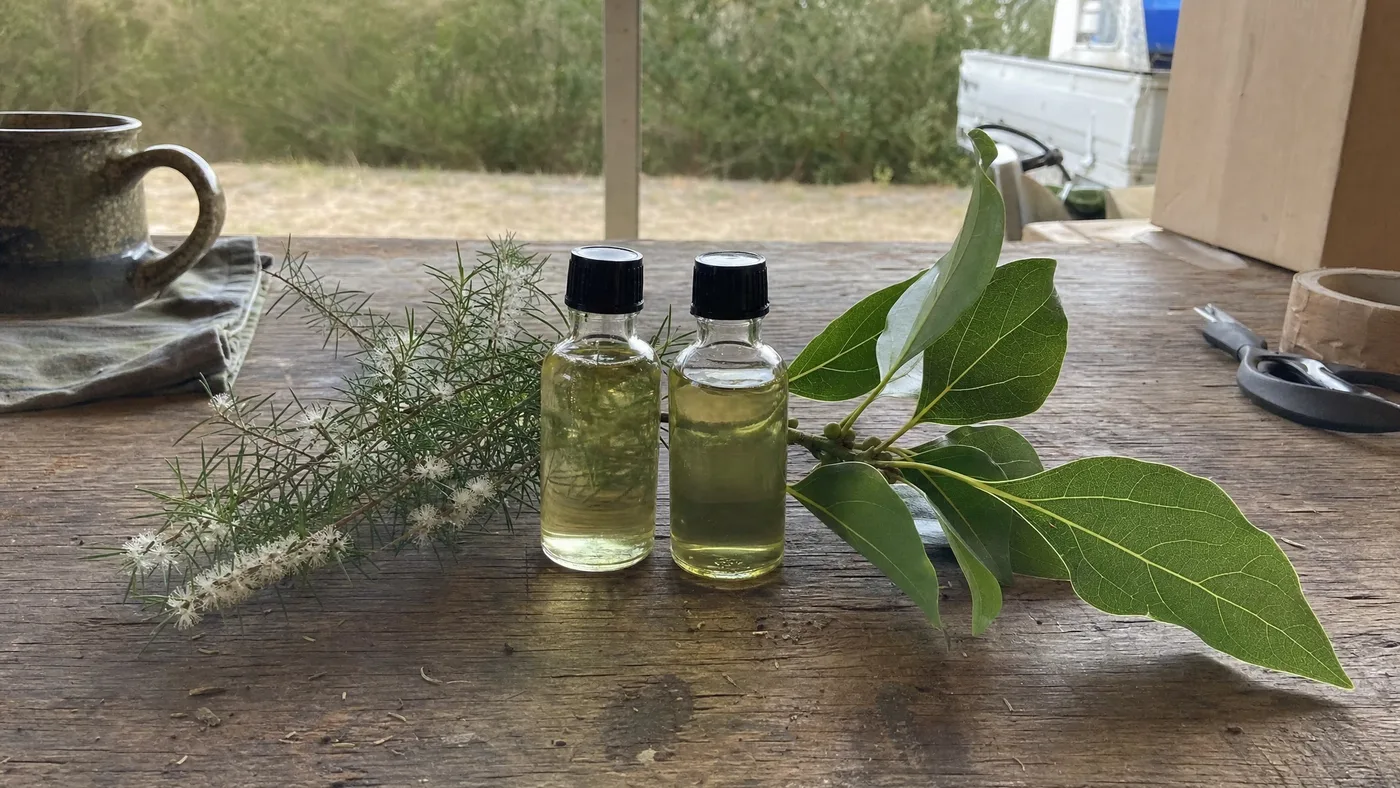
If you are curious about the aroma side, there is a simple, pleasant exercise. Put a drop of each of our two oils on separate cotton balls, smell them side by side from a few inches away, and notice how they differ. Both are crisp, green and camphorous, and the pages describe one with a faint earthy undertone and the other with a fresh, clean edge. We invite you to compare them in your own formulas, and we do not claim that one is better than the other.
A clear, specific answer is a good sign, and a vague one is worth noticing. We would sooner you asked than guessed, and we are glad to answer questions in writing about the oils we sell.
Our two oils
We sell two tea tree oils, one listed as Australian and one as South African, both Melaleuca alternifolia. Our listing for the Australian oil describes the aroma as crisp, green and camphorous with a faint earthy undertone, and the South African listing describes it as crisp, green and camphorous with a fresh, clean edge, closer to medicinal-herbal freshness than to sweetness. We invite customers to compare them in their own formulas, and we do not claim one is better than the other.
On documents, the Certificate of Analysis we publish covers one batch of the Australian oil and lists its relative density, refractive index and optical rotation. It does not include a gas chromatography report. If you need a composition report, or paperwork for the South African oil, ask us in writing through our contact page and get the answer in writing before you rely on it.
For more on how the leaf becomes oil, see our guide to how tea tree oil is made, and for a deeper look at the composition numbers, the notes on terpinen-4-ol. If you are comparing bottles from different sellers, our piece on reading label, lab report and price may help.
In the end, the country tells you where to start asking questions, and the chemistry tells you what the answers should look like.
Tea Tree Essential Oil
Tea Tree Essential Oil from our own shop, in sizes from 0.5 oz to bulk.
From $10.99
Shop Now →Sources & Further Reading
- Carson CF, Hammer KA, Riley TV. Melaleuca alternifolia (Tea Tree) oil: a review of antimicrobial and other medicinal properties. Clinical Microbiology Reviews, 2006
- AgriFutures Australia. Tea tree oil: from cottage industry to export powerhouse, 9 October 2018
- He C. The Developing Tea Tree Oil Industry in Guangxi Province, P.R. China. Perfumer & Flavorist, October 2005