Best Oils to Blend With Tea Tree, and Why They Work
Open a bottle of tea tree oil and the first thing you notice is how green it is: crisp, sharp and a little camphorous, with an earthy note underneath. It is a top note, which means it arrives first and fades first, and that single fact decides almost everything about what blends well with it. Some oils extend that bright opening, and some give it something to rest on.

Tea Tree Essential Oil
Our own Tea Tree Essential Oil, in sizes from 0.5 oz to bulk.
From $10.99
Shop Now →Echo it, or contrast it
Blending by scent family works, but blending by shared chemistry explains why certain pairings feel natural. Commercial tea tree oil is built around terpinen-4-ol, with a supporting cast of gamma-terpinene, alpha-terpinene, a little 1,8-cineole and a trace of pinene and limonene, according to the composition table in the Carson, Hammer and Riley review. An oil that shares some of that cast will sit beside tea tree comfortably. An oil that brings something different, soft and floral or deep and woody, gives the blend a second dimension.
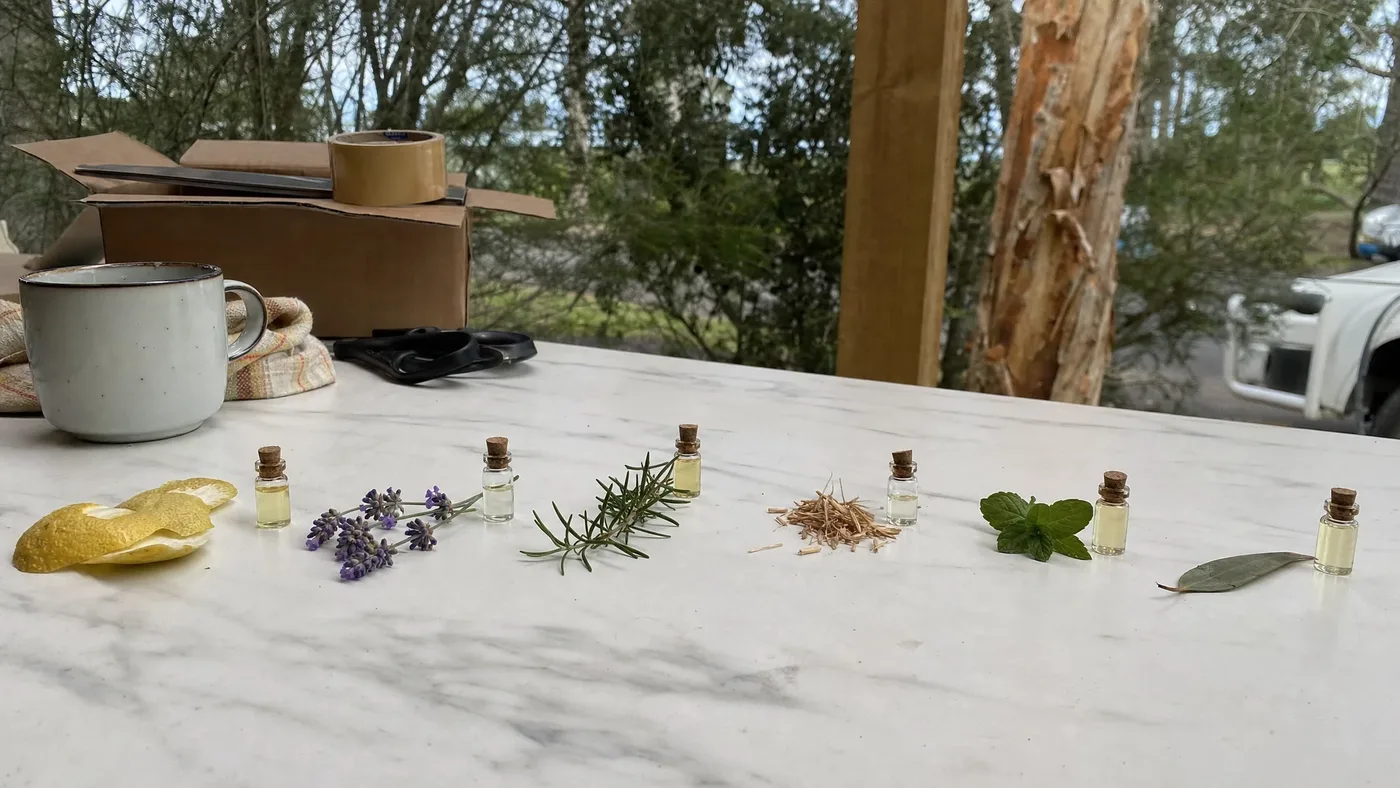
Our listings for both our Australian and South African tea tree oils suggest lemon, lavender, rosemary, eucalyptus and peppermint, and the South African listing adds cedarwood. We do not sell those oils, so you would find them at a craft or supply shop, a pharmacy or a health store. What follows is why each one earns its place.
The echoes: lemon, eucalyptus and rosemary
Lemon is the most interesting echo. An EFSA assessment of expressed lemon oil puts limonene at 60 to 73% of the oil, which is why lemon smells so sweet and bright, but it also lists gamma-terpinene at 6 to 12%. That same compound is one of tea tree oil's backbone ingredients. Put them together and the lemon lifts the green edge into something cleaner and more sparkling, while the shared terpinene keeps the two from sounding like strangers.
Eucalyptus and rosemary share the cooling, camphorous side. The EFSA assessment of rosemary oil reports 1,8-cineole at an average of about 34% (range 17 to 49% across batches) with alpha-pinene near 17%, and eucalyptus oil, once rectified, can pass 70% cineole. Tea tree contains cineole too, only far less. A drop or two of either one pushes the blend toward that clear, open-the-window freshness. Because they are loud, we would keep them to a minority share of the blend so tea tree still reads as the lead.
The contrasts: lavender and cedarwood
Lavender is the soft landing. Lavender oil's main components, per the EFSA assessment, are linalyl acetate (roughly 25 to 47%) and linalool (20 to 45%), both gentle, sweet and floral. Little in tea tree overlaps with those, so lavender rounds off the sharpness instead of matching it. If you find tea tree a little stern on its own, lavender is the pairing to try first.
Cedarwood works in the opposite direction. Where lavender softens, cedarwood grounds, adding a dry, woody base that gives the green top something to stand on. Since tea tree fades quickly, a base note like this also helps a blend keep its shape over an hour rather than trailing away to nothing.
Peppermint, the odd one out
Peppermint is a different kind of cool. Its character comes from menthol, which the EFSA assessment lists at 30 to 55% of the oil, together with menthone. That is a minty chill rather than tea tree's herbal freshness, and the two do not overlap chemically. Blended lightly, a hint of peppermint sharpens the whole thing. Blended heavily, it takes over, so we would treat it as an accent.
A few ways to smell your way there
Before you make anything, line the bottles up and smell them one at a time on separate cotton balls or paper strips, then hold two together under your nose. Your nose will often tell you within seconds whether two oils want to be neighbours. Wait a minute and come back, because a top note like tea tree changes as it fades, and the second sniff is often the more honest one. Jot a word or two beside each pairing you try, and by the end of the afternoon you will have a recipe card of your own.
Building a blend you will like
Here is a simple way to start, offered as a suggestion rather than a tested formula. Pick a lead (tea tree), one partner from the echo group, and one from the contrast group. Keep the proportions to something like three parts tea tree, one part of each partner, then smell it on a cotton ball before committing. Adjust by single drops. Scent preferences vary enormously, and a blend that smells right to you on the day is the right blend. If you plan several trial blends, our shop lists the sizes we sell, and our bulk page and guide to buying tea tree oil in bulk cover larger ones.
For anything that touches skin, the blend, not just the tea tree, counts toward your total. Our dilution guidance of 0.5% to 2% in a carrier oil refers to the oil as a whole, so a three-oil blend still goes in at that level overall, and the patch test still comes first. For unfamiliar mixes, our guide to ratios, carriers and patch tests shows how to scale it. If you are choosing partners for a diffuser or room scent rather than skin, our ideas for a single drop around the home and the comparison of tea tree and eucalyptus make good next reads.
One note for households with animals: the ASPCA advises keeping essential oils well away from pets, especially cats and birds, so blend where they cannot get at it. That aside, this is a very forgiving oil to blend with, and you will probably find your favorite pairing within three or four tries.
Tea Tree Essential Oil
Tea Tree Essential Oil from our own shop, in sizes from 0.5 oz to bulk.
From $10.99
Shop Now →Sources & Further Reading
- Carson CF, Hammer KA, Riley TV. Melaleuca alternifolia (Tea Tree) oil: a review of antimicrobial and other medicinal properties. Clinical Microbiology Reviews, 2006
- EFSA. Safety and efficacy of feed additives consisting of expressed lemon oil and its fractions from Citrus limon (L.) Osbeck and of lime oil from Citrus aurantiifolia (Christm.) Swingle for use in all animal species (FEFANA asbl). EFSA Journal, 2021
- EFSA. Safety and efficacy of a feed additive consisting of an essential oil derived from Eucalyptus globulus Labill. (eucalyptus oil) for all animal species (FEFANA asbl). EFSA Journal, 2023
- EFSA. Safety and efficacy of a feed additive consisting of an essential oil derived from the flowering aerial parts of Salvia rosmarinus Spenn. (rosemary oil) for use in all animal species (FEFANA asbl). EFSA Journal, 2025
- EFSA. Safety and efficacy of a feed additive consisting of an essential oil derived from the flowering tops of Lavandula angustifolia Mill. (lavender oil) for use in all animal species (FEFANA asbl). EFSA Journal, 2024
- EFSA. Safety and efficacy of a feed additive consisting of an essential oil derived from the aerial parts of Mentha × piperita L. (peppermint oil) for use in all animal species (FEFANA asbl). EFSA Journal, 2025
- ASPCA. Is the Latest Home Trend Harmful to Your Pets? What You Need to Know!