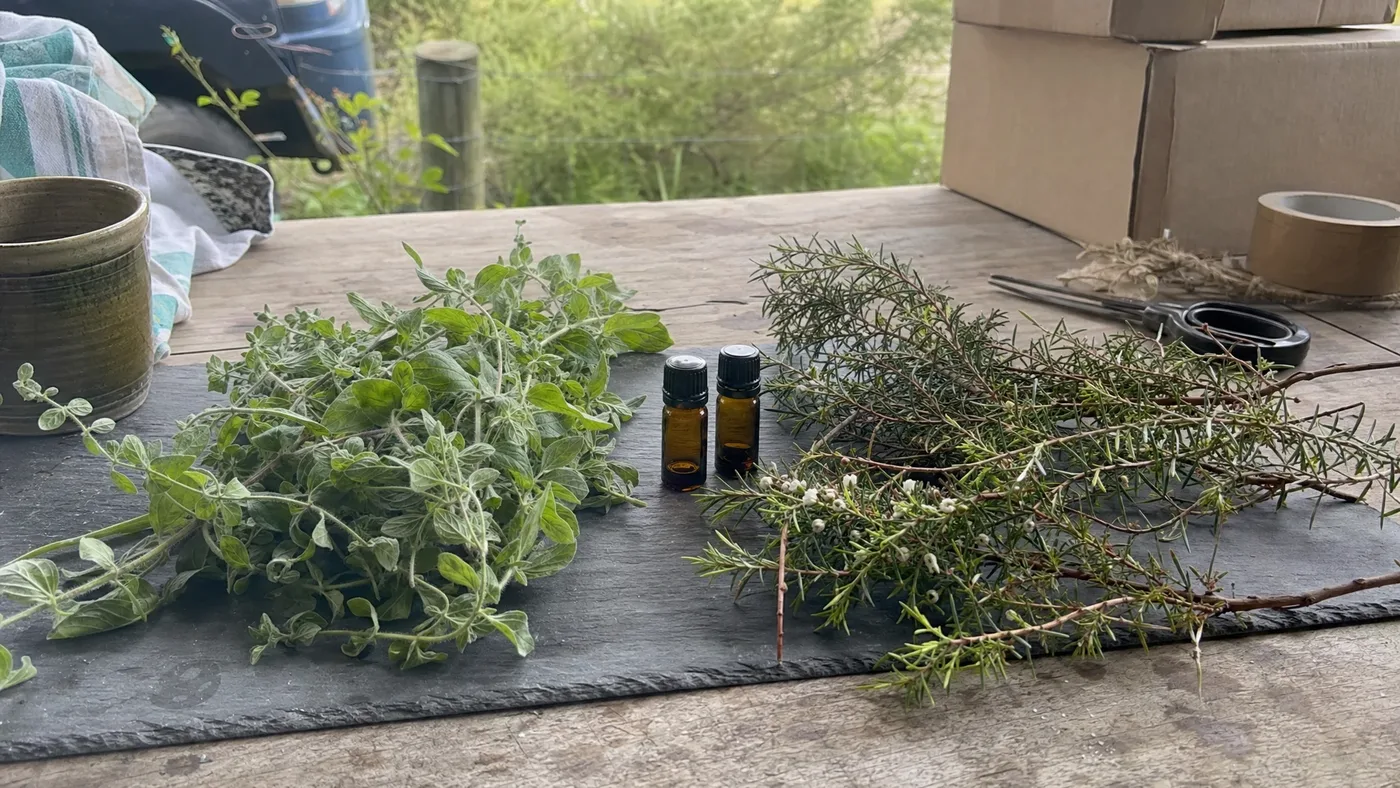
Tea Tree vs Oregano Oil: Two Strong Smells, Two Rules
Put tea tree and oregano on the same shelf and they look like cousins: small amber bottles, strong smells, big reputations. Open them and the resemblance ends. One is built around a terpene alcohol that has a long record in cosmetic formulas. The other is built around a phenol, and that single fact changes how you handle it, how much you use and where you would want it to smell.

Tea Tree Essential Oil
Our own Tea Tree Essential Oil, in sizes from 0.5 oz to bulk.
From $10.99
Shop Now →What is actually in each bottle
Tea tree oil is a blend of many compounds, and the lead is terpinen-4-ol, typically around 40 percent, with gamma-terpinene and alpha-terpinene behind it. It is a family of terpenes and terpene alcohols, and the published standard for the oil is built around keeping that balance in range.
Oregano oil is much more lopsided. When the European Food Safety Authority analysed five batches of oregano oil from Origanum vulgare subspecies hirtum, carvacrol, a phenol, averaged about 78 percent of the oil, with thymol a distant second. One compound is carrying nearly the whole oil, and it is the kind of compound that bites. The same assessment classed the oil as an irritant to skin and eyes and a possible skin and respiratory sensitiser. PubChem's odor entries for carvacrol read "thymol odor" and "medicinal smoke odor," which anyone who has opened a bottle will recognise.
What that means at the bench
An oil that is mostly one irritating phenol deserves a more careful hand than an oil of mixed terpenes, so the dilution you might use for tea tree does not carry over. We do not sell oregano oil, so we would send you to an authoritative aromatherapy safety reference for the right figure for your use, and to a qualified professional if you have a medical question.
Tea tree has its own sensible limits, which is worth saying plainly. Europe's Scientific Committee on Consumer Safety, in a 2025 opinion, called it a moderate skin sensitiser and set maximums for finished products: 2 percent in shampoo, 1 percent in shower gel and face wash, and 0.1 percent in face cream. We recommend diluting our tea tree oils to between 0.5 and 2 percent in a carrier and patch testing first, and we start at the low end. Oxidised oil is the other thing to watch, since the older literature ties allergic reactions mainly to oxidation products in aged or poorly stored oil. Our guide to storing tea tree oil covers keeping a bottle in good shape.
Respecting a strong bottle
Strength shows up in small habits. Work in a ventilated room, keep the cap on between uses, and wash your hands after handling any concentrated oil. Keep the bottle away from your eyes, because touching your face with oily fingers is the easiest way to get a stinging surprise. These are the same sensible habits for tea tree as for any bottle on your shelf, and they cost nothing.
Scent decides most purchases anyway
Here the two part ways in a way you can feel without a lab. Tea tree is crisp, green and camphorous; our Australian oil has a faint earthy undertone, and our South African oil has a fresh, clean edge. It sits comfortably in a diffuser, in a diluted body oil or in a cleaning spray, and it blends with lemon, lavender, rosemary, eucalyptus and peppermint. Oregano smells like the kitchen herb turned up to full volume. That is lovely in the right place and a lot to ask of a bedroom or a bathroom. When you read our tea tree scent guide, you can see why it has the everyday jobs and oregano does not.
A word on swallowing
Online, oregano oil is often sold as something to take by mouth. Essential oils are concentrated, and we do not recommend swallowing any of them. Our oils are external cosmetic products. If someone swallows essential oil, call Poison Control at 1-800-222-1222 straight away, and for a pet, call your veterinarian or an animal poison hotline. Questions about taking any oil for health reasons belong with a physician or pharmacist.
Smelling the difference
If you have both, use paper strips rather than the bottle openings, and keep them apart so the scents do not mix. Tea tree stays on the crisp, green side. Oregano pushes toward kitchen herbs, with a medicinal intensity you will notice even at arm's length. Give it a minute and see which one you still want to be near. That answer usually settles where each one belongs in your home.
How we would choose
If the goal is an aromatic oil you can work with confidently in a diffuser or a properly diluted skin routine, tea tree is the friendlier choice, and it comes with a well-documented profile. If you are curious about oregano, treat it as a separate project with its own reading list. For more on keeping dilutions straight, see how to dilute tea tree oil, and for how to weigh bold claims about either oil, how to read tea tree oil research.
Strong smell is not strong in the same way, and knowing the difference is what keeps a small bottle enjoyable.
Tea Tree Essential Oil
Tea Tree Essential Oil from our own shop, in sizes from 0.5 oz to bulk.
From $10.99
Shop Now →Sources & Further Reading
- Safety and efficacy of an essential oil from Origanum vulgare ssp. hirtum (Link) Ietsw. for all animal species, EFSA Journal, 2019
- Safety and efficacy of a feed additive consisting of an essential oil derived from leaves and terminal branchlets of Melaleuca alternifolia (Maiden & Betche) Cheel (tea tree oil) for use in all animal species (FEFANA asbl), EFSA Journal, 2024
- Melaleuca alternifolia (Tea Tree) oil: a review of antimicrobial and other medicinal properties, Clinical Microbiology Reviews, 2006
- SCCS - Scientific Opinion on Tea Tree Oil (CAS/EC No. 68647-73-4 /285-377-1), European Commission, 2025
- Carvacrol (PubChem compound record, Odor section), National Library of Medicine