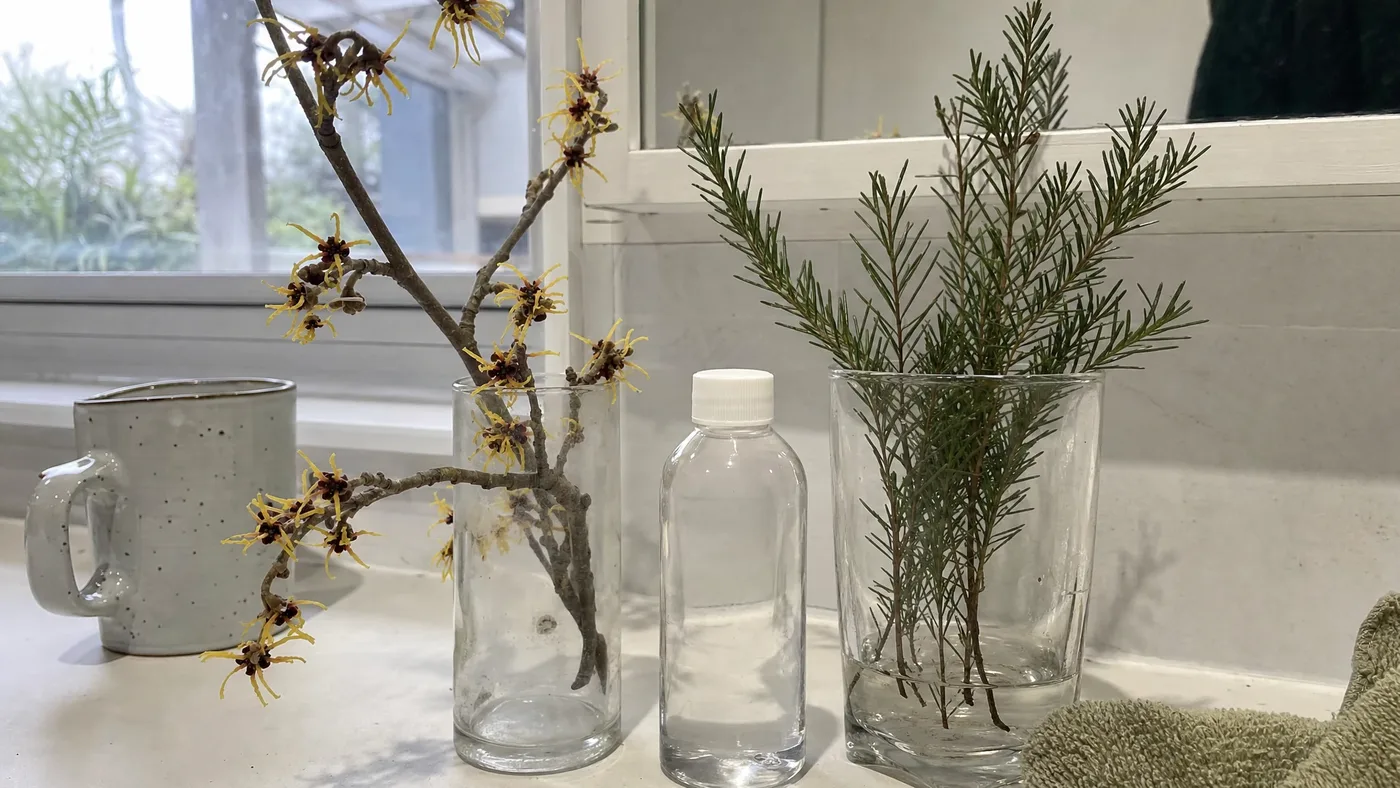
Tea Tree Oil and Witch Hazel: Why They Don't Mix
Witch hazel and tea tree oil end up on the same bathroom shelf, and that is about all they have in common. One is a water-based liquid you can tip onto a cotton pad. The other is a concentrated essential oil that belongs in a measured carrier. Seeing what each one is makes it easy to see where each one fits, and why the popular "drops of tea tree in a bottle of witch hazel" recipe does not quite work.

Tea Tree Essential Oil
Our own Tea Tree Essential Oil, in sizes from 0.5 oz to bulk.
From $10.99
Shop Now →What witch hazel really is
The familiar drugstore bottle is a distillate of witch hazel twigs, Hamamelis virginiana, with alcohol added. The United States Pharmacopeia monograph describes the process: twigs are soaked in water, distilled, and then alcohol is blended in at 150 mL per 850 mL of distillate. The finished liquid has to contain between 14 and 15 percent alcohol. So the bottle is mostly water, with a splash of alcohol, and it dries quickly with a faint woody smell. That alcohol is also why some people prefer to patch test witch hazel before regular use, and why a lighter hand suits skin that already feels dry.
What tea tree oil really is
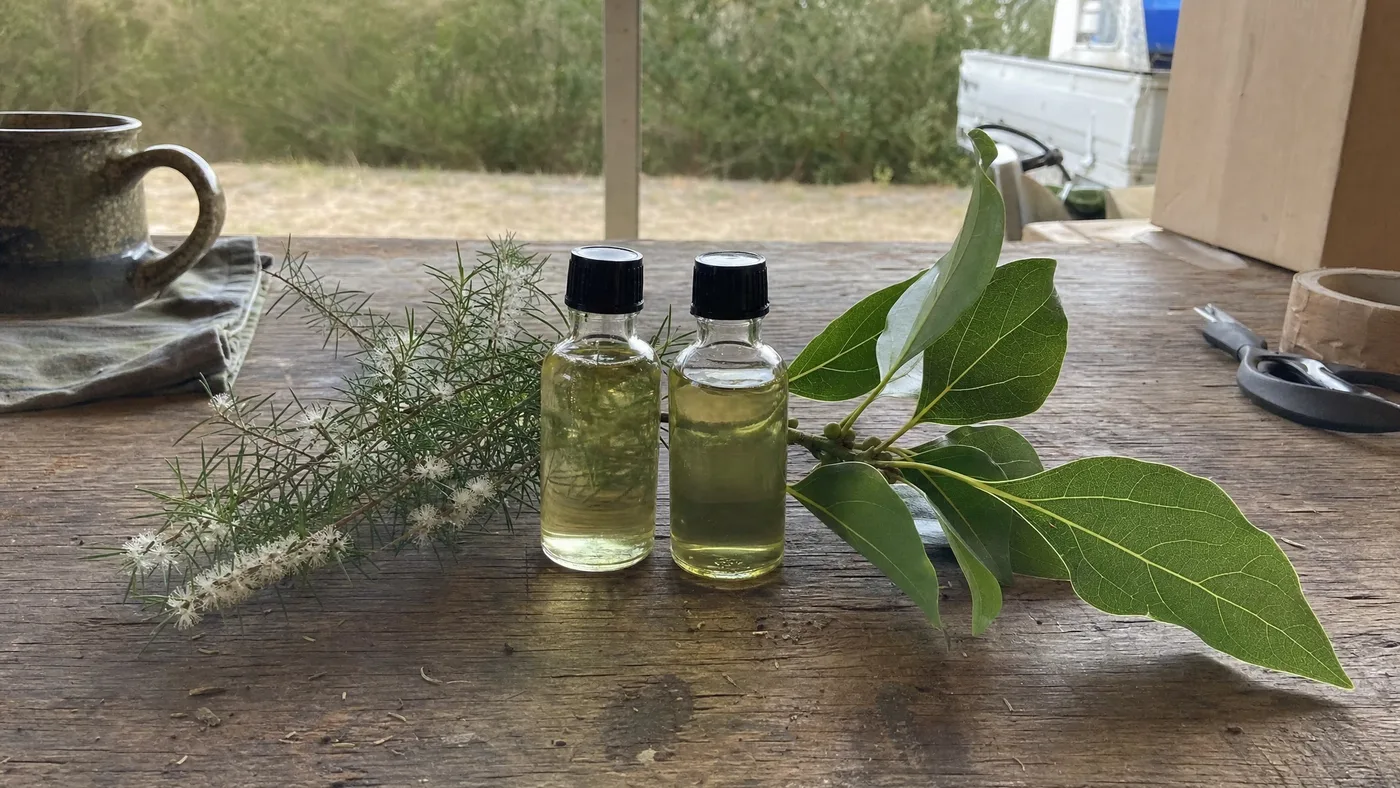
Tea tree oil is the steam-distilled leaf oil of Melaleuca alternifolia, the species in both of our bottles: one listed as Australian, one as South African. It is a concentrate made of terpenes and terpene alcohols, with terpinen-4-ol the lead compound. We recommend diluting it to between 0.5 and 2 percent in a carrier oil and patch testing first. Europe's Scientific Committee on Consumer Safety looked at tea tree in cosmetics in 2025 and put its limits at 0.1 percent in face cream and 1 percent in face wash, with 2 percent for shampoo. For anything left on the face, then, we begin at the low end of our range. Our evening routine for oily-feeling skin walks through how that looks.
Why they do not mix
Oil and water part company, and tea tree is no exception. A standard review of the oil describes it as only sparingly soluble in water: its lead compound dissolves at roughly 1,500 parts per million, which is about 0.15 percent, and most of the other main compounds dissolve far less. Witch hazel is around 85 percent water, so drops of tea tree oil float and bead instead of dispersing. Shake the bottle and you get a temporary cloud. Wipe a pad across it and one swipe may carry almost nothing while the next carries a droplet of undiluted oil.
That is a practical reason, rather than a rule of thumb, to keep the two separate. If you like the idea of a tea tree toner, the missing ingredient is a solubilizer designed to disperse oil into water, and that is a formulation project for a supply shop and a good recipe, not a few drops on a shelf. We do not sell solubilizers or witch hazel, so we point you to your local craft or drugstore.
If you want a toner anyway
The honest route is to use witch hazel on its own as the water-phase step and keep tea tree for an oil-phase step in a carrier. If you simply love the scent, you can diffuse it, following your diffuser's guidance, and let the aroma live separately from your skincare. That keeps each product doing the one job it is good at.
Where each belongs
Think in layers, thinnest first. Witch hazel is a water-phase step, swiped on after cleansing and gone within a minute. Tea tree is an oil-phase ingredient, blended into a carrier first, so it sits later in a routine and in far smaller amounts. If you use both, you simply use them one after the other. The scent will tell you which is which: witch hazel is quiet, and a single drop of tea tree announces itself with a bright, crisp, camphorous note. Our tea tree scent guide describes it, and our carrier oil guide covers the oil side of the pairing.
A simple shelf rule
Label every homemade blend with what is in it and the date you made it, and keep water-based and oil-based things in separate places. They age differently, so storing them apart makes it easier to notice when something has changed. If a bottle looks cloudy, smells different or stings in a way it did not before, set it aside and start fresh with a new batch. It is a small piece of housekeeping that saves frustration later.
Both products are for the outside of the body only. Keep tea tree away from eyes, children and pets, and store the bottle tightly capped in a cool, dark place. Patch test any new product before you use it widely.
Different jobs, different phases: that is the whole comparison, and it is why the two work best as neighbors rather than a blend.
Tea Tree Essential Oil
Tea Tree Essential Oil from our own shop, in sizes from 0.5 oz to bulk.
From $10.99
Shop Now →Sources & Further Reading
- Witch Hazel (USP35-NF30, Page 5043), United States Pharmacopeia
- Melaleuca alternifolia (Tea Tree) oil: a review of antimicrobial and other medicinal properties, Clinical Microbiology Reviews, 2006
- SCCS - Scientific Opinion on Tea Tree Oil (CAS/EC No. 68647-73-4 /285-377-1), European Commission, 2025