What Does Tea Tree Oil Smell Like? A Scent Guide
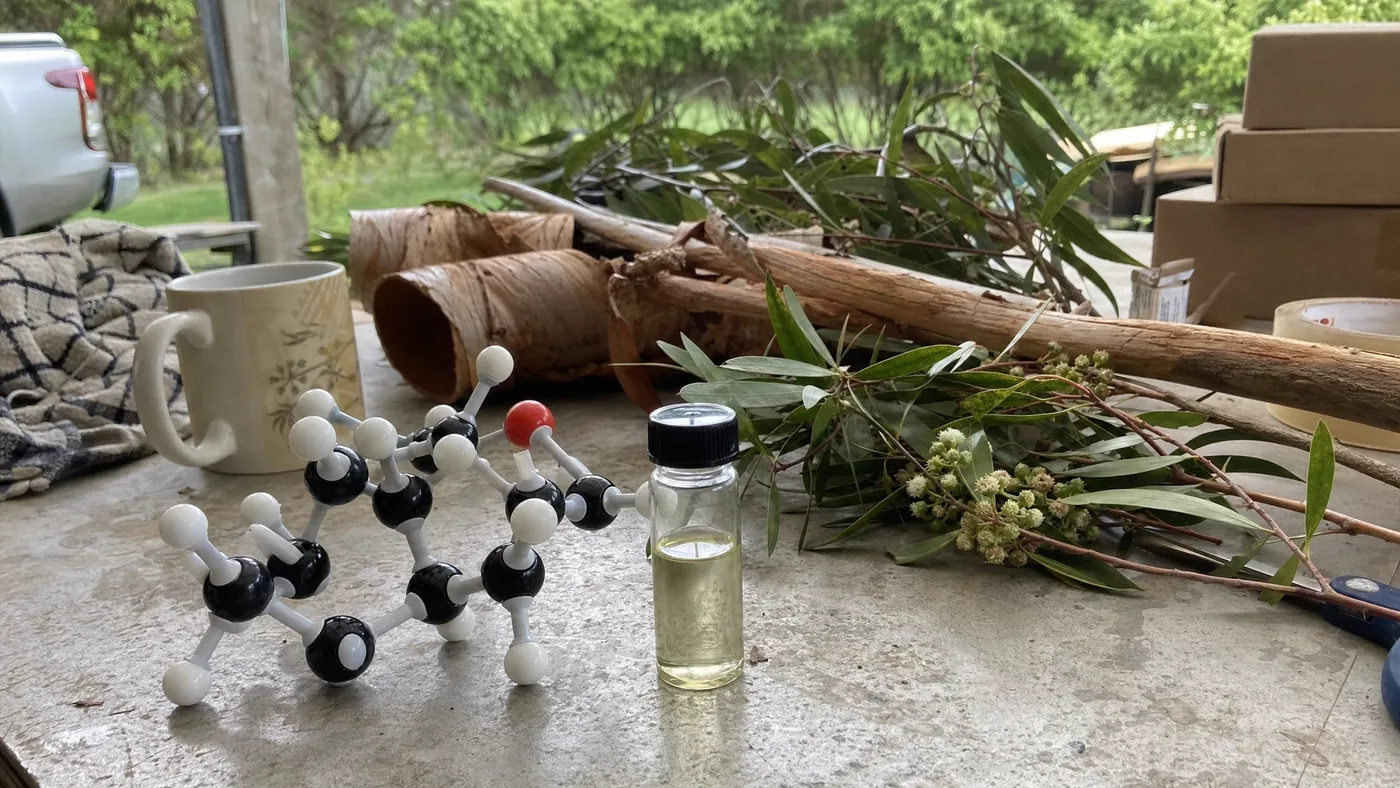
Open a bottle of tea tree oil and the first thing you notice is that it does not smell like tea. There is no leaf-in-hot-water softness, no flower, no fruit. It is bright, green and a little sharp, with a camphor edge, the sort of scent that makes a room feel like someone just opened every window.

Tea Tree Essential Oil
Our own Tea Tree Essential Oil, in sizes from 0.5 oz to bulk.
From $10.99
Shop Now →The scent, in plain words
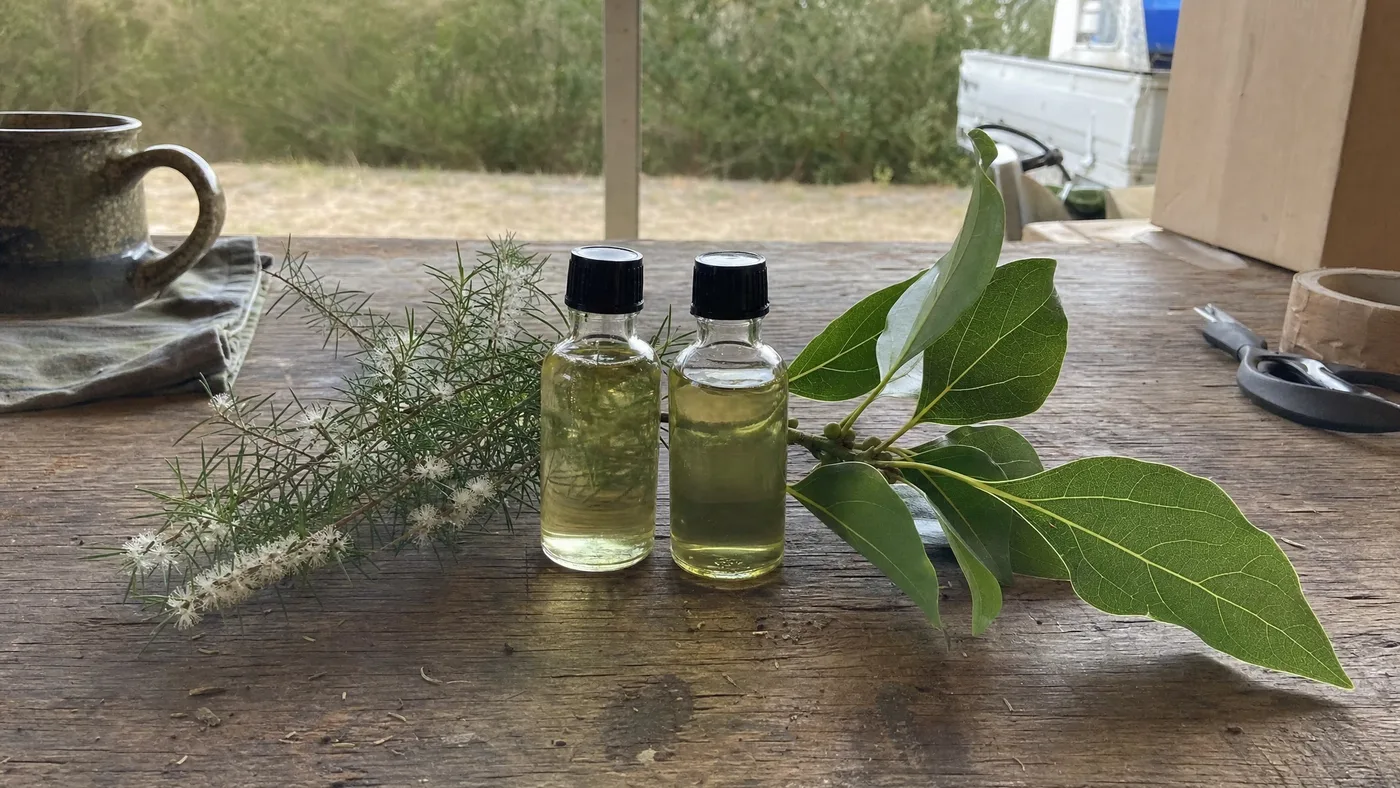
We describe our Australian tea tree oil as crisp, green and camphorous, with a faint earthy undertone. Our South African oil is crisp, green and camphorous as well, with a clean edge that sits closer to medicinal-herbal freshness than to sweetness. Both are the same species, Melaleuca alternifolia, and both are top-note oils, which in perfumery means the scent arrives first and fades first.
Scientists reach for similar words. The European Food Safety Authority's panel describes the oil as a clear, mobile, colourless or pale-yellow liquid with a characteristic odour of turpentine. That is not as unflattering as it sounds. Turpentine and pine woods share a family of aromatic compounds called terpenes, so "turpentine" is a technical way of saying piney and resinous. The Certificate of Analysis we publish for one batch of our Australian oil lists its smell standard as camphorous, fresh and herbal, and the batch is marked as complying with it.
Why it smells the way it does
Tea tree oil is a blend of dozens of naturally occurring compounds, and the international standard for it, ISO 4730, sets a range for each of the main ones rather than a single recipe. In the well-known review by Carson, Hammer and Riley, a typical sample is led by terpinen-4-ol, followed by gamma-terpinene and alpha-terpinene, with smaller amounts of 1,8-cineole, terpinolene and alpha-pinene. Reasoning from what those compounds are known for, the pine-like freshness is the terpene family at work, and the camphor note is what people usually associate with cineole, the same compound that gives eucalyptus its cooling sharpness.
Because the ranges are wide, two bottles from two sources can smell a touch different from each other: one a little greener, another a little more herbal. That is natural variation in a plant oil, and it is a good reason to smell before you commit to a big size.
Who tends to love it, and who does not
If you like the smell of a clean workshop, a pine forest after rain or a eucalyptus steam room, you will probably like tea tree oil straight away. If you reach for vanilla, rose or orange blossom, you may find it brisk on its own. The good news is that it rarely has to stand alone.
It is a natural partner for lemon, lavender, rosemary, eucalyptus and peppermint, and our South African oil's page adds cedarwood to that list. Lemon lifts the green edge, lavender rounds it, rosemary and peppermint turn the volume up. We do not sell those oils, so pick them up at a craft or supply shop. Our piece on scent pairings for tea tree oil walks through the combinations, and if eucalyptus is the scent you are comparing against, see tea tree versus eucalyptus. Looking for something softer on the floral side? Tea tree versus lavender sets out how the two behave side by side.
A simple way to get to know it: open the bottle, hold it a hand's width from your nose and breathe in gently, rather than putting your nose right over the opening. The first thing you will notice is the sharp, green top. Give it a few seconds and the earthy or herbal edge behind it comes forward. Put the cap back on tightly straight afterwards, since this is an oil that likes to be kept sealed.
Getting the best out of the aroma
A top-note oil tells you how to use it. A little goes a long way, and the scent will have lifted after a short while, so smaller, more frequent additions suit it better than one heavy dose. In a diffuser, follow your diffuser's own guidance and give the room some air; our diffuser notes cover the basics. For skin, the scent is the least of your considerations: dilute to 0.5% to 2% in a carrier oil such as jojoba or sweet almond, which you will find at a craft shop or pharmacy, and patch test a small area first. We start at the lower end of that range, since the EU's Scientific Committee on Consumer Safety, which judged tea tree oil a moderate skin sensitiser, set lower maximums for some product types.
The reason that matters for scent is that tea tree oil changes when it is exposed to air and light. A laboratory study in which the oil sat on a window sill found that its composition shifted within days, with p-cymene climbing from 2% to 11.5% and oxidised oil proving about three times stronger as a skin sensitiser than the same oil freshly distilled. Keep the cap tight and the bottle in a cool, dark place, as we describe in how to store tea tree oil. Our Australian oil's page lists a typical shelf life of two to three years unopened; the South African oil's page says one to two years when sealed.
One last household note: we keep tea tree oil away from the eyes, children and pets. It is toxic to cats and dogs at the strengths people casually use, so if a furry family member shares your space, talk to a veterinarian before you diffuse anything, and never swallow the oil.
That is tea tree in a sentence: green, camphorous and unmistakable. If that sounds like the scent you have been looking for, you will know within one sniff.
Tea Tree Essential Oil
Tea Tree Essential Oil from our own shop, in sizes from 0.5 oz to bulk.
From $10.99
Shop Now →Sources & Further Reading
- EFSA FEEDAP Panel, 2024. Safety and efficacy of a feed additive consisting of an essential oil derived from leaves and terminal branchlets of Melaleuca alternifolia (Maiden & Betche) Cheel (tea tree oil) for use in all animal species (FEFANA asbl), EFSA Journal. europepmc.org/PMC11513608
- Carson CF, Hammer KA, Riley TV, 2006. Melaleuca alternifolia (Tea Tree) oil: a review of antimicrobial and other medicinal properties, Clinical Microbiology Reviews. pmc.ncbi.nlm.nih.gov/PMC1360273
- Hausen BM, Reichling J, Harkenthal M, 1999. Degradation products of monoterpenes are the sensitizing agents in tea tree oil, American Journal of Contact Dermatitis. PMID 10357714
- Scientific Committee on Consumer Safety, 2025. SCCS - Scientific Opinion on Tea Tree Oil (CAS/EC No. 68647-73-4 /285-377-1), SCCS/1681/25. health.ec.europa.eu