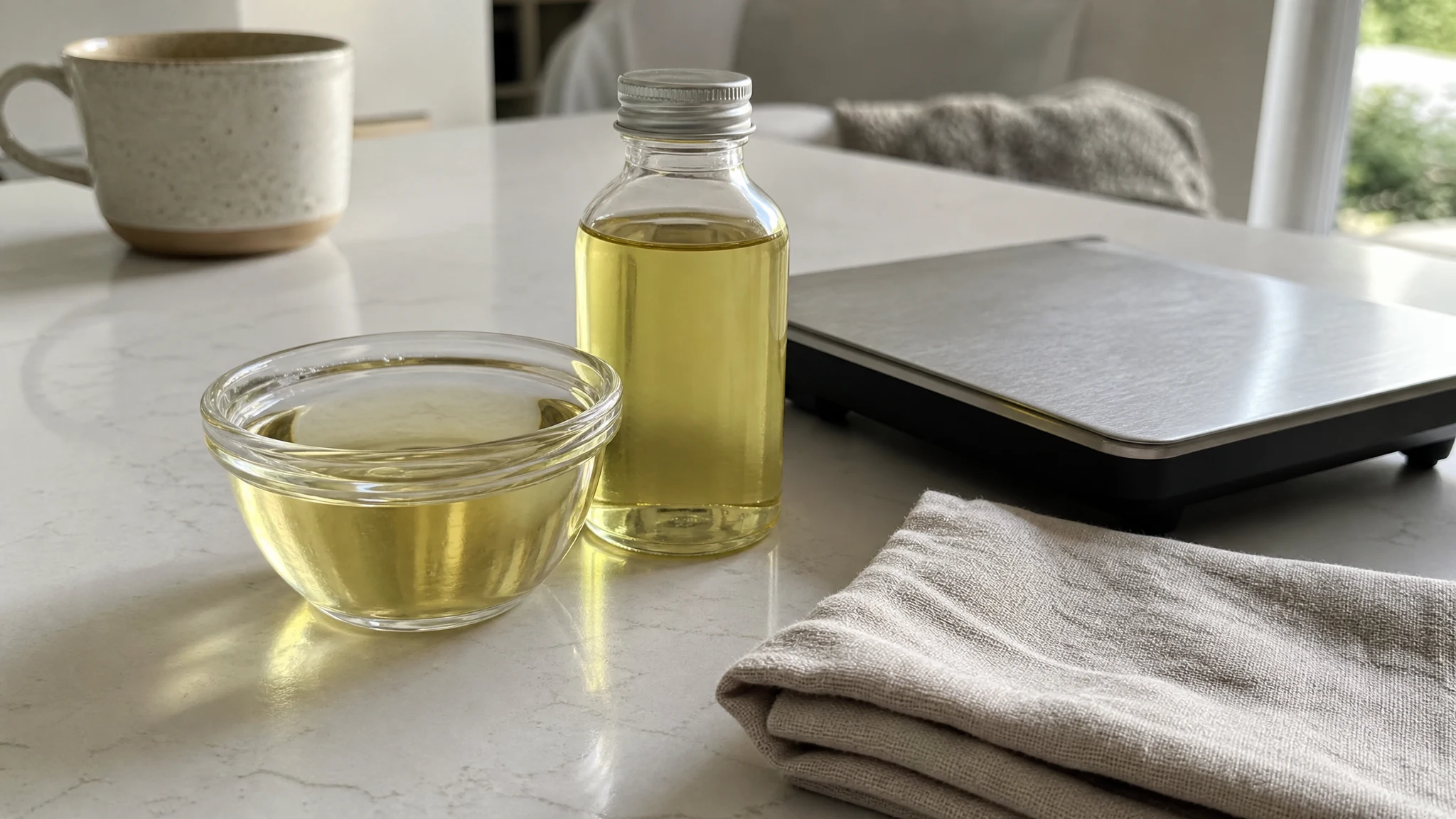
Blending Tea Tree Oil: How to Split the Drops
The easiest mistake in blending is to treat each oil as if it had its own allowance. Pick a 1% blend, add the usual handful of tea tree drops, then a similar handful of lavender and another of something citrusy, and the bottle that was meant to be 1% is suddenly nearer 3%. The percentage belongs to the whole blend, and tea tree is only one voice in it.

Tea Tree Essential Oil
Our own Tea Tree Essential Oil, in sizes from 0.5 oz to bulk.
From $10.99
Shop Now →Start with the total, then divide it
We recommend 0.5% to 2% in a carrier oil for general skin use on either of our tea tree oils, with a patch test first, and that range is for tea tree on its own. In a blend, we treat the figure you choose as the total of all the essential oils together, then share that total out. The sum is simple: carrier volume in millilitres, times the percentage, gives millilitres of essential oil; at the common rough figure of 20 drops per millilitre (droppers vary), multiply by 20 for drops. Our dilution guide has the full table for tea tree alone, and our reasons for starting at the low end.
That low-end start has a source. The EU's consumer safety committee adopted its opinion on tea tree oil on 30 October 2025 and considered it acceptable up to 1.0% in a shower gel and 1.0% in a face wash, and 0.1% in a face cream. It calls tea tree a moderate skin sensitiser, and its figures cover adults and oil that meets the ISO 4730:2017 composition. We read that as a good argument for keeping the total modest and the tea tree share smaller still.
A worked example for a 30 mL bottle
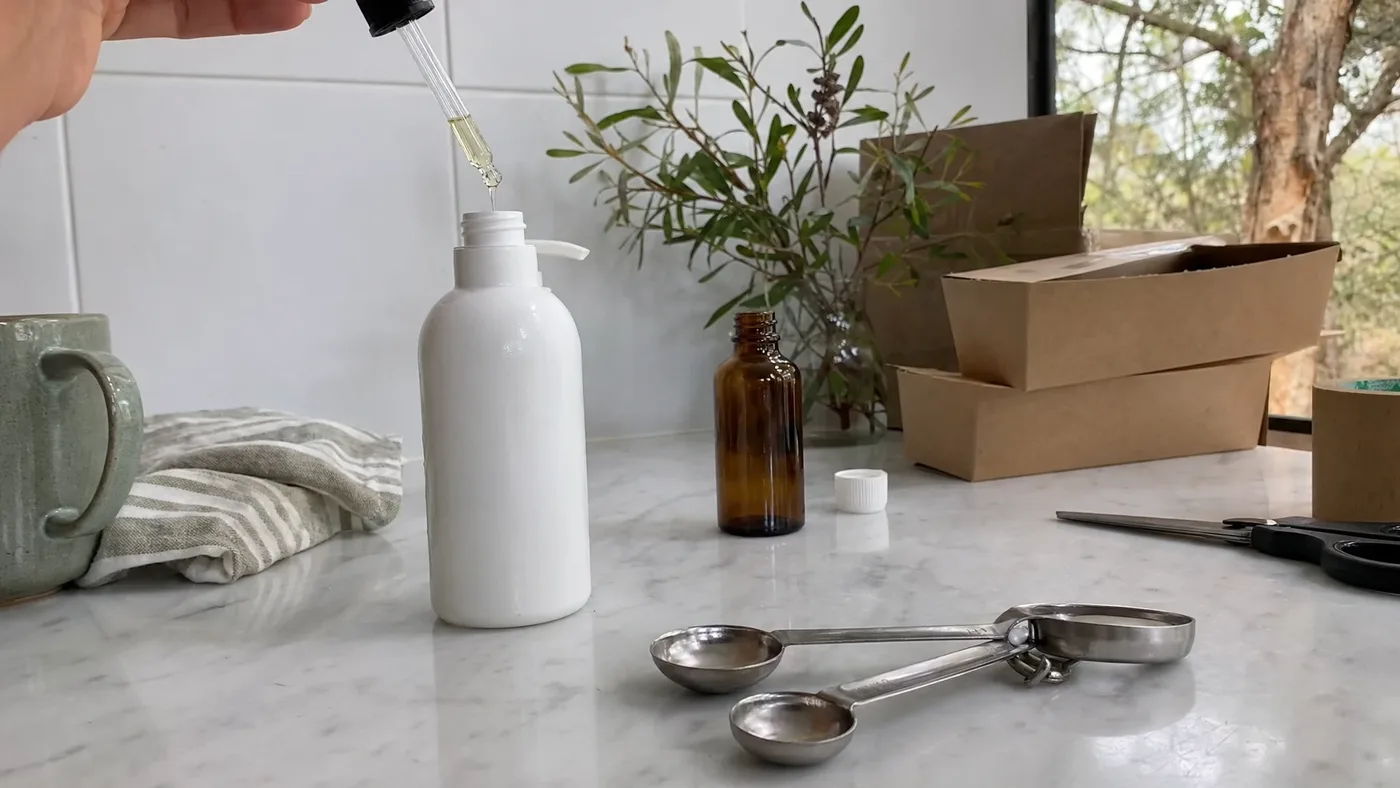
Say you want a 1% body blend in 30 mL (about one ounce) of carrier. 30 mL times 1% is 0.3 mL of essential oil, and at 20 drops per millilitre that is 6 drops in total. Now divide them. A ratio of one part tea tree to two parts of a softer partner oil gives 2 drops of tea tree and 4 of the partner. A one-to-one split gives 3 and 3.
| Total in 30 mL | Drops, all oils | Tea tree at one part in three | Partner oil |
|---|---|---|---|
| 0.5% | about 3 | about 1 | about 2 |
| 1% | about 6 | about 2 | about 4 |
| 2% | about 12 | about 4 | about 8 |
These are suggestions built from arithmetic, not a recipe anyone has to follow. The drop counts are approximate, so a scale is better when you want accuracy. The Certificate of Analysis we publish for one batch of our Australian oil gives a relative density of 0.896 at 20 C, so 0.1 mL of it weighs about 0.09 g. We publish no density for the South African oil, so weigh that one rather than assume.
Why make tea tree the smaller share? This is aroma reasoning, not a finding. Tea tree opens crisp, green and camphorous, a top note that tends to lead a blend, so a third of the drops is often enough for it to be noticed while the partner oils round it out. Our pairings article looks at which oils suit it.
Partner oils have their own ceilings
The Tisserand Institute explains that some topical maximums exist to prevent skin reactions and apply no matter how much skin is covered, giving lemongrass at 0.7% as the example. So a partner oil can have a lower limit than tea tree, and the total in your bottle has to respect the lowest of them. We do not sell any other essential oil, so look up each partner's limit in the IFRA standards or Tisserand's safety data for the product you are making, and treat anything for the face as a much lower-percentage job than a body blend.
Habits that keep a blend behaving
- Carrier first, oils second. Pour the carrier in, add the drops, cap, and turn the bottle end over end.
- Keep it oil on oil. The 2006 Clinical Microbiology Reviews review calls tea tree oil only sparingly soluble in water, so adding it to water or a water-based mist leaves it floating. A blend like this belongs in a carrier, and the SCCS figures above apply to the products they name, not to sprays.
- Choose glass. The same review says tea tree oil is readily absorbed into plastics, so a glass bottle is the better home for a blend you plan to keep. Our carrier oil guide covers what to mix it into.
- Make small batches. Light, heat, air and moisture all affect the oil, according to that review. A bottle that is nearly full of blend and kept in a drawer ages less than a half-empty one on a sunny shelf, and our storage article explains why.
- Patch test the finished blend, not just the single oil. Our patch test walkthrough shows the steps.
Who should check first
If you are pregnant, nursing, using a blend around a child, or living with a skin or medical condition, ask your physician before using any blend. For pets, a veterinarian is the person to ask, and blends belong out of reach of animals as well as children. We sell an external aroma and cosmetic oil, not a remedy.
Carrier oils, glass bottles and partner oils are all easy to find in craft supply shops and pharmacies, which leaves the pleasant part to you: deciding what the room, or the bottle, should smell like.
Tea Tree Essential Oil
Tea Tree Essential Oil from our own shop, in sizes from 0.5 oz to bulk.
From $10.99
Shop Now →Sources & Further Reading
- SCCS - Scientific Opinion on Tea Tree Oil (CAS/EC No. 68647-73-4 /285-377-1), Scientific Committee on Consumer Safety, adopted 30 October 2025
- Q&A safety maximums for dermal application, Tisserand Institute
- Melaleuca alternifolia (Tea Tree) Oil: a Review of Antimicrobial and Other Medicinal Properties, Carson, Hammer and Riley, Clinical Microbiology Reviews, 2006