Tea Tree Oil in Candles: Scent Load and Flash Point
Tea tree oil has a loud, green, camphorous voice, and that makes it an intriguing candle ingredient: a little goes a long way in a jar, and the question is how little. The answer comes down to a little arithmetic, a flash point and an honest look at what burning anything indoors involves. We sell the oil, not wax or wicks, so everything here is built from published candle-making guidance plus our own maths.

Tea Tree Essential Oil
Our own Tea Tree Essential Oil, in sizes from 0.5 oz to bulk.
From $10.99
Shop Now →Start with how load works
Candle makers describe scent strength as fragrance load: the weight of oil as a percentage of the wax. NorthWood Candle & Craft's guide gives the formula plainly (oil weight equals wax weight times load) and lists typical ranges for fragrance oils: 6% to 10% for soy wax with 8% as a common starting point, 6% to 12% for paraffin, and 3% to 6% for beeswax. Two things in that guide are worth carrying over to any oil. Weigh the oil on a scale rather than counting drops, and expect the wax type, cure time and wick size to matter at least as much as the load itself. Soy candles, they note, need one to two weeks to cure before the scent is fully bonded.
Those ranges describe fragrance oils, though, and an essential oil is a different material with its own limits. Rather than borrow a number, we suggest you read the maximum usage level on the oil's IFRA certificate. CandleScience explains how: find the row for Category 12, which covers candles and other air care products not meant for skin, and treat the figure as a ceiling, not a recommendation. If you want that document for any tea tree oil you are considering, ask the supplier for it in writing.
The arithmetic for one jar
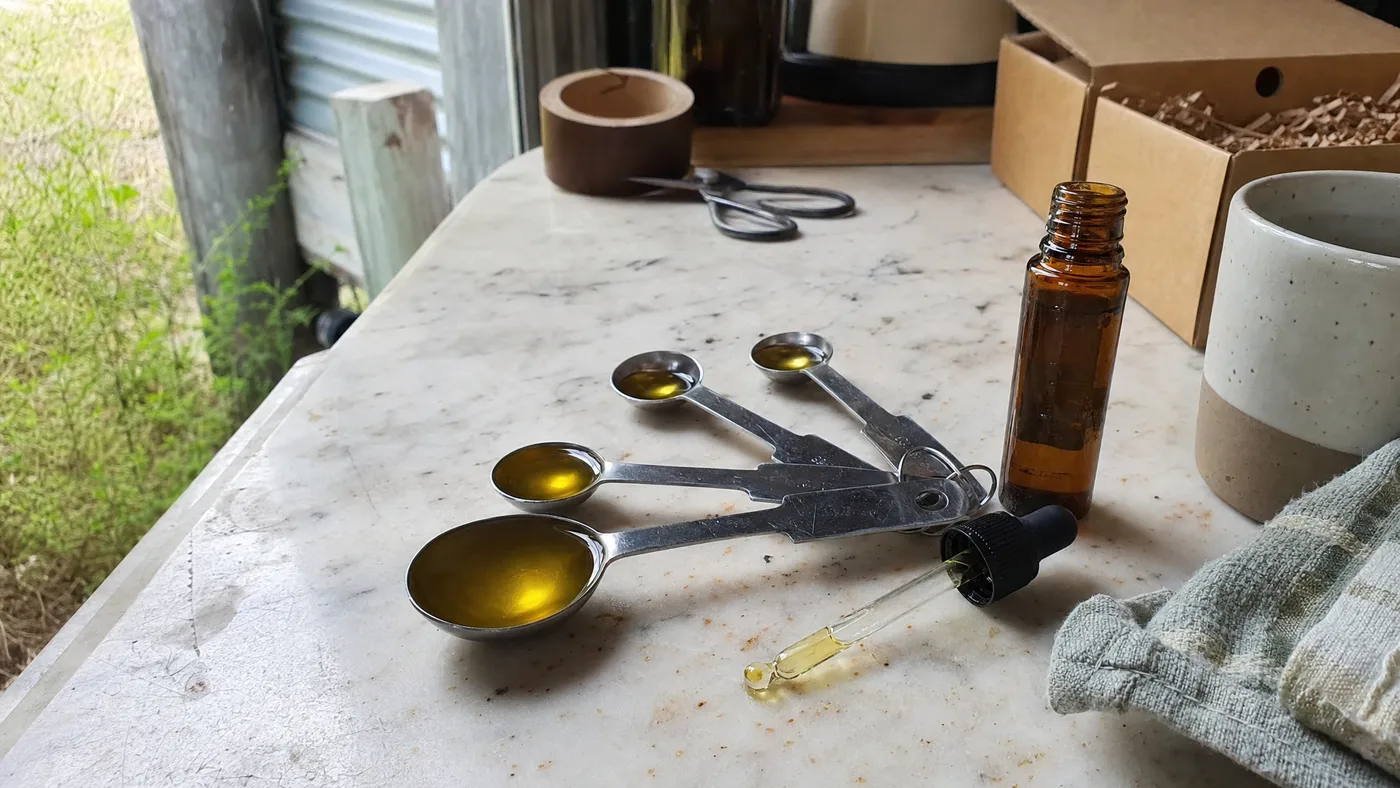
Here is what the numbers look like, shown as arithmetic rather than advice. Suppose you pour 300 g of wax. A 2% load is 6 g of oil, 4% is 12 g, and 8% is 24 g. Our Australian tea tree oil batch on the Certificate of Analysis we publish has a relative density of 0.896 at 20 C, so 1 ml weighs about 0.9 g. That puts 6 g at roughly 6.7 ml, which is about 130 drops, a good reminder of why weighing beats counting. It also shows how far a bottle goes: a 1 oz bottle holds about 26.5 g, enough for roughly four jars at 2%, or one jar and a bit at 8%.
The flash point comes first
Flash point is the temperature at which an oil's vapor can ignite near a flame. One supplier's safety data sheet for a tea tree oil lists 56 C, which is about 133 F. NorthWood's guide notes that any fragrance with a flash point under 170 F needs to be added at a lower temperature, which affects the pour, not the load. By that yardstick, tea tree falls in the group that wants cooler handling. Stir the oil in once the melted wax has cooled enough, and check your wax manufacturer's recommended range to find the window that works for both.
What a burn involves
Scented or not, a burning candle releases combustion products. In a chamber study of scented and unscented candles, Salthammer and colleagues measured gaseous and particulate emissions from 24 experiments with four waxes and five fragrances. In most cases the calculated indoor concentrations stayed well below guidance values, with exceptions noted for nitrogen dioxide, acrolein and benzo[a]pyrene. The sensible habits are the familiar ones: trim the wick, burn in a ventilated room, and never leave a flame unattended.
The same caution applies to anyone sharing the room. The ASPCA warns that concentrated tea tree oil can upset pets with only a few drops, and advises against essential oil diffusion in homes with birds, whose airways are very sensitive. If you have a bird or a cat, a tea tree candle is probably not the one to burn.
Setting up your workspace
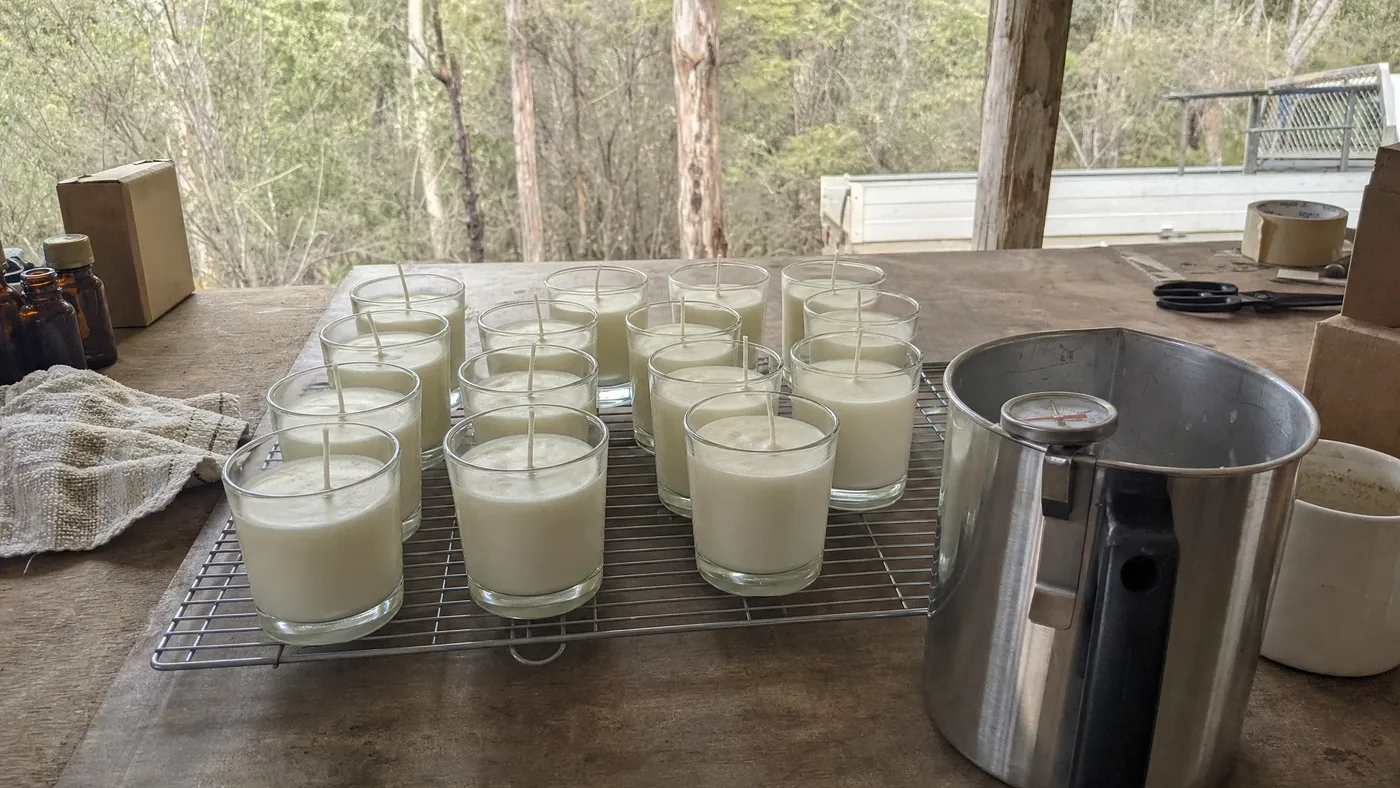
A tidy station makes candle work calmer. A kitchen scale that reads to the gram is the most useful tool, followed by a thermometer, a pouring pitcher and a heat-safe surface. Lay everything out before you start, keep the oil bottle capped until you need it, and keep pets and children out of the room.
Label each jar with the date, the wax, the wick and the percentage of oil you used. When you smell the cold jar and then the lit one, you will notice that they can be quite different, and your notes are what let you adjust sensibly next time.
Test small, then trust your nose
Every candle maker's advice ends in the same place: make a single jar, let it cure, and burn it before you scale up. Check that the pool melts evenly, the wick stays upright, and the scent is where you wanted it, both cold and lit. If the scent is faint, check cure time and wick size before raising the load; NorthWood's guide makes the same point, since oil seeping from the wax or a sooty burn are signs of too much. If you also like the oil in the home in a gentler way, our notes on where a single drop belongs and our scent pairing guide are worth a look, and the storage guide keeps the oil in good shape between batches.
A jar of crisp, green scent is a very satisfying thing to make, and the pleasure of it comes from taking the small steps in order.
Tea Tree Essential Oil
Tea Tree Essential Oil from our own shop, in sizes from 0.5 oz to bulk.
From $10.99
Shop Now →Sources & Further Reading
- NorthWood Candle & Craft. How to Calculate Fragrance Load for Any Wax (With Formula)
- CandleScience. How to Use the IFRA Certificate
- Youwish. Tea Tree, Essential Oil (product dossier with safety data sheet)
- Salthammer T, Gu J, Wientzek S, Harrington R, Thomann S. Measurement and evaluation of gaseous and particulate emissions from burning scented and unscented candles. Environment International, 2021
- ASPCA. Is the Latest Home Trend Harmful to Your Pets? What You Need to Know!